Storytailor: Turning Children's Imagination into a Personalized AI Picture Book World

Storytailor transforms children's drawings and imagination into evolving personalized picture books with vocabulary and offline activities.
Storytailor is an AI-powered children's story product built around kids' imagination, letting users turn drawings and creative ideas into personalized illustrated stories with recurring characters rather than pre-made IP. It serves families, educators, and care teams — with teacher editions that include lesson plans. Wonder Words embeds vocabulary learning into the reading experience, while off-screen activity prompts address parents' screen time concerns. The first two stories are free. The product represents a compelling generative AI path in edtech, though content safety, values alignment, and real integration with educational systems remain its core long-term challenges.
When a Child's Doodle Becomes the Story's Hero
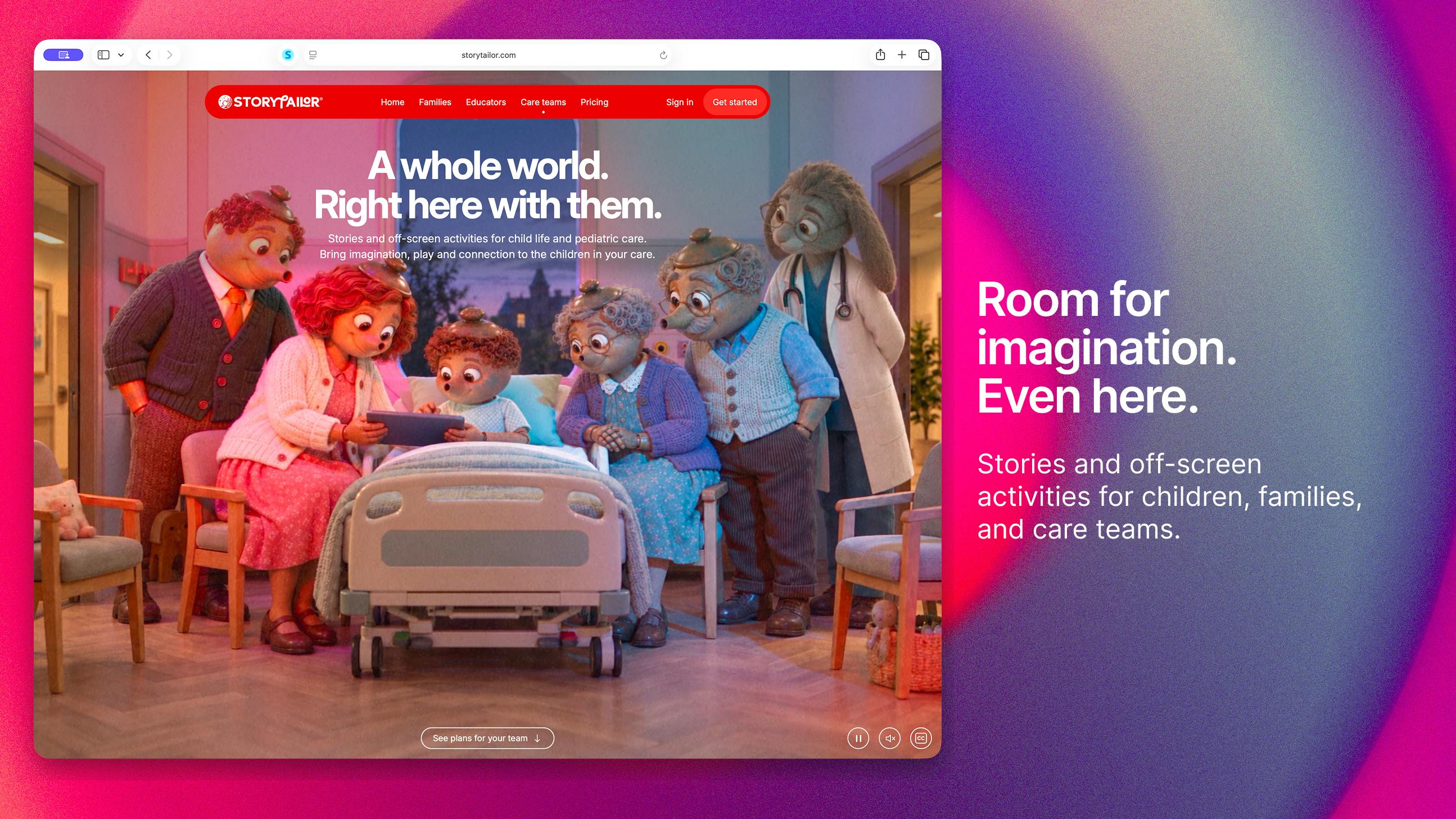
On Product Hunt, a product called Storytailor® made its debut with the tagline "a world built around your child's imagination," earning 76 upvotes and landing at #14 for the day. It enters a space that is both timeless and full of creative potential — children's storytelling. Unlike the cookie-cutter e-picture books flooding the market, Storytailor's core idea is to transform a child's own ideas and drawings into recurring characters and illustrated stories.
That distinction is worth unpacking. For a child, seeing the monster they scribbled or the imaginary friend they invented appear in a "real book" is a far more meaningful experience than consuming an off-the-shelf IP. The recognition, the concreteness of it — that's something a pre-made story can't replicate. Storytailor pushes this personalization to a product-level commitment: characters aren't one-and-done. They return across future stories, gradually building a coherent narrative universe that belongs entirely to the child.
Three User Groups, One Content System
Storytailor clearly targets three distinct use cases: families, educators, and care teams. That positioning is deliberately broader than simply "for parents."
For families, the product supports shared reading or listening, with stories that can center on everyday challenges, major life changes, or pure silliness — helping a child process a move or the arrival of a new sibling, or just having a laugh. For educators, Storytailor's teacher-facing stories come bundled with lesson plans, meaning it's positioning itself not just as entertainment but as something that can actually integrate into classroom workflows. For care teams — a niche but genuinely underserved group — personalized stories can serve as a medium for companionship and communication. This single-system, multi-role approach meaningfully expands the product's addressable audience.
Wonder Words and the Offline Extension
The product includes a feature called Wonder Words™, designed to help children explore unfamiliar vocabulary. This addresses a commonly overlooked gap in children's content: a story can be finished without any real vocabulary growth actually happening. Embedding word recognition and explanation directly into the reading experience adds a lightweight language-learning scaffold to the parent-child reading session.
More interesting still is Storytailor's emphasis on "off-screen activities." At a time when screen time anxiety is nearly universal among parents, the product actively encourages children to step away from the screen after a story and engage in offline extension activities. This is both a statement of values and a practical differentiator. Rather than treating "keeping kids glued to the screen" as a success metric, Storytailor actively encourages closing the device and continuing to play.
The design philosophy behind off-screen activities has solid grounding in developmental psychology. Research has long emphasized the importance of extension activities for children's learning — story reading is just input. It's when children reprocess that content through drawing, role-play, or hands-on making that language and emotional experience truly get internalized. This design also responds to regulatory pressure around screen time: the American Academy of Pediatrics (AAP) recommends no more than one hour of daily screen time for children aged 2–5. Products that proactively build in an offline exit tend to earn more parental trust at the point of decision.
The Opportunity and Limits of AI Personalization in Children's Education
Zooming out, Storytailor represents a classic application of generative AI in the edtech space: using AI to transform user input — ideas, drawings — into highly personalized content in real time. Its commercial strategy is measured — the first two stories are free, using a low-friction experience to build trust before nudging users toward a paid subscription.
That said, products in this category face inherent challenges. Children's content carries exceptionally high requirements around safety, accuracy, and values alignment. How AI-generated content avoids inappropriate outputs, and how the balance between personalization and content quality is maintained, are long-term open questions. The teacher-facing lesson plan feature, meanwhile, needs genuine alignment with how education actually works in classrooms before it can deliver on its promise.
As a "rebuilt" product, Storytailor demonstrates a more complete product vision — spanning personalized characters, vocabulary learning, and offline extension — than a simple AI picture book generator would. Whether it can hold its ground in a fiercely competitive children's education market awaits more real-world validation. But its choice to build around "a child's imagination" rather than a pre-existing content library offers a genuinely valuable perspective.
The safety challenges of applying generative AI to children's content have produced dedicated industry frameworks. The Children's Online Privacy Protection Act (COPPA) places strict limits on data collection from users under 13, while the EU's General Data Protection Regulation (GDPR) includes special provisions for handling children's data. On the content side, real-time filtering of generated outputs, human review processes, and preventing AI hallucinations from producing inappropriate language are engineering and operational challenges every product in this space must solve. Some companies use a "constrained generation space" strategy — limiting the model to a predefined set of safe vocabulary and narrative frameworks — trading some creative flexibility for predictable content safety. Whether Storytailor employs a similar mechanism will directly determine the ceiling on its content quality consistency.
Related articles

5 Practical Ways Real Estate Agents Can Use AI to Boost Efficiency (2026 Edition)
How can real estate agents use AI to boost efficiency? Based on a YouTube walkthrough, this breaks down five methods — ChatGPT for listing descriptions, Canva for marketing materials, forms for open house leads, Zapier for automated follow-up, and seller meeting prep — and flags risk boundaries like fair housing laws, photo authenticity, and price verification.

Grok Bot vs ChatGPT Agent: Which AI Agent Is More Powerful?
How does Grok Bot differ from ChatGPT Agent? This comparison examines how they work: Grok Bot has a cloud computer and runs persistently inside tools to execute multi-step tasks automatically; ChatGPT Agent operates web pages in a browser and is more mature at general tasks. Includes selection advice.

Walmart Agent Gateway: AI Shops for You Automatically—Why Is Amazon Going the Opposite Way?
Walmart's Agent Gateway lets ChatGPT, Gemini and other AI assistants access its product catalog to search, compare and add to cart, with spending limits and per-purchase approval. Amazon blocks external AI agents—two retail giants, opposite paths. Currently US-only, India may follow.