Strata in Action: Running a 176B Qwen Model Locally on a 12GB GPU

Strata lets a 12GB GPU run a 176B MoE model locally via three-tier whole-machine storage coordination.
Strata is an open-source LLM inference project that combines GPU VRAM, CPU RAM, and SSD into a three-tier storage system. Leveraging the sparse activation of MoE architecture — where only a handful of experts fire per token — a 12GB GPU can smoothly run the 176B Qwen3.8 Flash Next model at 93 tokens/s for short chats and 74 tokens/s on 128K context. It also integrates MTP speculative decoding for a 1.6–1.8x additional speedup, auto-selects quantization levels from Q2 to iQ2XS based on available RAM, and ships with an OpenAI-compatible API out of the box.
One 12GB GPU, One 176B Model
Local LLM deployment has long been bottlenecked by VRAM limits. A 12GB or 16GB gaming laptop GPU is typically no match for models with tens of billions of parameters. An open-source project called Strata is changing that. According to hands-on testing shared by a Bilibili content creator, anyone with a 12GB VRAM GPU — whether in a gaming laptop or a desktop PC — can smoothly run the Qwen3.8 Flash Next model, which has 125 billion active parameters within a 176B total architecture.
The project approached 5,000 GitHub stars within 10 days of launch, with the author pushing new releases at a remarkable pace — nearly daily. The creator flat-out said Strata is one of the two best tools he's used all year.
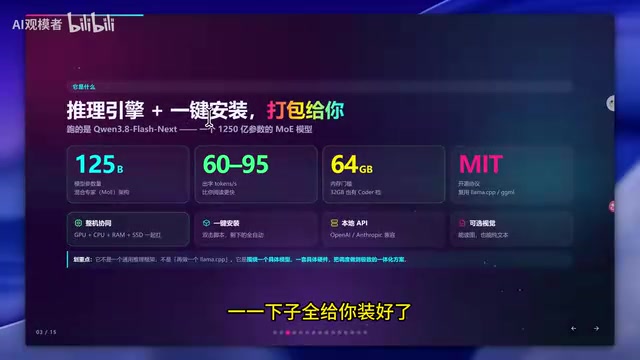
Real-world benchmarks back this up. On a setup with a 5070 12GB GPU and 64GB of system RAM, short-chat scenarios hit 93 tokens/s, and even 128K long-context conversations run at 74 tokens/s. For a 176B MoE model, that's entirely usable.
The Three Walls Strata Breaks Down
Local LLM deployment typically runs into three hard problems. Strata addresses each one directly.
The VRAM wall is the biggest obstacle. VRAM prices remain high, and most users are stuck at the 12GB or 16GB tier. Fitting a 125B-scale model requires at least an order of magnitude more memory, and even MoE models traditionally require all experts to be loaded into VRAM to run.
The deployment barrier is the second wall. Getting started with tools like llama.cpp still means dealing with compilation, dependencies, quantization formats, and multi-gigabyte downloads — enough friction to drive most people away before they even start.
The missing ecosystem is the third wall. Even when a model runs, without a standard API interface it can't integrate with toolchains, leaving it useful only for casual chat and limiting its practical value.
Strata is designed to address all three: it's an inference engine, a one-click installer, and an opinionated setup tool in one — it pre-selects solid quantization options for you. Type a number, and it downloads and deploys the model locally while providing an OpenAI-compatible local API.
Core Technology: Three-Tier Storage Across the Whole Machine
Strata's ability to run a 176B model on a 12GB GPU comes down to a whole-machine coordination strategy spanning GPU VRAM, CPU RAM, and SSD, combined with a proprietary scheduling approach that keeps speeds high.
The most critical components live in VRAM: the Router, shared experts, output head, and KV Cache. All remaining VRAM space is used for an expert cache that adapts dynamically during conversation — it tracks which experts are called most often in the current session and optimizes accordingly.
System RAM holds over 20,000 experts as resident data. When the GPU cache misses, the CPU handles those experts directly using AVX512 or AVX2 instructions, with both sides computing in parallel. The SSD stores a 28.8GB N-gram lookup table — since this component isn't latency-sensitive, storing it on an SSD has no meaningful impact on overall performance.
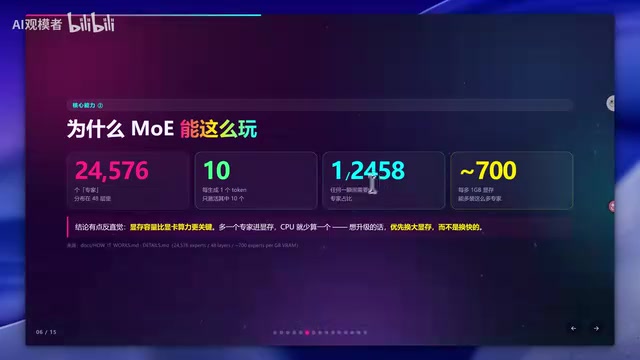
This approach works because Qwen3.8 Flash is a MoE model. It has 24,576 experts across 48 layers, but generating each token only activates roughly 10 of them. At any given moment, only a tiny fraction of all experts are needed — there's no reason they all need to be in VRAM.
This leads to an important insight: in MoE architectures, VRAM capacity matters more than GPU compute power. Every additional expert that fits in VRAM is one fewer expert the CPU has to handle. When deploying MoE models, VRAM should be your upgrade priority, not raw GPU performance. This three-tier storage strategy doesn't apply to Dense models like Qwen3.8 27B.
What is MoE? MoE (Mixture of Experts) is a sparsely activated neural network architecture. Unlike traditional Dense models, MoE splits feed-forward layers into many independent "expert" sub-networks, with a lightweight Router deciding at each step which experts to call. Qwen3.8 Flash has a total of 176B parameters, but only about 10 experts are activated per token, so the actual compute per step is far smaller than the total parameter count suggests. This design makes MoE models naturally suited for "on-demand scheduling" across heterogeneous storage — the vast majority of expert weights can live in RAM or even on an SSD, with only the router-selected experts temporarily loaded into VRAM or computed by the CPU, effectively bypassing hard VRAM limits.
MTP Speculative Decoding and Long-Context Speed
Beyond whole-machine coordination, Strata integrates MTP (Multi-Token Prediction) speculative decoding. This is an acceleration technique built into the model itself, and Strata's MTP hit rate is significantly higher than that of generic inference frameworks, delivering a real-world 1.6x to 1.8x speedup.
Long-context prefill is also optimized. With a 32K prompt input, Q2 quantization achieves prefill speeds ranging from 572 tokens/s up to 1,290 tokens/s, while Q3 scales from 383 to 1,208 tokens/s. It's worth clarifying: the "fast reading" here refers to processing speed, not unlimited context window capacity.
What is Speculative Decoding? Speculative decoding accelerates generation by "guessing then verifying." Traditional autoregressive generation produces one token per step; speculative decoding uses a lightweight draft model (or an embedded prediction head) to guess multiple candidate tokens at once, then has the main model verify them in parallel. Correct guesses are accepted immediately; failed guesses fall back to standard generation. Since verification is parallelizable and guessing is cheap, overall throughput increases significantly. MTP (Multi-Token Prediction), as natively introduced in models like DeepSeekAd, embeds multi-token prediction heads directly into the model weights — yielding higher hit rates than external draft model approaches. Strata takes advantage of the MTP structure built into Qwen3.8 Flash itself, which is why its hit rate surpasses generic inference frameworks and achieves that 1.6–1.8x measured speedup.
Choosing a Quantization Level for Your Hardware
Strata automatically recommends a quantization level based on your available memory, which is especially helpful for beginners.
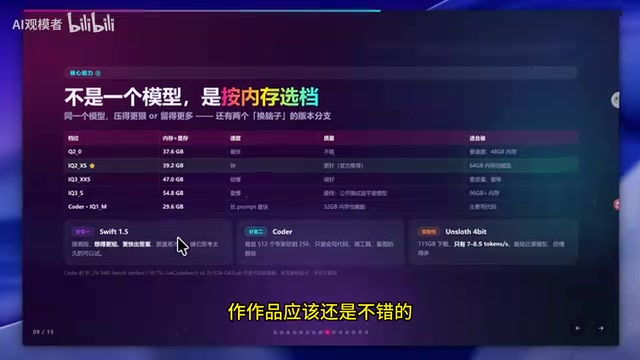
- Total VRAM + RAM around 37.6GB: Q2 is sufficient. On the Qwen3.8 generation, Q2 quantization from skilled quantization authors is genuinely usable.
- Around 40GB: iQ2XS is recommended — it includes matrix calibration for better performance, and it's the officially recommended tier.
- 64GB or more: Higher quantization levels are available and worthwhile.
- Coding use cases: The project offers a dedicated Coder IQ1 variant optimized for programming tasks, which reaches usable quality with as little as 32GB of RAM.
The project also includes multiple branches: a Swift 1.5 post-trained version that reduces thinking token length, and a vanilla quantization that preserves the original model. The vanilla version is largest but most balanced; the post-trained version saves tokens while minimizing performance loss.
Benchmark highlights from the author: 5070 12GB gets 93 tokens/s on short chat and 74 tokens/s on 128K context. Bumping to the iQ3S tier drops that to 53 and 46 tokens/s respectively — still completely usable. A 3090 with 24GB VRAM (two generations older) reaches 100–140 tokens/s; a 4090 with 48GB delivers an even better experience.
What is Quantization? Quantization compresses model weights from high-precision floating point (e.g., FP16/BF16, 2 bytes per parameter) down to low-bit integer representations, drastically reducing storage and VRAM requirements while preserving as much model performance as possible. Common levels like Q2 and Q3 use only 2 or 3 bits per parameter — more than 8x smaller than FP16. The iQ series (e.g., iQ2XS) is an "importance quantization" variant in the GGUF format that assigns different precision levels to different weight layers and applies matrix calibration, retaining more model quality than standard uniform quantization at the same file size. Quantization inevitably introduces accuracy loss — the lower the level, the greater the loss — but on MoE architectures with well-crafted quantization, Q2's performance degradation on typical conversational tasks has been brought within acceptable bounds.
Getting Started: Just Hand It to a Coding Agent
One of Strata's biggest strengths is how fast you can get running. Regular users can follow the prompts, and complete beginners have an even easier path.

The creator's recommendation: paste the project URL directly into a coding agent like Codex, Claude Code, or Qwen Coder, and let it handle the installation. You just wait and double-click the generated script. Once deployment is complete, a browser window opens automatically to the Web UI, where you can review and adjust model settings.
Limitations to Know
This isn't magic — a few constraints are worth keeping in mind:
- Single-request only: No concurrent batch processing. That said, users on 12GB/16GB cards are unlikely to need multi-user concurrency, so the impact is limited.
- First long message must be fully prefilled: A 30K-token input takes roughly one minute to process. After that, it switches to incremental mode, and follow-up messages return nearly instantly.
- Some features are experimental: The project is young, and a few capabilities may be unstable.
Final Thoughts
Strata demonstrates something important: the real barrier to running large MoE models locally is largely about scheduling quality. With the right whole-machine resource orchestration, even modest hardware can handle mid-to-large-scale models.
Qwen3.8 Flash Next is genuinely capable — Alibaba's Qwen team even sells API access to it as part of a subscription plan, while the 27B Dense version isn't offered separately. The fact that a 12GB or 16GB GPU can now run this tier of model locally is something that would have seemed impossible not long ago. For anyone who wants to experience a truly large local model, Strata is worth trying.
Related articles

Amphibious Transforming Drone: Beyond 100x Power Savings, What Are the Real Needs?
Is the amphibious transforming drone just a gimmick? Starting from the 100x power difference of the M4 Morphobot, explore real application scenarios and thesis topic ideas, analyzing boundary conditions where pure drones and pure ground robots both fail.

Warhound Raises $200 Million: Genetically Engineered "War Dogs" Paired with Anduril Gear
Warhound raises $200M, backed by Ben Lamm and Palmer Luckey, to genetically engineer dogs for military and law enforcement use and equip them with Anduril gear. This article analyzes its technology direction, funding logic, and ethical controversy.

Claude API Comes to Google Cloud: IAM Integration and SDK Access Guide
Anthropic hosts the full Claude API on Google Cloud with IAM-controlled permissions and unified billing. This guide covers the Vertex AI and Anthropic-hosted entry points, IAM role configuration, and SDK access.