Strata Update Hands-On: IQ3_S Quantized Model Performance and Analysis

Strata's IQ3_S model approaches BF16 quality but demands 50GB+ RAM — great if your hardware can handle it.
Strata's latest update introduces the IQ3_S quantized model, which approaches BF16 precision in benchmarks and shows clear improvements over IQ3_XXS in visual generation quality and structural coherence. Real-world tests spanning Cyberpunk-style animation, 3D cycling, and Statue of Liberty generation showed cleaner results overall, though some bugs persist. The trade-off: the model is ~7GB larger than IQ3_XXS, consumes 50GB+ RAM at runtime, and can spike to 62GB during complex debugging — posing serious OOM risks on memory-limited hardware.
Strata Gets Another Update: IQ3_S Quantized Model Worth Your Attention
The local LLM tool Strata has received yet another update. This release brings dual-GPU optimization and adds the IQ3_S quantized model as the official default. Built on the IQ3_S scheme introduced by Astra Labs, the model is broadly comparable in parameter scale to the earlier 27B GSQ series and uses the same IQ3_S quantization precision.
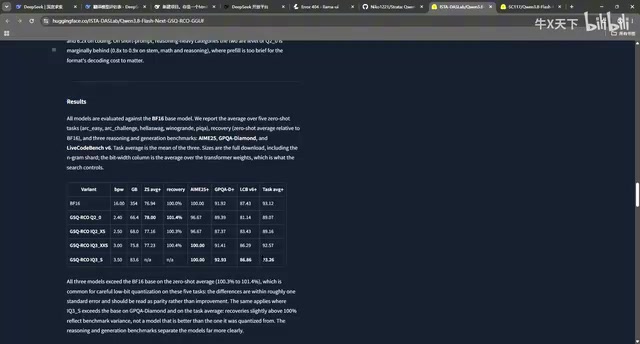
Based on the benchmark data reviewed, IQ3_S performance comes close to BF16 native precision — a remarkably strong result for low-bit quantization. That said, two metrics in the published data appear anomalous, which may inflate the overall average score somewhat. Even accounting for that, IQ3_S still shows a clear improvement over the earlier IQ3_XXS.
Background: What Is IQ3_S Quantization?
IQ3_S is part of the Importance-aware Quantization (IQ) family, developed by Astra Labs within the llama.cpp ecosystem. In the naming convention, "IQ" identifies the series, "3" indicates an average of roughly 3 bits per weight, and the suffix "S" (Small) signals a finer grouping strategy at the same bit depth to reduce quantization error. Compared to the older IQ3_XXS (Extra Extra Small) at the same bit count, IQ3_S allocates different precision levels to weights based on their importance, allowing critical layers to retain higher fidelity — significantly improving output quality with virtually no added computational overhead. BF16 (Brain Float 16) is the original half-precision floating-point format and is typically treated as the precision baseline. The fact that IQ3_S approaches BF16 performance means it achieves near-original inference quality using less than a quarter of the storage — which is precisely the core goal of low-bit quantization.
Real-World Testing: Animation and 3D Generation
Rather than stopping at benchmark scores, the author ran a few common generation tasks for a quick hands-on comparison.
Cycling Animation (Cyberpunk 2077 Style)
The first test was a "stick figure cycling" animation rendered in a Cyberpunk 2077 visual style. Compared to IQ3_XXS outputs, IQ3_S showed clear improvement in visual aesthetics and compositional control, with cleaner layering. The author did note that this version seemed to miss some elements in terms of motion, but attributed this more likely to single-run variance rather than a regression in model capability.

3D Cycling and Statue of Liberty Tests
In the 3D cycling test, the figure "pedaled with plenty of effort" and the camera transitions were reasonably functional — overall an acceptable result.
The more complex Statue of Liberty test revealed sharper differences. The author felt this version produced a more structurally coherent result overall, particularly at the base platform where fewer bugs appeared, and the internal spiral staircase showed an attempt at implementation — though its structure still had issues. The model also added interactive elements and a historical timeline, but certain features (such as a material transition from brass to bronze) exhibited noticeable bugs and didn't fully realize the intended design.

In knowledge Q&A tasks, the quality gap between IQ3_S and IQ3_XXS was not dramatic, though a modest improvement was perceptible.
Performance and Memory Usage: The Pressure Is Real
A key question for many users is: how much does a larger quantized model actually cost in terms of local hardware resources? Since screen recording software caused the model to exit automatically, the author captured key data via screenshots instead.
The results show that the IQ3_S model is about 7 GB larger than IQ3_XXS and generates slightly slower, though the speed difference during the profiling phase was minimal and token output speed remained within acceptable range.
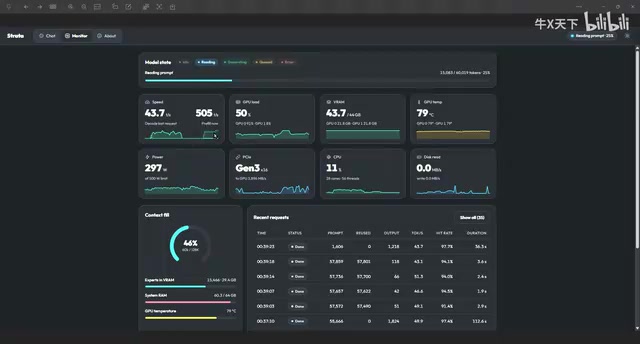
The real bottleneck is memory. In testing, the model consumed over 50 GB of RAM during runtime, and when opening the generated HTML for debugging, memory usage spiked all the way to 62 GB. This means that on machines with limited hardware where available memory is already tight after startup, adding IQ3_S's high footprint can quickly create a strained situation. As projects grow larger and more complex, this easily triggers OOM (Out of Memory) errors, causing the program to crash and exit entirely.
OOM (Out of Memory) and Local Inference
OOM — "Out of Memory" — occurs when a program requests more memory than the system can provide, forcing the OS to terminate the process. When running large language models locally, model weights, the KV cache (which stores intermediate attention states), and activation values during inference all need to remain in memory. While quantized models significantly compress weight size, the KV cache grows linearly with longer context windows or increased concurrent tasks — making it easy to trigger OOM on top of the memory already occupied by weights. Unlike server-side deployments, local devices typically cannot dynamically expand memory. Once the limit is hit, inference either halts mid-run or the entire application crashes, with no automatic recovery mechanism. Maintaining adequate memory headroom is therefore essential for stable long-context conversations or complex generation tasks on local hardware.
Summary: Real Progress, But Know Your Hardware
Overall, this round of testing confirms that the IQ3_S model in Strata's latest update is a genuine step up from IQ3_XXS: near-BF16 precision, more structurally sound generation, and cleaner visual output are all clear wins. But it comes with meaningfully higher model size and memory demands.
For users with ample hardware, IQ3_S is a worthwhile upgrade to try. For memory-constrained devices, blindly jumping to a larger quantized model may simply result in frequent OOM crashes. Ultimately, which version to use comes down to your own hardware situation. For a more complete side-by-side comparison, refer to the author's earlier test videos covering different quantization versions.
Related articles

Random Pruning of the DPO Computation Graph: 1.4x Training Speedup and Lower Peak Memory
DPO training too slow and memory-hungry? This paper proposes a random pruning framework for the DPO computation graph, sampling independently across position, sequence, and branch dimensions; branch pruning achieves a 1.426x step-time speedup and cuts training time by about 30%, with in-depth attribution of memory and time gains.

Why Does JEPA Underperform MLM in Longitudinal EHR Representation Learning?
New study compares JEPA and MLM for longitudinal EHR representation learning on MIMIC-IV: three JEPA variants train stably without collapse but underperform MLM; target size, not heterogeneity, drives prediction error.

Transfer Learning + Visible Light Communication: A New Approach to Energy-Efficient Indoor Positioning
A study proposes a transfer learning-based visible light communication indoor positioning method, achieving 47% accuracy improvement on the BOSCH factory dataset, 67.5% model efficiency under high noise, and introducing the ME composite metric for energy-efficient positioning in energy-constrained industrial IoT scenarios.