StrictlyVC Comes to TechCrunch Disrupt: How AI Is Rewriting the Rules of Venture Capital

StrictlyVC joins TechCrunch Disrupt 2026 to examine how AI is fundamentally reshaping VC valuation and investment frameworks.
TechCrunch's venture capital brand StrictlyVC will appear at TechCrunch Disrupt 2026, focusing on the profound impact of the AI boom on the investment ecosystem. The rapid iteration of generative AI has disrupted the stable technological pace that traditional VC models relied on, forcing a rethink of valuation frameworks, moat assessments, and exit strategies. AI startups can achieve exponential growth in months — or lose their edge overnight when a tech giant ships a similar feature. The session targets Investor Pass holders, with $200 off available before September 25. For both founders and investors, understanding each other's evaluation logic in the AI era is fast becoming an essential skill.
AI Is Rewriting the Foundations of Venture Capital
StrictlyVC is joining TechCrunch Disrupt 2026 to tackle an increasingly urgent question: how is the explosive growth of AI changing the rules of the venture capital game? This dedicated session zeroes in on AI's deeper impact on the startup investment ecosystem, offering investors a critical window into industry transformation.
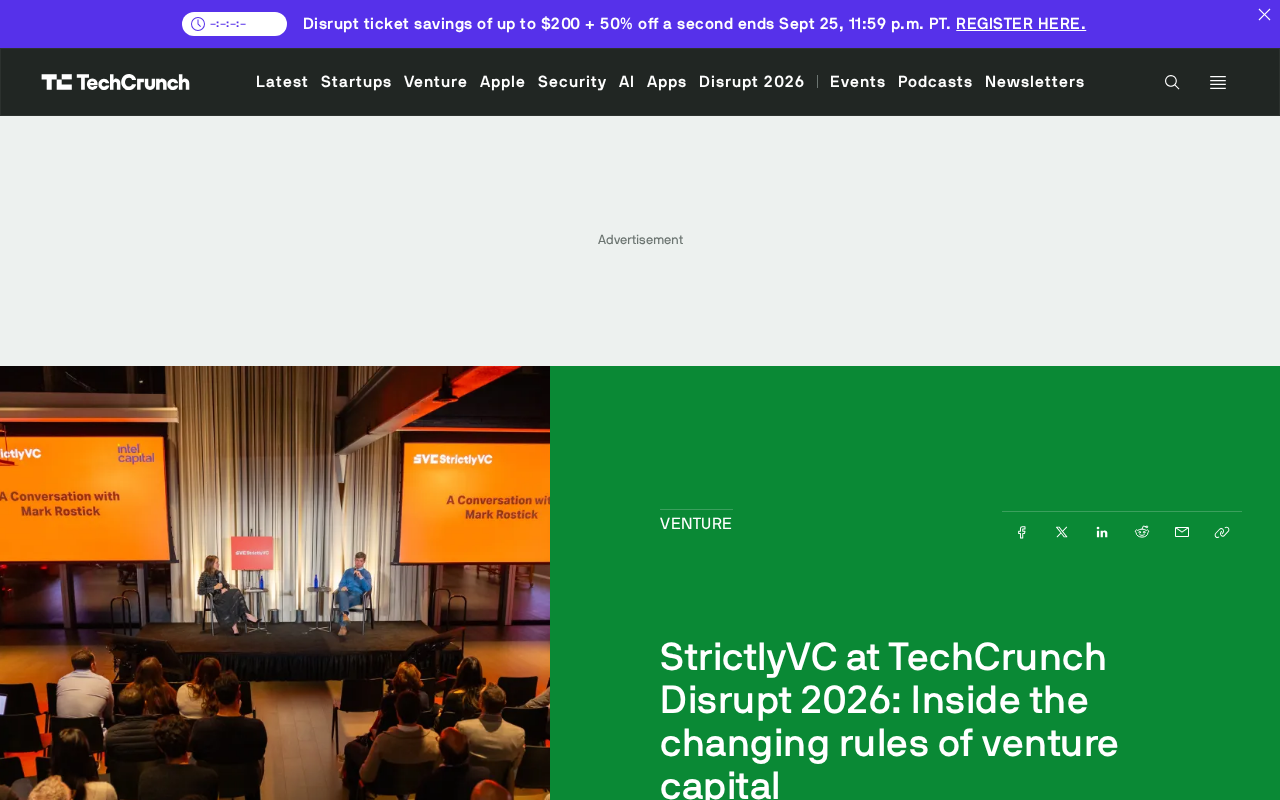
According to official information, the session is geared toward attendees with an Investor Pass, with an early-bird discount of $200 off available through 11:59 PM PT on September 25. That positioning alone signals who the core audience is: active investors and practitioners working on the front lines.
Why AI Has Become an Unavoidable Topic for VCs
Over the past few years, AI has rapidly evolved from a cutting-edge technology into something nearly every startup feels compelled to incorporate. This shift has created new challenges for venture capital: How do you assess the true value of an AI company? Do technical moats still hold up against rapidly iterating models? Infrastructure costs, compute dependency, and data access have all become new variables in investment decision-making.
Traditional VC valuation models were built on a relatively stable pace of technological progress — and generative AI has shattered that pace. A startup might achieve exponential growth within a matter of months, or it might instantly lose its edge the moment a tech giant ships a comparable feature. This extreme uncertainty is precisely the backdrop that StrictlyVC's discussion is designed to address.
Generative AI refers specifically to AI systems capable of producing text, images, code, and other content — exemplified by large language models such as the GPT series, Claude, and Gemini. Unlike earlier discriminative AI, generative AI expands its capability boundaries at a rapid pace and is highly dependent on compute infrastructure (such as GPU clusters) and massive training datasets. This directly means that AI startups have a fundamentally different cost structure than traditional SaaS companies: marginal costs don't fall linearly with scale and may actually compress margins due to persistently high inference costs. On top of that, major players like OpenAI, Google, and Meta continue pushing further into the application layer, making "big tech encroachment" a systemic risk that investors must factor in when evaluating AI startups — one for which traditional VC frameworks offer almost no ready-made analytical tools.
The Analytical Value StrictlyVC Brings
As TechCrunch's venture-capital-focused brand, StrictlyVC has long tracked capital flows, institutional moves, and industry trends across the startup investment world. Its analysis tends to stay close to the real concerns of frontline investors, rather than resting on high-level macro narratives.
Bringing this specialized vertical into TechCrunch Disrupt — one of the tech industry's flagship events — signals that the organizers want to weave the capital perspective more tightly together with technological innovation. For founders, understanding how investors evaluate companies in the AI era can help them tell their story more precisely. For investors, sessions like this are opportunities to recalibrate their thinking and exchange perspectives.
Key Directions Worth Watching
While publicly available details are still limited, the session's theme points to several likely discussion areas: valuation differences between AI-native companies and traditional software firms; the trade-offs between investing in the foundation model layer versus the application layer; and whether AI is compressing investment timelines and reshaping exit paths. None of these questions have clean answers, but they're exactly what the industry most needs to work through right now.
For readers following the venture capital space, this session reflects a broader trend: AI is no longer just the thing being invested in — it is actively redefining what investing itself looks like.
The trade-off between foundation model layer investing and application layer investing is one of the most contentious structural debates in AI investment today. The foundation model layer — think GPT-4, Claude, Llama, and similar general-purpose large models — can cost hundreds of millions to billions of dollars to develop, with moats built primarily on compute scale and data accumulation. The application layer, by contrast, refers to vertically focused products built on top of these models — AI legal assistants, medical diagnostic tools, and the like — where the barrier to entry is comparatively lower but competition is far more intense. Most VCs currently lean toward application-layer investments, partly because the capital requirements of foundation models have exceeded what traditional venture funds can absorb, and partly because winner-take-all dynamics are extremely strong at that layer. Yet application-layer companies face their own skepticism: if a product's core capabilities depend entirely on a third-party API, any shift in the underlying model provider's strategy could undermine the very foundation of the company's valuation.
Related articles

uGAP: An AI Platform Unifying 100+ African Geospatial Datasets
uGAP is an African geospatial AI platform by a University of Cape Town team, unifying 120+ African datasets with a Python SDK for discovery, processing, and model training, already used in cyclone flood mapping.

Cursor Can Now Control Your Computer: AI Agents Can Drive Desktop Apps for Testing
Cursor adds desktop control: AI agents can drive desktop apps like the iOS Simulator to test their own features. We analyze the impact on dev workflows, possible technical approaches, and reliability concerns.

Vibecoding a Custom Inference Engine: High Hopes, Harsh Reality
A Reddit developer shares the real experience of vibecoding a custom inference engine: running GGUF Q4 models in the browser with WebGL2 and GLSL, only to fall into tokenizer debugging hell. This article analyzes the engineering challenges of browser-side LLM inference and why cloning llama.cpp is the more rational choice.