Stripe Acquires OpenRouter: The Business Logic Behind Paying $7 Billion for an AI Model Gateway

Stripe's $7B OpenRouter acquisition reveals that AI's real value lies in gateways and data, not just models.
Stripe's $7B+ acquisition of OpenRouter signals that in AI's next phase, gateways and distribution matter more than models. This article analyzes five key industry developments: the strategic logic behind Stripe's deal, Anthropic's explosive revenue growth indicating enterprise AI procurement at scale, a post-Transformer architecture achieving high efficiency with only 150M parameters, Claude Code updates, and Dario Amodei's candid remarks on the AI industry's trust crisis.
Why would a payments giant spend over $7 billion to acquire an AI model gateway? This seemingly cross-industry acquisition reveals the true focal point of today's AI infrastructure competition: the most valuable asset may not be the models themselves, but the "gateway" connecting models to users. Based on reporting from Chinese tech news source "AI上新社," this article breaks down five key recent developments in the AI industry.
Stripe Acquires OpenRouter for Over $7 Billion: Buying the Gateway and the Data
According to Bloomberg, citing people familiar with the matter, payments company Stripe has agreed to acquire OpenRouter for over $7 billion. It should be noted that neither party has made a formal announcement, and the amount and completion status are based on media reports.
OpenRouter's value lies in being a unified model aggregation gateway — connecting over 80 providers and 500+ models through a single interface, processing more than 200 trillion tokens monthly. From a technical architecture perspective, OpenRouter is essentially an API Gateway for the AI space, abstracting different AI model providers' interfaces into a unified calling protocol. Developers only need to connect to a single endpoint to freely switch between models from OpenAI, Anthropic, Google, Meta, and dozens of other providers. This architectural pattern is similar to load balancers and API management platforms (like Apigee or Kong) from the early cloud computing era, but with added intelligent routing capabilities — automatically selecting the optimal model based on task type, cost budget, and latency requirements. Processing over 200 trillion tokens monthly means OpenRouter has become a critical infrastructure node for AI calls, with traffic volumes that reflect the real demand distribution across the entire industry.
Its valuation curve has been extraordinary: in May, it was valued at just $1.3 billion, and just over two months later it jumped to approximately 5.4 times that amount. A 5x increase in 82 days — growth of this magnitude is rare even in software.

What Stripe sees goes far beyond the interface itself. The true core assets are the payment, routing, and demand data accumulated behind model calls. When enterprises and developers call various large models through OpenRouter — who's using them, what they're using, what they're paying for, and how they make routing decisions between different models — this data constitutes the most valuable commercial map of the AI era.
To understand the strategic logic of this acquisition, you need to understand Stripe's positioning. Founded in 2010, Stripe is one of the world's largest online payment infrastructure companies, valued at over $70 billion, providing payment processing services to millions of businesses. Stripe's core competitive advantage isn't just the payment channel itself, but the business intelligence capabilities built on massive transaction data — it knows which companies are growing and which business models excel at payment conversion. After acquiring OpenRouter, Stripe gains a "capital flow map" of the AI economy: which models enterprises continuously pay to use, how AI spending structures distribute across industries, and migration trends between models. This data is irreplaceable for building financial products for the AI era (such as AI usage credit, pay-per-performance billing models, etc.).
For a payments company, controlling the knowledge of "where money flows to which AI capabilities" is itself a business that can be continuously monetized.
The signal from this deal is clear: as model capabilities gradually commoditize, gateways and distribution are becoming the new moats.
Anthropic's Revenue Surge: Enterprise AI Moves from Experimentation to Large-Scale Procurement
The second development also comes from Bloomberg, based on investor documents. The documents show that Anthropic's preliminary Q2 revenue exceeded $11.5 billion, compared to just $787 million in the same period last year and $3.7 billion in Q1. The steep revenue growth curve is remarkable.

Anthropic was co-founded in 2021 by former OpenAI Research VP Dario Amodei and his sister Daniela Amodei, with "AI safety" as its core philosophy. Its flagship Claude model series has established differentiated advantages in code generation, long document comprehension, and complex reasoning. The fundamental difference between enterprise AI procurement and individual subscriptions is that enterprises aren't buying one-off conversational capabilities — they're purchasing continuous computational resources that can be embedded into workflows. The surge in Claude's API call volume reflects the accelerating adoption of "AI as a productivity tool" — enterprises deeply integrating AI coding assistants, intelligent customer service, and document analysis into their business systems, creating rigid expenditures rather than elastic consumption.
The documents also mention that the company's adjusted operating profit has turned positive. However, it's important to distinguish: adjusted operating profit turning positive does not equal net profitability, and these preliminary figures may still be revised.
Setting aside the precision of specific numbers, the trend signal worth noting is this: enterprises are paying at scale for cloud coding, agent capabilities, and more. This means AI applications have moved from the "experimentation" phase to the "large-scale procurement" phase. When payment shifts from individual subscriptions to enterprise-level bulk purchasing, both the stability and ceiling of the business model change fundamentally. Anthropic, with Claude's reputation in coding and agent scenarios, is a direct beneficiary of this wave of enterprise demand.
Post-Transformer Architecture Exploration: A 150-Million-Parameter Model Achieves $500 Million Valuation
The third development falls into the frontier research category. A post-Transformer model with only 150 million parameters suddenly received a $500 million valuation, drawing industry attention.
To appreciate the significance of this news, you first need to understand Transformer architecture's position and limitations. The Transformer architecture was proposed by a Google team in the 2017 paper "Attention Is All You Need." Its core mechanism is Self-Attention, which captures global dependencies by computing the association weights between every pair of elements in a sequence. GPT, Claude, Gemini, and all current mainstream large models are based on the Transformer architecture. However, Transformer's computational complexity grows quadratically with sequence length, and the inference process must unfold token by token into readable text, leading to enormous computational overhead — the larger the model and the longer the generation, the higher the cost.
This model from Pathway (the BDH/CQ series) employs a reasoning mechanism different from the mainstream: instead of writing the reasoning process as tokens, it continuously updates memory in a recurrent latent space. This design attempts to break free from Transformer's token-by-token generation paradigm, using continuous internal state evolution to complete reasoning. A simple analogy: this is like how humans doing "mental math" don't need to speak every step aloud — thinking occurs directly in an internal continuous space, with results output only at the final moment.
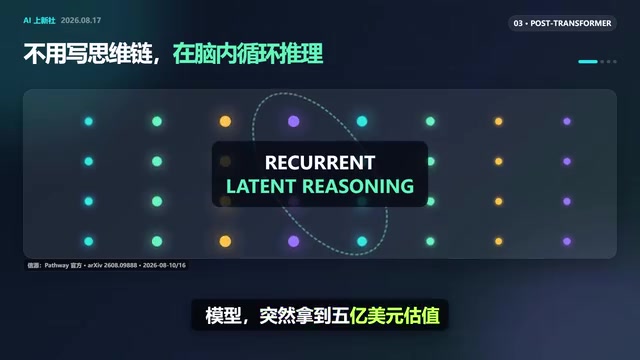
The paper claims it achieved a score of 29.5% on ARC-AGI benchmarks, with a per-question computational cost of only $0.0007 — remarkably efficient. The ARC-AGI benchmark was designed by Keras creator François Chollet to measure abstract reasoning and generalization abilities, considered closer to evaluating "true intelligence" than traditional NLP benchmarks — it requires models to induce abstract rules from few examples and apply them to new situations. However, it must be emphasized: these are results on a specific benchmark and the paper's own estimates, and do not mean its general capabilities have surpassed mainstream large models like GPT or Claude.
Post-Transformer architecture exploration represents an important direction — when the parameter arms race hits cost and energy consumption bottlenecks, using more elegant architectures to achieve more with less may be another path to efficient AI. But there remains considerable distance between lab benchmarks and universally reliable products.
Claude Code Update and Dario Amodei's Rare Public Response
The final two developments are at the product and perspective level.
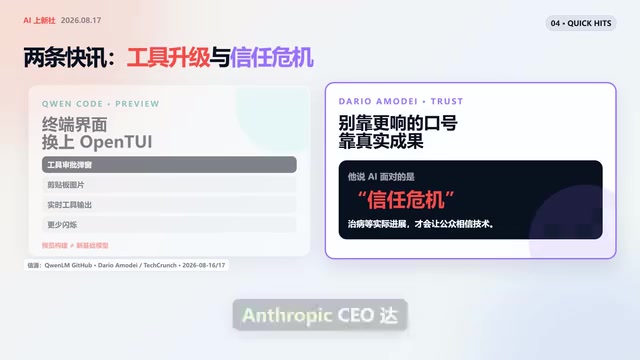
The coding tool Claude Code released preview version 0.21.12, featuring the OpenTUI interface along with tool approval, clipboard images, and real-time tool output capabilities. Note that this is a tool-level iteration, not a new foundation model.
Claude Code is Anthropic's terminal-based coding assistant that runs directly in command-line environments, supporting code generation, debugging, refactoring, and other tasks, competing with products like GitHub Copilot, Cursor, and Windsurf. OpenTUI is a terminal-based text user interface framework that provides richer interactive elements (such as panels, buttons, progress bars) compared to traditional pure command-line output. The "tool approval" feature means Claude Code requires user confirmation before executing operations like file modifications or command runs — a key element in AI Agent safety design to prevent models from producing irreversible destructive operations during autonomous execution. Updates like these may seem modest, but they directly impact developers' daily experience and represent the necessary refinement for Agents to become practical.
More intriguing is a rare public response from Anthropic CEO Dario Amodei. Facing public discussion about an "AI backlash" and industry cooling, he stated bluntly that what the industry faces is fundamentally a trust crisis. To win back the public, what's needed are tangible results like "curing diseases," not louder slogans.
The context behind this statement is worth expanding on. Since ChatGPT's release in late 2022, the AI industry has experienced a dramatic cycle of expectation inflation and correction. The transition from the "Peak of Inflated Expectations" to the "Trough of Disillusionment" described by the Gartner Hype Cycle is underway: enterprises are finding that AI's actual deployment costs far exceed expectations, many advertised capabilities are unstable in production environments, and predictions about AGI timelines have repeatedly failed to materialize. Dario's reference to "curing diseases" refers to Anthropic's collaborative exploration with the biomedical field — using AI to accelerate drug discovery and disease mechanism research. Such verifiable, quantifiable results can rebuild public confidence more effectively than abstract "path to AGI" narratives.
A head of a leading company proactively discussing "trust" rather than "capability" is itself a footnote to the industry's shift from frenzy to pragmatism.
Conclusion: Gateways, Efficiency, and Real Results Will Determine the Second Half of AI
Looking across these five developments, a clear thread emerges: As AI competition enters its second half, the most valuable assets may no longer be the models themselves, but rather gateways, efficiency, and real results.
Stripe's acquisition of OpenRouter is a bet on gateways and data; the high valuation of post-Transformer models is a bet on efficiency; and Dario's statement places the emphasis on tangible outcomes and trust. As industry hype returns to rationality, whoever can build true barriers across these three dimensions will be the one to survive the cycle.
(The developments in this article are based on reporting from Chinese tech news source "AI上新社." Acquisition amounts and revenue figures are based on media reports and unconfirmed documents.)
Related articles

Workbuddy for Absolute Beginners: How a Desktop AI Agent Fits Into Real Workflows
A beginner's guide to the Workbuddy desktop AI agent: installation, claiming credits, file management, and building automated workflows—compared with CodeX for fit and cost, helping professionals shift from AI question-askers to AI managers.

OpenAI's New Agent Stack: Computer Use, Decisions API, and Ultra-Fast Workflows
OpenAI Dev Day unveiled a new agent stack: Computer Use outperforms humans, Decisions API delivers ultra-low-latency classification via Luna, Agents API opens the same Computer Use capabilities, and GPT-6.1 Sol costs only one-seventh of Astra. Core updates, benchmark data, and developer insights.

Liang Wenfeng Open-Sources DeepInfo Inference Framework, Takes On U.S. Ban
DeepSeek open-sources its DeepInfo inference framework after its models, featuring GPU/CPU cross-pipelining, small-model prediction with large-model verification, and full Huawei Ascend and NVIDIA chip support—facing the U.S. federal ban head-on. This article analyzes its significance for AI deployment and open-source strategy.