Stripe's $7B Acquisition of OpenRouter: AI Routing Becomes Big Business as Edge Models Rise

Stripe's $7B OpenRouter acquisition validates AI routing as infrastructure while edge models push AI onto smartwatches.
Stripe's $7 billion acquisition of OpenRouter signals that AI API routing and billing is now recognized as core infrastructure by tech giants. Meanwhile, Anthropic's release of Claude's full system prompt reveals how top models rely on principle-based alignment rather than hard-coded rules. On the edge side, projects like Needle (14MB model on a smartwatch) and local fine-tuning tools show AI rapidly migrating to devices—complementing cloud inference with privacy-preserving, zero-latency local processing.
Today's AI world is buzzing with activity: payment giant Stripe is spending $7 billion to acquire AI routing platform OpenRouter, Anthropic has proactively released Claude's complete system prompt, and debates about whether "models are deliberately getting dumber" have exploded across developer communities. These seemingly disparate events actually trace a clear outline of the AI industry's next chapter: API routing has become big business, and edge models are on the rise.
Stripe's $7B Acquisition of OpenRouter: The Battle for AI's Cash Register
The biggest news today is undoubtedly payment industry titan Stripe acquiring OpenRouter for approximately $7 billion. The strategic significance of this move far exceeds the transaction itself.
What is OpenRouter? Simply put, it's a unified AI model routing and aggregation platform. Developers can call hundreds of models from OpenAI, Anthropic, Google, and others through a single interface, while the platform handles intelligent routing, billing, and load balancing.
From a technical architecture perspective, the core value of an AI model routing platform lies in solving the fragmentation problem of the multi-model era. When developers need to use GPT-4, Claude, Gemini, and other models simultaneously, each provider has different API formats, authentication methods, billing rules, and rate limits. A routing platform abstracts away these differences through a unified API gateway layer while providing intelligent routing functionality—automatically selecting the optimal model based on task type, cost budget, and latency requirements. This architecture is similar to how CDNs consolidate content distribution, or how payment gateways aggregate different banking channels. Load balancing ensures that when a model provider experiences outages or throttling, requests automatically switch to backup channels, guaranteeing service availability.
Stripe's core competency happens to be payment and billing infrastructure.

Combining these two, the logic becomes crystal clear: in the AI era, model call "routing + billing" is the next-generation cash register. Stripe putting down real money is effectively announcing to the entire industry—AI API routing isn't a fringe business in a gray area, but a core track certified by a payment giant.
For entrepreneurs building routing and aggregation services, this is both good news and a warning: the track is validated, but the giants have entered the arena, and future competition will be even more intense.
Claude's Full System Prompt Released: The Ceiling of Top-Tier Models
The second major event: Anthropic officially released Claude's complete system prompt, with the post hitting #1 on Hacker News with 576 points.
What's most intriguing is that this prompt contains virtually no specific task instructions—it relies entirely on principle-based constraints: role definition, behavioral guidelines, and value boundaries. After developers studied it overnight, they arrived at a somewhat tongue-in-cheek conclusion: the ceiling of top-tier models essentially boils down to one phrase—"don't go rogue."

This actually reflects the evolution of large model engineering paradigms. In the early days, we were accustomed to using heavily hard-coded rules to "tame" models. Now, when model capabilities are sufficiently strong, guiding them with high-level principles is actually more effective and generalizable. This is a concrete manifestation of the "Constitutional AI" approach that Anthropic has long championed.
Constitutional AI is an alignment methodology proposed by Anthropic in 2022. Traditional RLHF (Reinforcement Learning from Human Feedback) relies on extensive human annotation to tell models what to do and what not to do—expensive and unable to cover all edge cases. Constitutional AI's core approach is: instead of specifying concrete rules one by one, give the model a set of high-level "constitutional principles" and let the model learn to follow them through cycles of self-evaluation and self-correction. This is analogous to how "the constitution supersedes specific regulations" in legal systems—specific situations are endlessly varied, but as long as the model has internalized core values, it can make reasonable judgments in novel scenarios.
For prompt engineers, this published document is an incredibly valuable learning reference: it demonstrates that when a model's underlying capabilities are sufficiently powerful, the optimal strategy for system prompts isn't exhaustive instruction-stacking, but clear value framework definition.
Models "Deliberately Getting Dumber"? Safety Redundancy or Capability Regression
Meanwhile, an HN post with 290 points sparked heated debate: users complained that models are "becoming increasingly conservative," repeatedly seeking confirmation for things they could clearly do, "refusing this, refusing that."
The debate centers on: is this redundant protection added by providers for safety, or a substantive regression in model capabilities?
From a technical perspective, the root cause of models "becoming conservative" lies in the concept of Alignment Tax. Providers use RLHF and safety fine-tuning during post-training to reduce harmful output probability, but this process often causes models to "over-generalize" near safety boundaries—misclassifying harmless requests as dangerous and refusing to execute them. This is technically similar to the false positive problem in classifiers. Additionally, model "laziness" (such as giving overly brief answers or frequently requesting confirmation) may stem from distribution shift in training data, or from the RLHF reward model assigning excessively high reward signals to "cautious responses."
Here's a thought-provoking perspective: choosing a model shouldn't be based solely on benchmarks—willingness to actually do the work is what matters. A model that scores highly on benchmarks but hesitates and frequently refuses in actual tasks offers limited practical value to developers and users. As AI safety regulatory pressure increases, finding the balance between "safety" and "usability" will become a key long-term battleground for all providers.
AI Quota Reselling: The Gray Business of Scalper Logic
The third noteworthy development is that AI quota reselling has quietly become a business (HN post with 245 points).
The specific playbook: people buy monthly subscription packages at low prices, split them into API shares, and resell them at a markup. This logic is identical to concert ticket scalping, operating in the gray area of terms of service.

This model will attract price-sensitive users in the short term, but the risks are obvious: once platforms tighten policies, these resale channels could become invalid at any time. For users who depend on routing services, stability and compliance matter far more than temporary low prices. This also indirectly confirms why Stripe wants to acquire OpenRouter—once formalized routing and billing infrastructure is established, the survival space for gray channels will be further compressed.
The Rise of Edge AI: From Local Fine-Tuning to Models on Watches
In today's events, two trending open-source projects also deserve attention, both pointing to one trend—AI is migrating toward edge devices and local deployment.
Local Fine-Tuning Barrier Drops Again
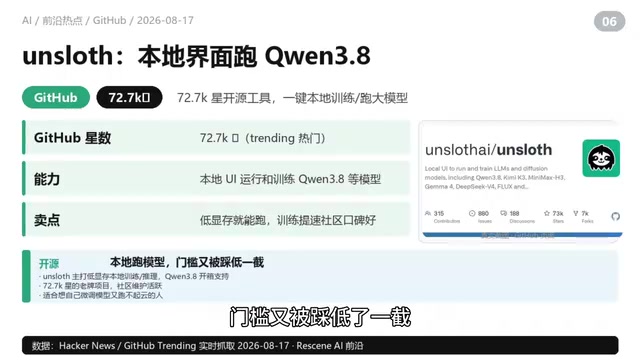
A project with 72.7k stars provides a local interface supporting one-click model running and fine-tuning, with the key feature being low VRAM requirements and faster training speeds. For developers who want to fine-tune their own custom models but can't afford cloud compute, this is a major blessing.
The lowering of local fine-tuning barriers is primarily thanks to the maturation of Parameter-Efficient Fine-Tuning (PEFT) techniques, especially the LoRA (Low-Rank Adaptation) method. Traditional full-parameter fine-tuning requires loading all model weights into VRAM and computing gradients—a 7B parameter model needs at least 28GB of VRAM. LoRA inserts low-rank matrices between model layers and only trains these newly added parameters (typically less than 1% of the original model), reducing VRAM requirements to 1/4 or even less. Combined with quantization techniques (like QLoRA), a consumer-grade 8GB GPU can fine-tune models with billions of parameters, completely changing the landscape where only cloud-scale compute could handle fine-tuning.
Needle: 14MB Model Running on a Smartwatch
Even more imaginative is a project called Needle (today's rising star, 6.7k stars): it compresses a model to just 14MB, capable of running directly on a smartwatch.
Compressing a model to the 14MB level involves the comprehensive application of multiple model compression techniques: Quantization—compressing model weights from 32-bit floating point to 4-bit or even 2-bit integers; Knowledge Distillation—using large models to guide the training of small models, allowing small models to "inherit" some capabilities of larger ones; Pruning—removing neural connections that contribute minimally to final output; and architecture search—designing lightweight network structures specifically adapted for edge devices.
Phones, wearables, smart home devices... all these edge scenarios can host such tiny models as persistent residents. While sacrificing some capability, what's gained is privacy protection and zero latency—data never leaving the device naturally satisfies privacy compliance requirements (like GDPR), while eliminating network round-trip latency and remaining usable in weak-network or offline environments. This will likely become the core selling point of the next wave of smart hardware.
Summary: Routing Is Business, Edge Is the Future
Stringing together today's six news stories, two main threads of the industry become clear:
On one hand, Stripe's acquisition of OpenRouter proves that AI API routing is already big business recognized by giants—routing plus billing is becoming the infrastructure of the AI era. On the other hand, from local fine-tuning tools to watch-level models, models are getting smaller and smaller, and edge deployment is the next stop.
These two threads aren't contradictory but complementary: the cloud handles high-complexity reasoning tasks, edge devices handle high-frequency low-latency daily interactions, and an intelligent routing layer in between decides task distribution—this may well be the complete picture of future AI infrastructure.
For developers and entrepreneurs, understanding these two threads may be the key to seizing the critical opportunity window of the next one to two years.
Related articles

Gaussian Process Bandit Optimization: Exploration Strategies and Inference Regret Guarantees
Cumulative regret guarantees in Bayesian optimization fail to reflect final recommendation quality. This article examines a new study that provides inference regret guarantees for Gaussian process bandit optimization through exploration query strategies and fill distance analysis, validated on hyperparameter optimization and control tasks.

The Most Detailed Codex Guide on Bilibili: From Installation to Real-World Practice
The most detailed Codex guide on Bilibili: from app store installation to daily work mode configuration, with a real coffee shop project demonstrating file organization, data extraction, dashboard creation, and other practical tasks. Learn to use Plan Mode and desktop pets to leverage Codex efficiently.

Appearance Compensation in Volume Rendering: Why RGB Accuracy Cannot Guarantee Density Correctness
Volume rendering research reveals that volumetric data perfectly reproducing external RGB views may still contain density errors: appearance compensation can double central density and keep external rays unchanged even when L2 error exceeds 14.52%. Density recovery depends on appearance capacity, spatial resolution, and measurement design.