Student Dilemma: Is Claude Pro Worth the Upgrade?

Whether budget-constrained students should upgrade to Claude Pro depends on whether actual usage hits the free version's quota ceiling.
A Chilean student faces the choice of upgrading Claude from free to the $20/month Pro version for teaching materials, papers, and academic work, having seen four-month-old comments saying the free version is more cost-effective. The article notes core differences lie in usage quotas, model access, and peak priority. Since AI policies update frequently, old comments may be outdated. For budget-tight students, it recommends a 1-2 week quota stress test, distinguishing must-haves from nice-to-haves, and using other free AI tools. Conclusion: worth depends on personal usage curve; actual data beats old comments.
A Real Student's Dilemma
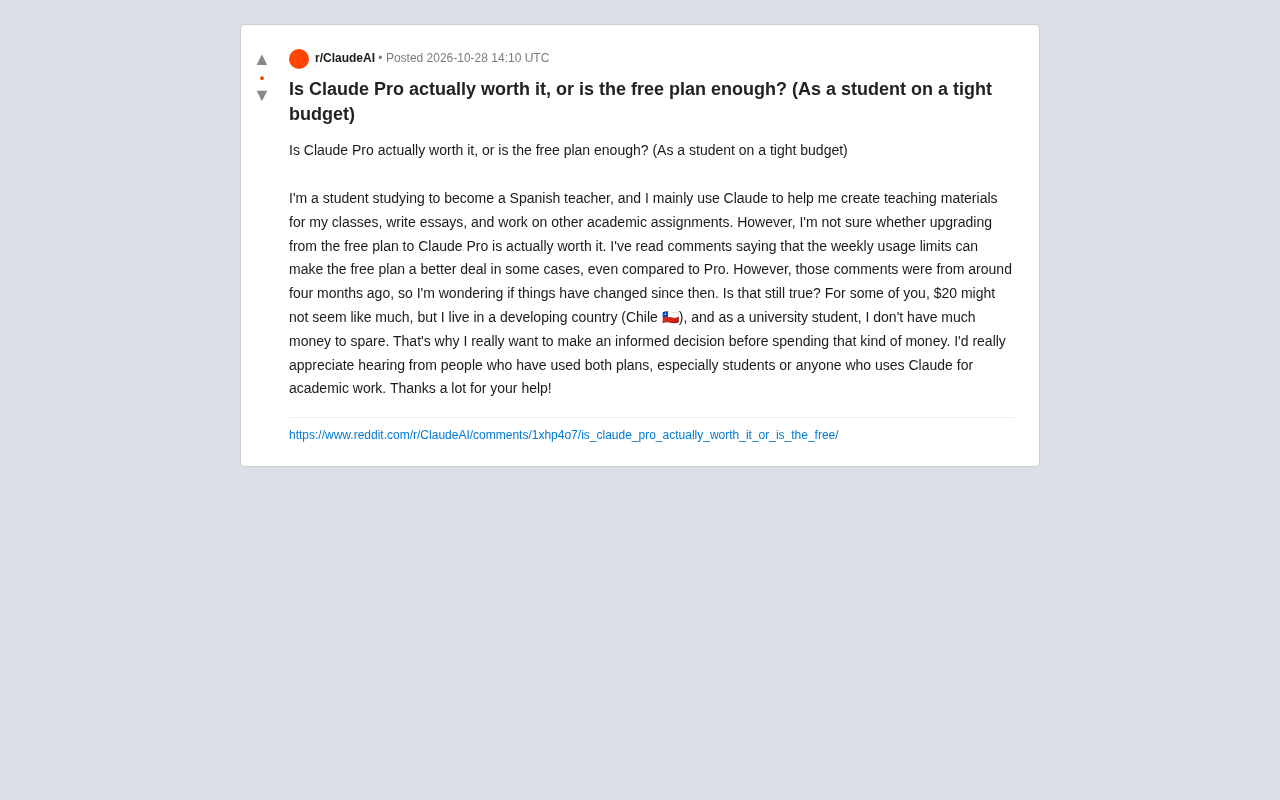
On Reddit, a student from Chile who aspires to become a Spanish teacher raised a very practical question: he mainly uses Claude to create teaching materials, write papers, and handle academic assignments — should he upgrade from the free version to the $20/month Claude Pro? He mentioned seeing some comments saying that the free version's weekly usage limits sometimes actually make the free plan more cost-effective, even more practical than Pro. But those comments were written about four months ago, and he wasn't sure whether things had changed. For a student living in a developing country, $20 is not a small amount, and he wanted to hear real experiences from people who have used both versions — especially students or academic workers.
This question actually touches on a pain point for many light but frequent users: are the limits behind the paywall really worth paying for?
The Core Differences Between Free and Pro
To answer whether it's worth it, we first need to understand exactly where the two versions differ. According to publicly available information from Anthropic, the main differences between the free and Pro versions center on several aspects: usage quotas, model access, and priority during peak periods.
Free users can access Claude's base models but have daily or weekly message limits. Pro provides higher usage limits and priority access during peak periods. For a user like this student who needs to frequently generate teaching materials and repeatedly revise papers, quota limits can be a key bottleneck — especially when multiple assignments or lesson-prep tasks need to be handled within a week, the free version's limits may interrupt the workflow.
However, the student's claim that "the free version is more cost-effective in some cases" also deserves serious consideration. If the free version's quota already covers daily use, then paying an extra $20 does seem unnecessary. The core question is: will your usage intensity actually hit the free version's ceiling?
Claude's model tiers: Anthropic divides Claude into three tiers — Haiku, Sonnet, and Opus — corresponding to speed-first, balanced, and strongest reasoning capabilities respectively. The free version typically only provides access to the lighter models (such as a certain version of Sonnet), while Pro unlocks higher-tier models as well as first access to new models. This means the difference isn't just "how many times you can use it" but also "how smart a model you can use" — for users who need to generate complex teaching materials or perform in-depth paper revisions, model capability itself may constitute a reason to upgrade.
Peak-period priority access: AI services experience slower responses or queuing during periods of concentrated use (such as weekday daytime in Europe and the US). Pro users' priority means they can still get relatively stable response speeds during congestion, while free users may be downgraded or made to wait. For academic tasks with deadlines, this stability is sometimes more critical than the quota number.
Do Comments from Four Months Ago Still Hold?
The student specifically mentioned that the comments he saw were about four months old and worried that the information might be outdated. This point is crucial. AI products' pricing, quotas, and features update very frequently, and policy adjustments within a few months are not uncommon. Anthropic has made multiple updates to Claude's availability and model capabilities over the past period, and the boundary between free and Pro may have changed accordingly.
Therefore, relying on community comments from several months ago to make a decision carries risk. A more reliable approach is to check Anthropic's current official pricing page and quota descriptions directly, or to observe during actual use whether you frequently hit the limits. If the free version frequently prompts that the quota is exhausted in recent use, then the case for upgrading is stronger; conversely, if it's always sufficient, there's no need to pay for quota you "might use."
The pace of AI product iteration: The version update cycle for large model services is usually measured in weeks or months, not years. Anthropic periodically adjusts the free version's quota caps, available model versions, and even redefines Pro benefits (for example, it has moved some previously free features into Pro, or vice versa). Community comments are often based on the version experience at the time of writing, and once official policies are adjusted, the reference value of old comments decays rapidly. It's advisable to check the "current" descriptions on the official pricing page directly and to pay attention to quota or model change records in the changelog.
Practical Advice for Budget-Constrained Students
For users with tight budgets like this Chilean student, there are several approaches to consider. First, conduct a one-to-two-week "quota stress test": deliberately complete all academic tasks under the free version, recording whether you encounter limit prompts, how often they occur, and whether they seriously affect progress. Second, distinguish between "must-haves" and "nice-to-haves" — if Claude is only assisting with paper writing and lesson prep, and school or free tools can cover part of the needs, then Pro's marginal value is diminished. Third, check whether there are student discounts or educational pricing. Although there is currently no public information indicating that Claude Pro offers student pricing, educational software often has such policies, so it's worth actively checking.
Additionally, you can consider using Claude alongside other free or low-cost AI tools, spreading high-intensity tasks across different platforms to reduce dependence on any single service's quota cap.
How to conduct a quota stress test: A "stress test" means deliberately using the free version for one to two weeks to complete all the tasks you would actually do (such as lesson prep, paper writing, grading), and recording three types of data: the number of times limit prompts are triggered, the duration of forced interruptions or waiting after triggering, and whether you had to switch to other tools or lower task quality as a result. If you trigger limits more than two or three times within a week and it clearly affects progress, your usage curve is approaching or exceeding the free version's ceiling; if you only occasionally hit the limit without affecting results, then Pro's marginal benefit is limited.
Conclusion: It Depends on Your Usage Curve
Whether Claude Pro is worth it has no universal answer. For students with low usage frequency and small task volumes, the free version may be entirely sufficient, and those comments from four months ago saying "the free version is more cost-effective" still have reference value as long as the quota isn't maxed out. But for users who need to generate large amounts of teaching content and repeatedly iterate on papers every week, Pro's higher quota and peak-period priority can reduce interruptions and improve efficiency.
The safest decision path is: run the free version for a while first, and use the actual number of limits you encounter to judge whether you really need to pay. After all, $20 is not a small amount for a Chilean student, and letting usage data make the decision for you is more reliable than relying on community comments from months ago.
One-line Summary
Whether budget-constrained students should upgrade to Claude Pro depends on whether their actual usage intensity hits the free version's quota ceiling.
Paragraph Summary
A Chilean student faces the choice of whether to upgrade Claude from the free version to the $20/month Pro version. He mainly uses Claude to create teaching materials, write papers, and handle academic assignments, and has seen comments from four months ago saying "the free version is more cost-effective." The article points out that the core differences between free and Pro lie in usage quotas, model access, and peak-period priority, rather than fundamental feature differences. Since AI product policies update frequently, community comments from months ago may be outdated, and official current descriptions or actual usage experience should be referenced. For budget-constrained students, it's recommended to conduct a one-to-two-week quota stress test, record the frequency and impact of hitting limits, distinguish must-haves from nice-to-haves, and use other free AI tools to spread tasks. The conclusion: whether it's worth it depends on your personal usage curve, and making decisions with actual data is more reliable than relying on old comments.
Related articles

Qwen4 Architecture Preview Open-Sourced: 125B Parameters, 512 Experts, Designed for VRAM-Constrained Hardware
Qwen4 isn't released yet, but its architecture is previewed via open-source Qwen3.8 Flash Next: 125B params, 6B activated per token, 512 experts, 262K context, built for VRAM-limited hardware. This article covers official confirmations, key config.json metrics, and local deployment tests on 24G memory.

Run 8K Images on 6GB VRAM! Hands-On Test of Fudan's Open-Source MOSS-Image Model
Fudan OpenMouse team and Shanghai MOSS Intelligence open-source MOSS-Image, a 500M-parameter DT architecture text-to-image model that runs locally on 6GB VRAM with precise text rendering, structured layout control, and 4K Token prompt support—ideal for e-commerce posters and local deployment by individual creators.

Overseas Blogger Tests Local Deployment of 100B-Parameter MoE Model: Key Lessons on Quantization and Tool Calling
Overseas blogger tests local deployment of Alibaba's Qwen 3.8 Flash Next 100B MoE model on a Strix Halo mini PC and CUDA workstation, revealing how quantization precision affects tool-calling success and the real-world performance of the Strata and GUFO inference engines.