Supademo AI Demo Agent: The Interactive Demo That Actually Listens

Supademo's AI Demo Agent puts buyers in control of interactive demos while AI listens and answers questions in real time.
Supademo AI Demo Agent addresses the core flaw of existing AI demo tools — fake interactivity — with a buyer-centric approach: buyers navigate a hands-on, freely explorable demo while an AI agent listens and responds to real questions with relevant product proof, rather than playing through a rigid script. Supporting both voice and text across 50+ languages, it's built for B2B SaaS teams serving global markets who want to scale their demo process without scaling headcount. The product is still early-stage, and whether its AI can handle complex questions and deliver on the "listening" promise in real sales scenarios remains to be seen.
When AI Demo Agents Stop Talking at You
Product demos have long been a critical part of the SaaS sales funnel — yet traditional automated demo tools tend to fall into an awkward trap: buyers feel like they're watching a pre-recorded video, passively following someone else's script. Supademo's AI Demo Agent aims to break this one-way experience. It landed on Product Hunt with 87 upvotes, 6 comments, and a #10 ranking, categorized under Sales, Marketing, and Artificial Intelligence.
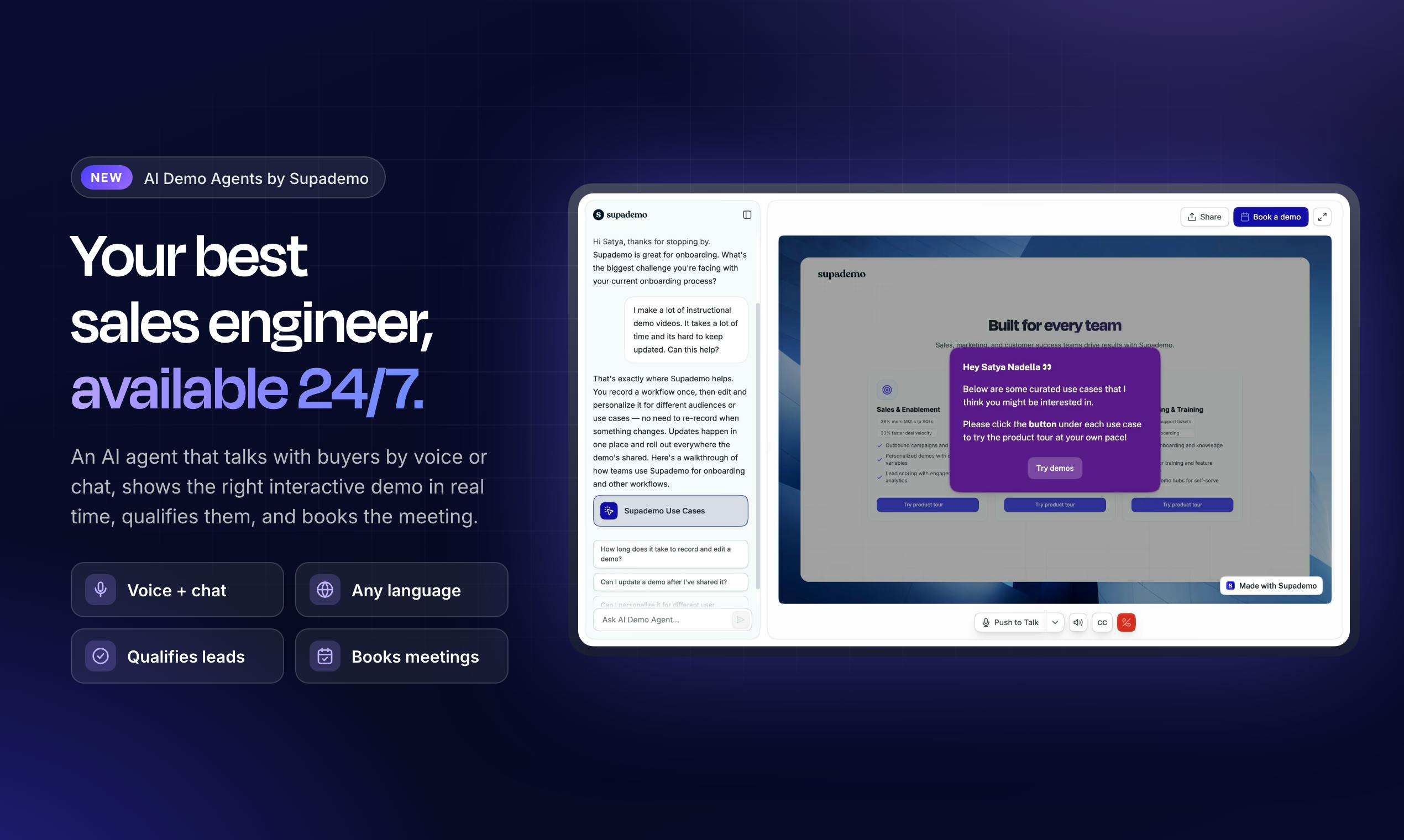
The product's tagline is refreshingly blunt — "Demo like your best sales rep, without the salary." It targets two persistent pain points in the demo stage: high labor costs and the rigid, lifeless experience of automated demos.
The Real Problem: Passive Watching Disguised as Interaction
The Supademo team takes a sharp stance against existing AI demo agents in their product introduction. They argue that most AI demo agents feel like a video call where the other side isn't really listening — either a cartoonish animated avatar or an obviously fake virtual human.
The deeper issue is the interaction logic itself. You ask a question and it keeps reading from the script. You want to click around and explore, but all you can do is watch someone else's screen. This "fake interactivity" strips away the sense of discovery a demo should offer. When buyers lose control, they lose interest.
This critique hits a real nerve in the current AI sales tool landscape. Many tools have achieved "automation" in a technical sense, but haven't genuinely become user-centric in their experience. An auto-playing script is still a one-way broadcast — just dressed up in an AI wrapper.
Supademo's Approach: Buyer-Led, Real Interaction
Supademo's core differentiator is putting control back in the buyer's hands. According to the official description, it works in the opposite direction from traditional tools:
- Buyers interact directly with a real, hands-on demo — not a screen recording of someone else's session
- They can navigate any path — jump back, skip ahead, explore at their own pace
- The AI agent listens and answers genuine questions, surfacing relevant product proof at the right moment rather than robotically reading a script
This design shifts the demo from a "presentation" to a "guided exploration." As buyers interact with the product and questions naturally arise, the AI responds in real time with targeted supporting evidence — much closer to having a skilled sales rep standing by to answer questions.
Voice, Text, and 50+ Languages
The product supports both voice and text interaction and covers more than 50 languages. For B2B SaaS companies targeting global markets, this has real practical value — a single set of demo assets can serve potential customers across different language regions without needing dedicated sales staff for each market.
This design philosophy aligns naturally with the Product-Led Growth (PLG) trend. PLG's core principle is letting the product itself drive acquisition and conversion, rather than relying on a sales team to push every decision point. Traditional sales demos are typically part of a "Sales-Led" process — scheduling calls, coordinating with sales engineers, navigating a long, high-friction chain. Returning control to buyers and enabling self-serve exploration at any time essentially transforms the demo from a manually gated sales funnel checkpoint into an asynchronous, always-available product experience entry point. This logic echoes PLG-native products like Calendly and Figma: lower the barrier to first contact, and let users build their own understanding and trust in the product without any sales pressure.
What This Means for Sales and Marketing Teams
From an industry perspective, Supademo represents an evolution in the "AI sales engineering" niche. Traditional product demos either rely on one-on-one sales walkthroughs (expensive, hard to scale) or static presentations (poor experience, low conversion). Supademo tries to find a balance: using Agentic AI to replicate the adaptability of a great sales rep, while preserving the scalability advantage of self-serve demos.
The "without the salary" framing has a marketing spin to it, but it points to a genuine value proposition — giving every visitor to your product page an interactive demo experience that approaches the quality of your best sales rep. For smaller teams or companies with limited sales resources, that kind of leverage is genuinely compelling.
That said, this product is still in its early stages. Its Product Hunt engagement (87 upvotes, 6 comments) reflects a moderate level of interest, and the actual quality of responses, depth of understanding for complex products, and real-world sales conversion performance still need more user validation. Whether its claimed ability to "truly listen" holds up under complex questions is the critical test.
"Agentic AI" is the key concept for understanding products like this. Unlike traditional Q&A-style AI — where a user asks, the AI answers, and the interaction ends — Agentic AI has goal-oriented, sustained action capabilities. It can perceive current context (which feature module is the user looking at, what question did they just ask), autonomously decide on next steps (which demo clip to surface, which type of supporting evidence to present), and maintain coherent "task awareness" throughout the interaction. In a sales demo context, this means the AI isn't just retrieving from a knowledge base and generating a reply — it needs to understand the current state of the demo flow, infer buyer intent, and inject the right product proof (case studies, feature screenshots, performance metrics, etc.) at precisely the right moment. This is significantly more complex than a straightforward RAG (Retrieval-Augmented Generation) approach, and it's exactly where the capability gap between products in this category tends to show most clearly.
Takeaway
Supademo AI Demo Agent targets a clear and real pain point: the hollow pseudo-interactivity of existing AI demo tools. By letting buyers drive the experience, enabling real-time AI Q&A, and supporting multimodal interaction across multiple languages, it offers a self-serve demo solution that more closely mirrors a live sales conversation. For SaaS teams looking to reduce costs and improve efficiency in the demo stage, this is a direction worth watching — as long as its AI capabilities can actually deliver on the promise of listening.
Related articles

Gemini 4 Argon Launches Globally: Key Highlights from the AI Daily Brief
Google opens Gemini 4 Argon globally across Pro and Ultra subscriptions and the API, and demonstrates robot control. This article rounds up open-source models, Agent infrastructure, cost transparency, and safety governance updates.

OpenCode Surpasses Cursor with 213.5k Stars: The Three-Way AI Coding War Behind a $60 Billion Sale
OpenCode overtakes Cursor with 213.5k stars as Cursor reportedly seeks a $60B sale. We break down the business models, user scenarios, and moats of open-source OpenCode, commercial IDE Cursor, and Anthropic's Claude Code, plus three possible endings for the AI coding tool landscape.

Vercel CEO's AI Coding Workflow: 7 Key Principles
Vercel CEO shares his complete workflow for collaborating with AI agents: validate ideas with an MVP, use the direction command to prevent drift, scan security debt with DeepSec, use a breaker agent to attack the app, test from a first-visit user perspective, and close the customer feedback loop through MCP—plus seven actionable AI coding practices.