Superflow AI: Automating Website QA with AI Agents

Superflow AI uses AI agents to automatically perform website QA checks before launch.
Superflow AI is an AI agent-powered website QA automation tool that scans desktop and mobile pages before launch to detect broken links, missing images, layout issues, and more. It supports major platforms including Webflow, WordPress, Next.js, and Shopify, covers approximately 90% of routine QA workload, and learns from user feedback to reduce false positives over time.
The Persistent Challenge of Website QA
Behind every launched website lies a lengthy QA (Quality Assurance) checklist: Are images loading properly? Are links broken? Does the mobile layout break? Do buttons respond correctly when clicked? This work is tedious and repetitive, yet it cannot be skipped. The traditional approach involves team members manually checking every page on every device—time-consuming and prone to oversights.
QA in web development is a critical step for ensuring product quality, spanning multiple dimensions including functional testing, visual regression testing, performance testing, and accessibility testing. Traditional website QA relies on a combination of manual testing and automation scripts (like Selenium or Cypress)—manual testing is flexible but expensive and unscalable, while automation scripts are efficient but costly to write and maintain, and unfriendly to non-technical users. According to industry research, a complete QA cycle for a medium-sized website typically takes 2-5 business days, and the permutations of cross-device, cross-browser testing cause the test matrix to expand exponentially.
Superflow AI, which recently launched on Product Hunt and ranked #3 for the day, targets exactly this pain point. Its positioning is straightforward—use a team of AI agents to complete QA quality checks before your website goes live. The product has received 123 upvotes and 7 comments so far, categorized under Design Tools, Artificial Intelligence, and Marketing Automation.
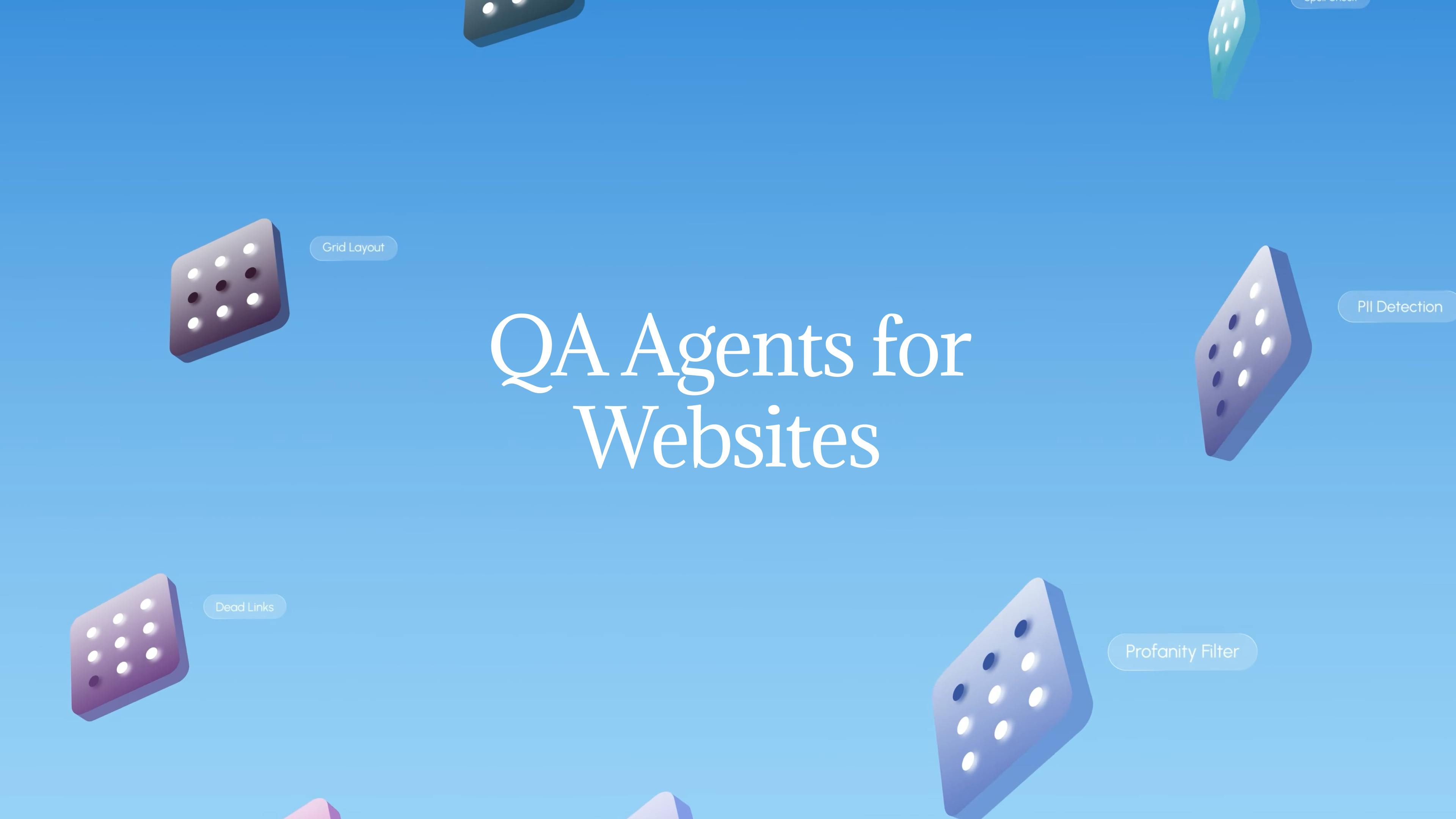
Turning Your QA Checklist into a Team of AI Agents
Superflow's core approach is: transform the QA checklist you're already using into a team of AI agents. These agents automatically scan every page of your website, covering both desktop and mobile viewports simultaneously, and pin each finding directly on your live website as annotations.
AI Agents here refer to AI systems capable of autonomously perceiving their environment, making decisions, and executing actions. Unlike simple rule engines, agents possess goal-oriented planning capabilities, tool-calling abilities, and environmental interaction skills. In the website QA context, AI agents render pages through headless browsers, use computer vision to identify layout anomalies, detect link status and element attributes through DOM analysis, and even simulate user clicks to verify interaction logic. Since 2024, with the maturation of multimodal large models (such as GPT-4V), AI agents can now "understand" page screenshots and identify visual-level issues—something traditional rule-based automation testing tools cannot achieve.
This "annotate issues directly on the live site" interaction model is worth noting. Compared to traditional QA tools that output a dry Excel report or screenshot list, leaving comments directly at the corresponding position on the page lets developers or designers instantly locate issues, dramatically reducing communication and reproduction costs.
Clear Division of Labor: Machines Handle Right and Wrong, Humans Handle Taste
The official description includes a statement with notable product philosophy: "Agents handle the black and white issues. Taste stays with you."
This means Superflow doesn't attempt to replace human aesthetic judgment. It excels at issues with clear-cut correct answers—broken links, missing images, misaligned layouts, obvious responsive design failures. Subjective decisions involving visual style, brand tone, and copywriting voice remain under human control. This division of "AI does the heavy lifting, humans make judgment calls" is one of the more pragmatic paths for AI tool adoption today.
AI Agents That Learn from Your Website QA
The biggest difference between Superflow and ordinary automation scripts is that its agents possess continuous learning capabilities:
- Rejected findings won't resurface: If you determine a report is a false positive and dismiss it, similar issues won't repeatedly pop up in the future—eliminating the frustration of traditional detection tools repeatedly flagging the same "false positive."
- Missed issues become future checklist items: When an agent misses a problem that you manually discover, that blind spot gets codified as a check item for future websites.
This feedback loop is essentially an application of Reinforcement Learning from Human Feedback (RLHF) at the product level. RLHF became widely known through OpenAI's use of it to fine-tune the GPT model series, with the core idea being to calibrate model behavior through human preference signals. Superflow productizes this concept: every time a user accepts or rejects a QA finding, it's equivalent to providing a positive or negative feedback signal, which the system uses to adjust detection strategy priorities and thresholds. This mechanism is known in industry as "online learning" or "incremental learning," making the product not a static tool but a system that dynamically evolves with usage scenarios. Similar product design philosophies appear in Grammarly (learning user writing style preferences) and GitHub Copilot (adjusting suggestion strategies based on user acceptance rates).
In other words, it's not an unchanging rule engine but a system that accumulates team experience. This is also a key characteristic distinguishing today's AI applications from earlier automation tools—continuously calibrating product behavior through human feedback.
Real-World Results and Platform Compatibility
According to user feedback cited by the company, teams using Superflow report catching approximately 90% of issues previously found manually. If accurate, this means it can already cover the vast majority of routine QA workload, freeing human effort from repetitive labor so teams can focus on the 10% that requires judgment and creativity.
In terms of platform compatibility, Superflow offers broad coverage across mainstream website building and deployment platforms:
- No-code/Low-code platforms: Webflow, Framer, WordPress, Shopify
- Frontend frameworks and hosting services: Next.js, Netlify
- And many more
This broad compatibility reflects the two mainstream paths in today's website development. No-code/low-code platforms target designers and marketing teams, allowing website construction through visual drag-and-drop—Webflow and Framer are especially popular among designers, WordPress powers approximately 43% of websites globally, and Shopify dominates e-commerce site building. The other path is the frontend framework + hosting service combination, targeting engineering teams: Next.js is a full-stack framework based on React supporting Server-Side Rendering (SSR) and Static Site Generation (SSG); Netlify and Vercel provide CI/CD deployment, CDN distribution, and Serverless functions infrastructure. Superflow's ability to cover both technology stacks indicates its detection mechanism doesn't depend on specific build methods but analyzes at the final rendered output level—whether it's a landing page built by marketing in Webflow or an application deployed by engineering with Next.js on Netlify, both can be included in automated QA checks.
Observations and Reflections on Superflow AI
Superflow emerges against the backdrop of the recent explosion of AI Agent applications. In the past, discussions of AI-assisted development focused mainly on code generation; the direction Superflow represents is extending AI into the downstream stages of the software delivery pipeline—testing and quality inspection.
The software delivery pipeline typically includes six major stages: requirements analysis, design, coding, testing, deployment, and operations. AI tools have penetrated each stage to varying degrees: the coding stage already has mature products like GitHub Copilot and Cursor; the design stage has Figma AI and Midjourney; but the testing and quality inspection stage has long been an "AI-ification" blind spot. The reason is that testing work is highly dependent on contextual understanding—you need to know "what is correct" to determine "what is wrong." Traditional automated testing defines "correct" through manually written assertions, while AI agents can internalize these standards by learning design specifications, brand guidelines, and historical feedback. The direction Superflow represents is forming a new market category alongside other testing AI tools (such as Applitools' Visual AI and Testim's self-healing test scripts), with Gartner predicting that by 2025, 70% of enterprises will incorporate AI assistance into their testing processes.
From a product logic perspective, several design choices stand out as particularly smart:
- Low adoption barrier—doesn't require teams to redesign their workflows, but "translates" existing QA checklists, keeping migration costs low.
- Preserves human decision-making authority—doesn't overstep by making subjective judgments for users, reducing user distrust.
- Builds a data moat—through continuous learning from team accept/reject behaviors, the longer you use it, the harder it is to replace.
Of course, users should also keep a few things in mind: the approximately 90% capture rate means there's still room for missed issues, so manual final inspections of critical pages before launch can't be entirely eliminated. Additionally, granting website access to a third-party AI tool requires evaluation of data security and privacy compliance.
Overall, Superflow AI is a website QA automation tool with clear thinking and a precise entry point. It doesn't shout slogans about "replacing humans" but instead pragmatically solves the real engineering pain point of "pre-launch quality checks being both exhausting and error-prone"—which is perhaps exactly why it quickly climbed the Product Hunt rankings.
Related articles

Claude Autonomously Designs Proteins with 35% Success Rate, Far Exceeding Human Expert Performance
Anthropic's Claude achieves 35% wet-lab success rate in autonomous protein design, far surpassing the 10-15% human expert average, signaling AI's move toward real scientific productivity.

Perplexity Discover's Multilingual Support Suddenly Disappears — Why Are International Users Upset?
Perplexity Discover's multilingual news feature suddenly dropped non-English support, frustrating international users. We analyze possible causes and the broader challenges of AI product internationalization.

GitHub Daily · August 20: Mojo Tops the Charts & The Local-First Open Source Rebellion
GitHub Trending Aug 20: Mojo tops charts for AI compute stack ambitions, OpenLogi surges 1225 stars with local-first philosophy, and privacy rebellion dominates.