Superforecasters Predict AI Revenue: Why $770 Billion Is Considered Bearish

Superforecasters' $770B AI revenue prediction by 2040 is called bearish — here's why.
Superforecasters project OpenAI and Anthropic will reach a combined $770 billion in annual revenue by 2040, yet AI industry insiders consider this estimate bearish. The article explores the Superforecasters' probability-based methodology, examines why the implied growth slowdown triggers skepticism among optimists, and highlights the fundamental divide between those expecting AGI-driven exponential growth and those anticipating market maturation and mean reversion.
A Set of AI Revenue Predictions That Sparked Controversy
Recently, a set of revenue predictions for AI giants from "Superforecasters" went viral on social media. According to these figures, the projected annualized revenue run rate for OpenAI and Anthropic combined is as follows:
- 2026: $90 billion
- 2030: $300 billion
- 2040: $770 billion
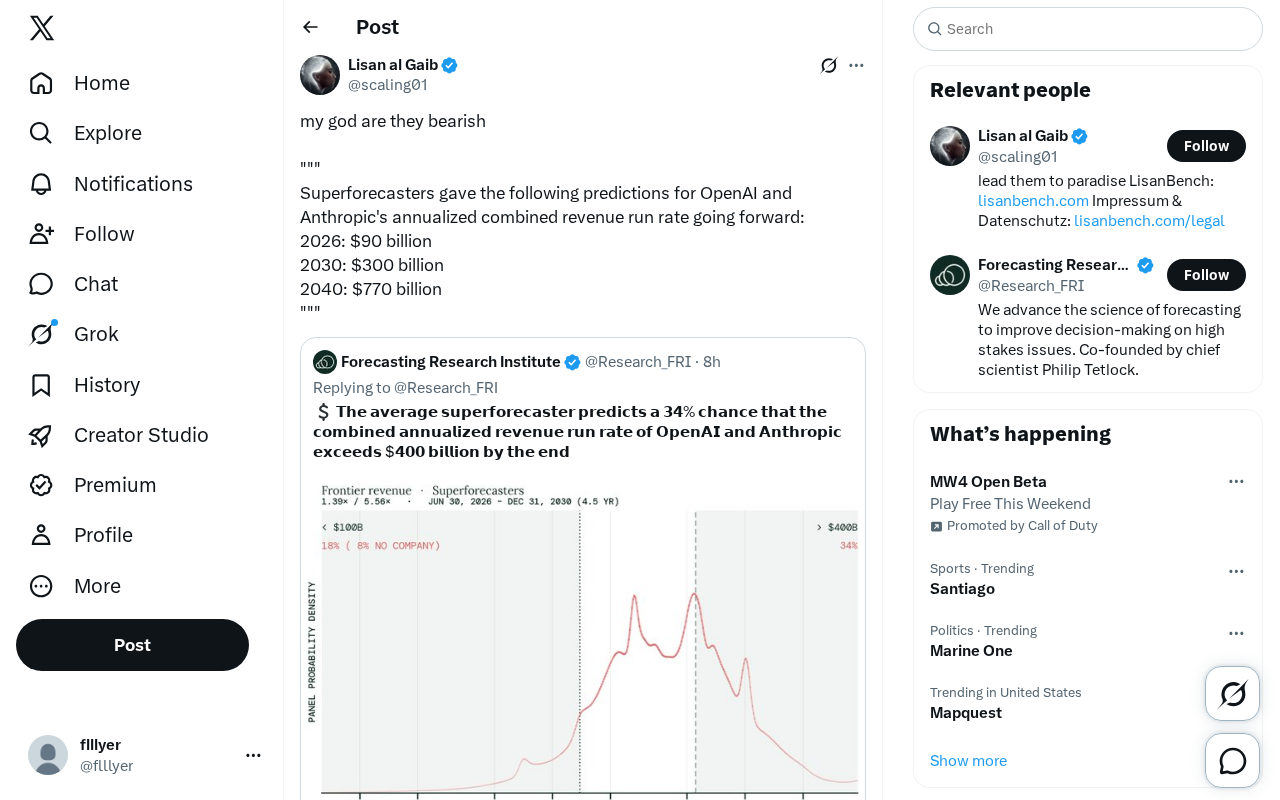
Interestingly, the tweet sharing this data was titled "my god are they bearish." This remark alone reveals a fascinating phenomenon in today's AI industry: even numbers this massive are still considered overly conservative by some industry observers.
What Are Superforecasters?
The concept of "Superforecasters" originated from the research of Philip Tetlock, a psychologist at the University of Pennsylvania. In his renowned Good Judgment Project, Tetlock discovered that a small group of ordinary people consistently outperformed even intelligence analysts with access to classified information when it came to predicting geopolitical and economic events.
These individuals tend to share several key traits: they're skilled at breaking complex problems into smaller parts, they synthesize information from multiple sources, they're willing to update their judgments based on new evidence, and they remain humble about uncertainty. As a result, when Superforecasters issue AI revenue predictions, their numbers typically represent a probability-driven, relatively restrained "median" estimate — rather than the conviction-heavy optimistic narratives common among industry insiders.
Why These Numbers Are Considered "Bearish"
To understand why such enormous figures would be labeled "bearish," we need to examine them within the context of the AI industry's current growth trajectory.
Current Revenue Baseline and Growth Velocity
OpenAI's revenue has experienced explosive growth over the past few years. Since the launch of ChatGPT, its annualized revenue run rate has skyrocketed from virtually zero to billions of dollars, and it's on track to break through even higher thresholds soon. Anthropic, the developer of the Claude model family, has likewise been expanding rapidly in the enterprise market.
If you extrapolate linearly — or even exponentially — from these companies' historical growth curves, some optimists argue that $300 billion in combined revenue by 2030 is merely the "base case," not the ceiling. By comparison, the Superforecasters' projections of $300 billion by 2030 and $770 billion by 2040 imply a notably decelerating compound annual growth rate in the later years — and that's precisely why the forecast is seen as "bearish."
The Logic Behind the Growth Slowdown Assumption
From $300 billion in 2030 to $770 billion in 2040, that's roughly a 2.6x increase over a decade, translating to a compound annual growth rate of less than 10%. This stands in stark contrast to the current pace of the AI industry, where doubling is almost taken for granted. The Superforecasters' assumption implicitly embeds several key judgments:
- The AI market will eventually mature, and hypergrowth cannot last forever;
- Intensifying competition will erode individual players' market share and pricing power;
- The marginal returns from technological breakthroughs may diminish over time.
In other words, the Superforecasters are applying a "reversion to the mean" lens, throwing cold water on the feverish AI narrative.
The Fundamental Divide Between Optimists and Skeptics
What makes this data valuable is how clearly it reflects a collision between two worldviews within the AI industry.
The optimists believe we are on the eve of a technological transformation on par with the internet — or even the Industrial Revolution. If artificial general intelligence (AGI) truly arrives, AI will permeate virtually every economic activity, and the revenue ceiling will be unimaginably high. In that scenario, $770 billion might be a mere rounding error.
The skeptics point out that nearly every technological revolution in history has been accompanied by excessive hype followed by valuation corrections. Massive compute expenditures, still-unclear profitability models, and regulatory uncertainty could all become stumbling blocks on the path to growth. From this perspective, the Superforecasters' numbers are actually the more grounded and reliable estimate.
Here's a telling detail: the Superforecasters' methodology is specifically designed to correct for humans' tendency toward "overconfidence" when confronted with emerging narratives. Their "conservatism" is, to some extent, a deliberate methodological choice — not a dismissal of AI's potential.
How to Think Rationally About AI Revenue Predictions
For professionals and investors following the AI industry, this dataset offers several important takeaways:
Any long-term forecast should be treated as a probability distribution, not a definitive number. Whether it's $770 billion by 2040 or the trillions that optimists envision, these figures rest on a host of assumptions, and a shift in any single one could dramatically alter the outcome.
Beware of anchoring bias. When the entire industry is caught up in the excitement of exponential growth, a relatively restrained third-party perspective serves a valuable calibrating function. That's precisely the role Superforecasters play — they don't participate in narrative construction; they focus on probability distributions.
Revenue figures don't tell the whole story. Even if OpenAI and Anthropic meet or exceed these revenue targets, the underlying capital expenditures, competitive dynamics, and whether sustainable profitability can be achieved are far more important questions to investigate.
Conclusion
The exclamation "my god are they bearish" is itself a microcosm of today's AI industry sentiment. When a ten-year revenue forecast of $770 billion can be called "bearish," it tells you just how inflated the market's imagination about AI's future has become.
Regardless of whether these numbers ultimately prove too optimistic or too conservative, they serve as an important reminder: in a field shrouded in enormous uncertainty, maintaining diverse perspectives and respecting probabilistic thinking is perhaps wiser than betting on any single narrative.
Related articles

Automate Job Search with AI Agents and Residential Proxies for Precise Matching
Build an AI Agent with MCP and residential proxies to bypass recruitment site anti-scraping and geo-restrictions, scrape thousands of DevOps jobs, then have Claude score and rank each against your resume. Includes proxy comparison experiments, project structure, and cost analysis—filtering only, no auto-submission.

The AI Task Assistant That Knows When to Back Off: A Cure for Activation Struggles
One Small Step is an AI assistant for task initiation struggles, using agentic decisions for guilt-free reminders, timely retreat, and cross-platform task management. The developer shares real test results on 13 tasks and architectural trade-offs.

FastAPI: A High-Performance Python Framework and a Production-Ready API Development Powerhouse
FastAPI is a high-performance web framework based on Python type hints, supporting async and automatic OpenAPI docs. With over 100k GitHub stars, this article analyzes its core strengths, production readiness, and selection advice.