Superhuman Brings Its Go Assistant to the Whole Platform: Full Integration with Docs and Mail
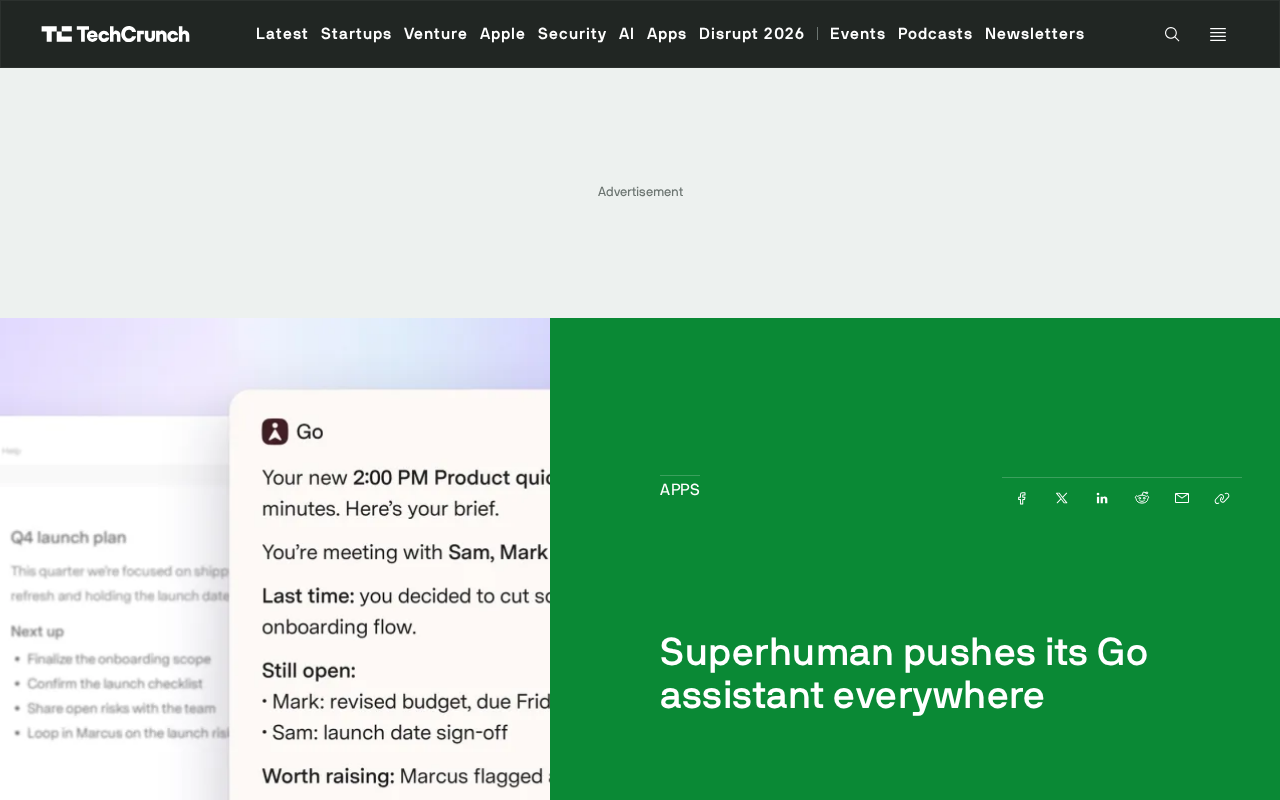
Superhuman upgrades Go into a core agent spanning Docs and Mail, betting on a unified Agent strategy.
Superhuman is upgrading its AI assistant Go from an auxiliary feature in a single email scenario into a core agent running across its product line, expanding it to two key entry points: Docs and Mail. This shift aims to broaden the Agent's contextual awareness and task execution radius, letting users invoke the same agent across different interfaces and reducing learning and switching costs. The unified Agent strategy reflects the industry trend of AI assistants moving from feature points to the platform layer, but it also brings new challenges such as cross-scenario data boundaries, permission management, and experience consistency. Its success will depend on how reliable Go actually is in cross-scenario collaboration.
Superhuman is upgrading Go from a single feature into a core agent that runs across its entire product line. According to the latest information, this assistant will no longer be confined to a specific scenario but will be rolled out to more entry points such as Docs and Mail, becoming a unified Agent that users can invoke anytime in their daily work.
From Assistant to Hub: The Repositioning of Go
Superhuman's positioning of Go has clearly changed. In the past, Go was more like an auxiliary feature attached to the email scenario; now it is explicitly regarded as a "central agent"—a hub agent that spans products and scenarios. This shift means Superhuman no longer treats AI as an embellishment to a feature, but instead tries to make Go the default entry point through which users interact with the entire product system.
Behind this repositioning is an adjustment in product logic. When an AI assistant is confined to a single interface, its value tends to be limited by the data and task boundaries of that scenario; only when it can reach multiple workflow nodes such as email and documents at the same time can it truly understand context and connect tasks. Superhuman's choice to push Go "everywhere" is essentially about expanding the Agent's perceptual range and execution radius.
Agent is a core concept in current AI products, referring to an AI system capable of perceiving its environment, planning autonomously, and executing multi-step tasks to achieve goals—distinct from a chatbot that only responds to single-turn input. An Agent typically has tool-calling, memory, and context-management capabilities, and can migrate between different interfaces while maintaining behavioral consistency. When Superhuman calls Go a "central agent," it emphasizes exactly this cross-product, cross-scenario autonomy and unity—users don't need to repeatedly describe the background, and the Agent can continue working based on the context it has already accumulated.
Docs and Mail: Two Key Deployment Scenarios
The most direct move in this expansion is to bring Go into Docs and Mail. Email is Superhuman's traditional strength, while documents are the core carrier of knowledge accumulation and collaboration. Deploying the same Agent in both scenarios at once means users can invoke information from documents while writing an email, and can reuse context from emails while organizing documents.
From a product design perspective, this cross-scenario integration is more valuable than simply adding features. It keeps Go's behavior consistent: no matter which interface the user is currently in, they are invoking the same agent rather than two disconnected sets of AI capabilities. For users, this lowers the cost of learning and switching; for Superhuman, it lays the foundation for subsequent capability iterations of the unified Agent.
Context in the AI Agent sense refers to the set of information—such as conversation history, user data, document content, and the operating environment—that a model can leverage when executing a task. The size and quality of the context window directly determine whether an Agent can accurately understand intent and connect tasks. The value of cross-scenario deployment lies in this: when an Agent can access both email and documents, it can piece together information scattered across different workflows into a complete context, thereby reducing repeated user input and improving the coherence and accuracy of task execution.
The Industry Implications of a Unified Agent Strategy
Superhuman's approach reflects a broader trend: AI assistants are moving from "feature points" to the "platform layer." As various products compete for users' work entry points, whoever can embed the Agent into more high-frequency scenarios has a better chance of building a context advantage. Go covering both Docs and Mail is precisely a manifestation of this thinking.
However, a unified Agent also brings new challenges. Cross-scenario operation means more complex data boundaries and permission management, and how the Agent ensures accuracy and security when invoking information across different products is a question Superhuman needs to answer. In addition, whether "everywhere"-style deployment can truly improve the experience also depends on whether Go's actual performance across scenarios is consistent enough.
Permission Management is a key engineering issue when deploying a unified Agent across products. When the same Agent needs to read different data sources such as emails and documents, the system must define the scope of data it can access and the types of operations it can perform, and ensure that invocation behavior complies with user authorization and regulatory requirements. Common practices include role-based access control, fine-grained data authorization, and operation audit logs. For Superhuman, how to prevent unauthorized access and data leakage while maintaining a smooth Agent experience is the technical prerequisite for whether the unified Agent strategy can be implemented.
Conclusion
Superhuman pushing Go into Docs and Mail is not just a feature expansion but a bet at the product architecture level: making the Agent the core running through the entire product, rather than an auxiliary tool tucked into a corner. Whether this path succeeds will depend on how reliable Go actually is in cross-scenario collaboration.
One-line Summary
Superhuman upgrades Go into a core agent spanning Docs and Mail, betting on a unified Agent strategy.
Paragraph Summary
Superhuman is upgrading its AI assistant Go from an auxiliary feature in a single email scenario into a core agent that runs across its product line, expanding it to two key entry points: Docs and Mail. This shift aims to broaden the Agent's contextual awareness and task execution radius, letting users invoke the same agent across different interfaces and reducing learning and switching costs. The unified Agent strategy reflects the industry trend of AI assistants moving from feature points to the platform layer, but it also brings new challenges such as cross-scenario data boundaries, permission management, and experience consistency. Its success will depend on how reliable Go actually is in cross-scenario collaboration.
Related articles

A 19-Year-Old's Rental Horror Story: Ceiling Collapse, Bug Infestation, and the Lessons It Taught Me
At 19, my first off-campus rental brought bug infestations, no heat, a collapsed ceiling, and a ruined laptop with no renter's insurance. Here are the hard-won lessons for first-time student renters.

Veda Nurse's Cranial Nerve Exam: Why ASMR Role-Play Is Going Viral
Bilibili creator Veda's cranial nerve exam ASMR video goes viral, blending humor and sensory triggers through nurse role-play. This article analyzes its unique appeal and the audience psychology behind ASMR role-play.

LG Cinebeam AI Review: 120-Inch Giant Screen + 3000 Lumens, a New Choice for the Living Room Theater
LG Cinebeam AI projector review: 3000 ANSI lumens, 4K, 100 inches from about 8 cm and 120 inches from about 18 cm. Built-in webOS, AI Concierge voice recommendations, AI Sound Pro 11.1.2 virtual surround, and Game Optimizer—positioned for fixed living room installation, complementing the portable Cinebeam S.