Supernova: Connecting Claude and Codex Directly to Your Business Data

Supernova connects your business data from 30+ sources directly into Claude and Codex for natural language analysis.
Supernova is an AI data connectivity layer that bridges real-time business data from 30+ sources — including Stripe, HubSpot, and PostgreSQL — with AI tools like Claude and Codex. By leveraging protocols like MCP, it enables founders, marketers, and operations teams to query revenue, customer, and operational data using natural language, bypassing traditional BI tools and engineering bottlenecks. While the opportunity to fill the last mile between AI and private business data is significant, challenges around data security, compliance, and analysis accuracy remain critical considerations.
When AI Assistants Meet Enterprise Data Silos
In an era where AI coding and conversational assistants are deeply embedded in workflows, there's an awkward reality: tools like Claude and Codex, despite their power, are often completely blind to a company's actual business data. You can ask them to write a complex SQL query, but you can't directly ask, "What was our paid conversion rate last month?" The data still sits quietly in Stripe, HubSpot, or PostgreSQL, waiting for engineers to query, export, and feed into analytics tools.
This phenomenon is known as "Data Silos" — data across different systems and departments within an organization remains isolated and unable to flow freely. Typical scenarios include: sales team customer data living in HubSpot, financial data in Stripe and QuickBooks, and product usage data in PostgreSQL or Mixpanel. Each dataset serves different business functions, but when cross-domain analysis is needed (such as correlating customer behavior data with payment conversion data), engineers must manually write ETL scripts or use data integration tools like Fivetran or Airbyte — a time-consuming and error-prone process. The disconnect between AI assistants' powerful reasoning capabilities and enterprise private data has become a critical bottleneck limiting productivity.
Supernova was built precisely to bridge this gap. It debuted on Product Hunt with 150 upvotes, ranking #2, with a clear and direct positioning — "All your data in Claude and Codex."
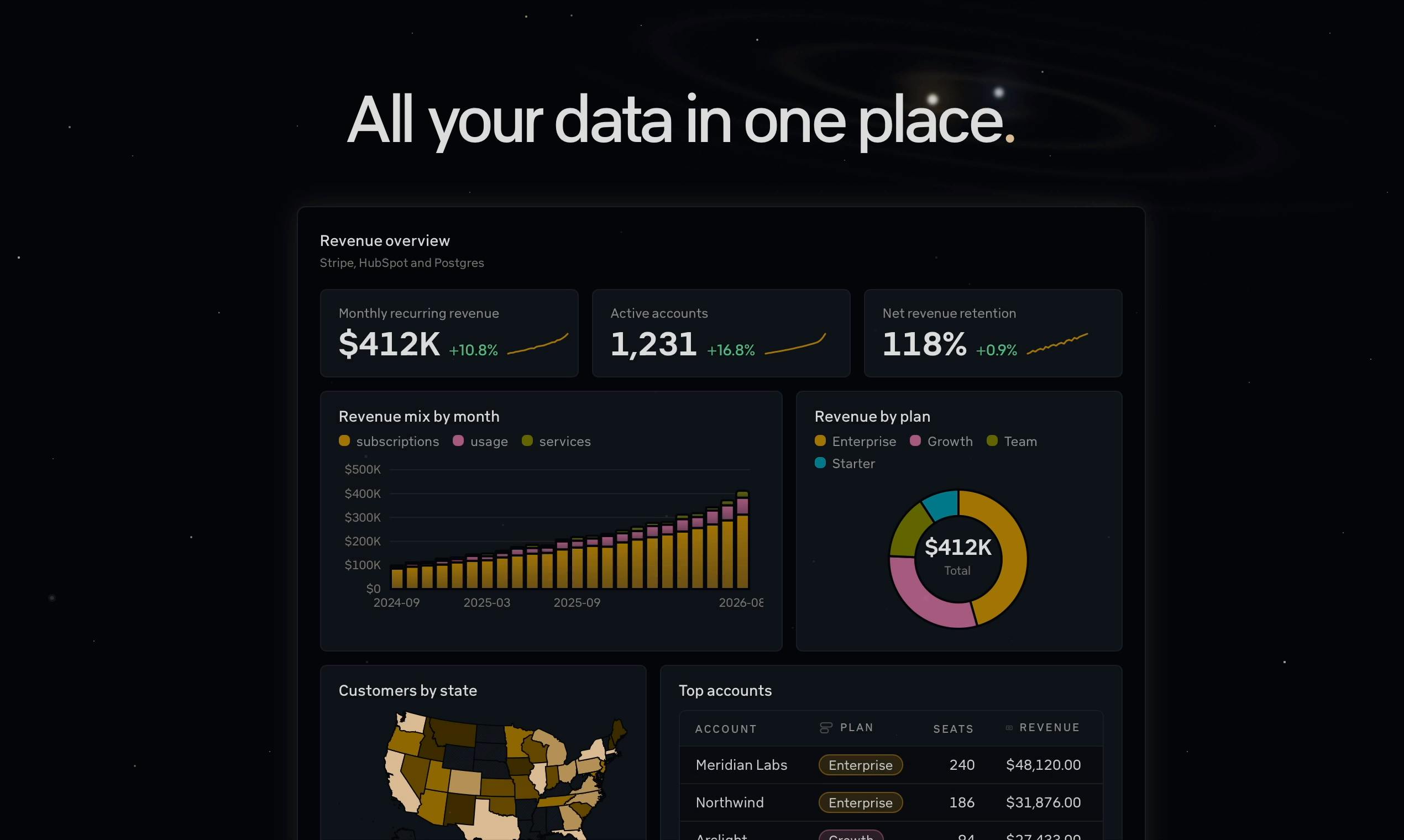
Supernova's Core Features and Positioning
In simple terms, Supernova is a bridge connecting real-time business data with AI tools. It pipes startup dynamic data sources into Claude and Codex, enabling anyone — whether a founder, operations lead, or marketer — to ask questions, troubleshoot performance, and run complex analyses directly within the AI tools they already know.
A brief introduction to the two core AI platforms Supernova builds upon is helpful here. Claude is a large language model series developed by Anthropic, renowned for its ultra-long context window (supporting up to 200K tokens) and excellent safety alignment, widely used in enterprise conversations, document analysis, and code assistance. Codex is OpenAI's AI agent designed for software engineering, capable of autonomously executing code, running tests, and submitting code changes in cloud sandbox environments — essentially an AI development assistant with code execution capabilities. Both support connecting to external data sources and tools via MCP (Model Context Protocol) or APIs, providing the critical technical foundation for connector products like Supernova.
Core Capabilities at a Glance
- Broad Data Source Connectivity: The team claims support for over 30 applications including Stripe, HubSpot, and PostgreSQL, covering the payment, CRM, and database systems commonly used by startups.
- Natural Language Data Analysis: Users can directly ask about revenue, sales pipeline, customer metrics, product usage, and operational data without writing query statements.
- Bypassing Traditional BI Workflows: No need to wait for engineering sprints or migrate all data into a heavyweight legacy BI stack.
In other words, Supernova aims to liberate "data accessibility" from the engineer's backlog and hand it back to the business people who actually need the insights.
Why AI Data Connectivity Layers Deserve Attention
The High Barrier of Traditional BI Tools
For a long time, enterprise data analysis has had an invisible moat: the people who understand the business don't know how to query, and the people who know how to query can't keep up with the demand. Traditional BI tools (like Tableau and Looker) are powerful but expensive to set up, have steep learning curves, and typically require dedicated data teams to maintain ETL pipelines. For early-stage startups, this entire system is both costly and cumbersome.
To understand the depth of this pain point, consider how traditional data analysis architecture works. ETL stands for Extract, Transform, and Load — the core process of traditional data analysis. Companies must first extract raw data from various business systems, clean it, convert formats, aggregate it, and then load it into a data warehouse (such as Snowflake, BigQuery, or Redshift) before BI tools can visualize and analyze it. This pipeline typically requires data engineers to build from scratch and maintain continuously. Going from kickoff to usable state often takes weeks or even months, with annual total costs (tool licenses + personnel + infrastructure) reaching tens of thousands to over a hundred thousand dollars. For an early-stage team of a dozen people, this isn't just a heavy financial burden — it's an enormous drain on precious engineering resources.
Supernova's approach is "lightweight integration + AI interface." It doesn't require companies to first build out an entire data warehouse. Instead, it connects SaaS data sources directly to AI assistants, enabling analysis to happen within a conversation. This "ask and get answers" experience is especially attractive to resource-constrained startup teams.
Leveraging the Claude and Codex Ecosystem Advantage
Interestingly, Supernova hasn't tried to build an entirely new analytics platform. Instead, it chose to "piggyback" on widely adopted AI tools like Claude and Codex. This is a smart strategy: rather than educating users on a new tool, let them gain new capabilities within their existing workflows.
From a technical architecture perspective, Supernova's implementation likely relies on MCP (Model Context Protocol), proposed by Anthropic. MCP is an open standard designed to provide AI models with a unified interface for connecting to external tools and data sources — think of it as the "USB-C port" of the AI world. Through MCP, AI assistants can call external APIs, query databases, or trigger workflows in real time during conversations, without users needing to manually export data and paste it into a chat window. This architecture transforms AI from a closed knowledge system into an intelligent agent capable of dynamically accessing real-time information. Supernova is essentially building a set of standardized connectors for business data sources on top of the MCP ecosystem.
As Anthropic's Claude and OpenAI's Codex continue to gain traction among developers and knowledge workers, and as protocols like MCP mature, the value of these "data connectivity layer" products will amplify accordingly — every new AI user is a potential customer for the data connectivity layer.
Opportunities and Challenges for Supernova
Opportunity: Bridging the Last Mile Between AI and Business Data
Most enterprise AI applications today are either general-purpose conversations or code generation. Products that can securely and reliably connect private business data to AI in real time remain scarce. Supernova is targeting exactly this "last mile." If it can deliver a stable connection experience across 30+ data sources, it has a real chance of becoming a default component in the startup data stack.
This opportunity window exists partly because current alternatives each have limitations: using APIs directly requires engineering effort, general-purpose integration tools (like Zapier and Make) focus on workflow automation rather than data analysis, and traditional BI tools' heavy-asset model doesn't suit early-stage teams. Supernova fills the underserved niche of "lightweight, conversational, real-time data analysis."
Challenge: Data Security and Analysis Accuracy
Connecting revenue and customer privacy data from Stripe and HubSpot to third-party AI services naturally raises security and compliance concerns. Companies need clarity on how data is transmitted, stored, and used.
Specifically, this involves multiple layers of compliance considerations. First is data transmission security, which requires end-to-end encryption (at least TLS 1.3) and zero-trust architecture to prevent data interception during transit. Second is data storage and usage policies — a core question being: will data be used by AI model providers for model training? Anthropic's Claude for Enterprise promises not to use customer data for model training, but this guarantee needs to be explicitly established at the contract level. Additionally, companies handling EU customer data must comply with GDPR (General Data Protection Regulation), ensuring a lawful basis for data processing and meeting cross-border transfer requirements; those handling payment card data must comply with PCI DSS standards. SOC 2 Type II audit certification is also an important reference for enterprise customers evaluating such third-party data tools, as it demonstrates the provider's sustained controls over security, availability, and data integrity.
Furthermore, whether AI-generated analysis results are accurate and reliable is a question these products must continuously validate — after all, an incorrect revenue figure could lead to flawed business decisions. Large language models still face "hallucination" risks in numerical reasoning, potentially producing errors in aggregate calculations, time-range filtering, or multi-table joins. How Supernova ensures analysis accuracy at the technical level (for example, through structured query generation rather than pure text-based reasoning) will be key to earning enterprise trust.
Conclusion: The Future of AI Data Connectivity Layers
Supernova represents an emerging product category: the AI data connectivity layer. It doesn't aim to replace traditional BI, but rather uses AI-powered conversations to lower the barrier to data analysis, freeing business teams from their dependence on engineers.
From a broader perspective, the rise of this category is an inevitable step as AI tools evolve from "general intelligence" to "domain intelligence." When AI models themselves are powerful enough, the bottleneck limiting their value shifts from "model capability" to "data accessibility." Whoever can build the smoothest and most secure channel between AI and enterprise private data will control the infrastructure of next-generation enterprise AI applications.
For startup teams looking for lightweight data insight solutions, these tools are worth exploring. But before handing over sensitive business data, thorough evaluation of security and accuracy remains essential. As the ecosystems around AI tools like Claude and Codex continue to mature, and open protocols like MCP gain broader adoption, we'll very likely see more "connector" products like Supernova emerge, collectively reshaping how enterprises access data insights.
Related articles

Chain of Thought Isn't Just for AI: How Humans Can Use CoT to Improve Thinking Quality
Chain of Thought isn't just a prompt trick for large models. Starting from a Hacker News discussion, this article analyzes why CoT works for human thinking too, breaks down actionable ways to transfer it, and highlights the key differences between human CoT and machine CoT.
Cloudflare Teams Up with OpenAI: Closi…
Cloudflare Teams Up with OpenAI: Closing the Loop from Vulnerability Discovery to Defense with AI
Cloudflare uses OpenAI Daybreak to investigate security vulnerabilities and generate reviewable remediation plans, while developers use Codex to boost coding efficiency and quality.

Orca Multi-Agent Orchestration in Practice: A Guide to Parallel Collaboration with Claude and Codex
Orca is Stable AI's free open-source agent workbench supporting 34 agents like Claude Code and Codex in parallel. Learn its Git worktree isolation, multi-model orchestration, and mobile management.