Surge in AI Data Centers Could Reverse Decades of Air Quality Progress

Texas AI data center power demand is surging; gas fill-ins could set air quality back 20 years.
Generative AI's compute race has made Texas a hub for hyperscale data centers, drawn by light regulation, cheap land, and the independent ERCOT grid. But 24/7 high-load demand is straining the grid, and the quickest fix—natural gas peaker plants—emits NOx, the very pollutant regulators have spent decades curbing. The report warns pollution could return to 2000s levels, erasing decades of gains, as ERCOT's isolated grid concentrates the pressure locally.
Title
Surge in AI Data Centers Could Reverse Decades of Air Quality Progress
Meta Description
Generative AI data centers are being built in concentrated clusters across Texas, and surging power demand could force the region to rely on natural gas generation, potentially pushing air pollution back to 2000s levels and risking the reversal of decades of cleanup gains.
Article Content
The generative AI compute race is fueling an infrastructure boom in Texas, but the resulting electricity demand could set local air quality back by two decades. According to TechCrunch, newly built and planned data centers are putting enormous strain on the grid, and how developers and utilities meet that demand—especially their reliance on natural gas—will determine the environmental cost of this AI boom.
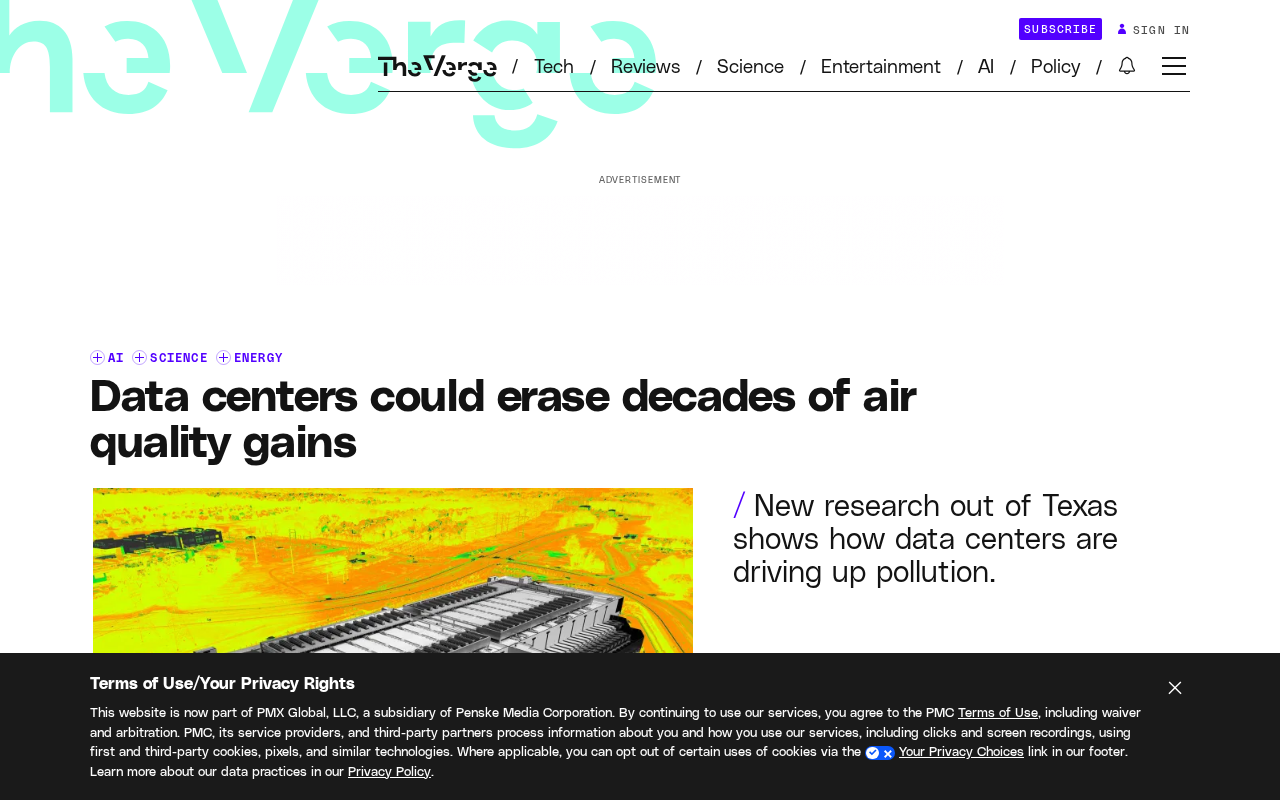
Why Texas Became the "Epicenter" of AI Infrastructure
With its light-touch regulatory environment, abundant cheap land, and independent grid system, Texas has attracted a large number of hyperscale data centers. It has become the core territory for the physical infrastructure behind generative AI. The report notes that the power demand from this new wave of data center construction is unprecedented, and where that power comes from is directly tied to the trajectory of regional air quality.
Data centers are typical 24/7 high-load electricity consumers, and their demand curves are very different from residential usage. When dozens of such facilities are built in concentrated clusters in the same area, the pressure to expand the grid escalates sharply in a short period.
ERCOT (Electric Reliability Council of Texas) is the independent grid operator covering about 90% of Texas's electricity load. Its "independence" stems from an isolated grid structure that Texas deliberately maintained to avoid federal interstate transmission regulation under the Federal Power Act—ERCOT has virtually no AC transmission connections to the Eastern and Western interconnections, only a few limited DC ties. This architecture has two consequences: first, Texas electricity prices and grid dispatch are not directly under FERC jurisdiction, giving it high policy flexibility and fast approvals; second, when regional supply and demand fall out of balance, it cannot buffer through interstate power transfers like other grids can—the winter outages of 2011 and 2021 are both related to this. For data centers, this means absorbing new load depends more on new local generation capacity than on external power imports.
The "Shortcut" of Natural Gas Generation and Its Pollution Cost
Faced with a rapidly growing power gap, the most direct solution is often building new natural gas plants. Compared with nuclear and large-scale renewable projects, natural gas peaker plants have shorter construction cycles and more flexible siting, making them naturally attractive to data center developers eager to come online.
The problem is that gas generation releases pollutants such as nitrogen oxides—exactly what U.S. air quality regulation has focused on controlling over the past decades. The report warns that if Texas relies heavily on natural gas to meet data center electricity demand, air pollution levels could rise back to 2000s levels, erasing decades of cleanup gains.
The core logic behind this judgment is not complicated: if incremental electricity demand is met by fossil fuels, incremental pollution emissions will follow. And air quality improvements are often the result of slow accumulation, while reversal may take only a few years.
Nitrogen oxides (NOx) are a byproduct formed when nitrogen and oxygen in the air react during high-temperature combustion in gas-fired generating units. It is not only a respiratory irritant itself, but also undergoes photochemical reactions with volatile organic compounds in sunlight to form ozone and fine particulate matter (PM2.5), making it one of the main precursors of summer "photochemical smog." Since the 1990 Clean Air Act Amendments, the United States has imposed continuously tightening controls on power plant NOx emissions through the Acid Rain Program, the NOx Budget Trading Program, and later the Cross-State Air Pollution Rule (CSAPR)—a major driver of air quality improvements in the eastern U.S. and Texas over the past two decades. Although gas peaker plants are cleaner than coal plants, their NOx emission intensity is still significantly higher than zero-emission sources such as wind, solar, and nuclear, and emissions per unit are often higher during frequent start-stop cycles.
The Dilemma of Grid Expansion
The Texas grid (ERCOT) is known for being independent of the national grid, which allows it to avoid interstate regulation but also means supply-demand balance pressures within the region are more concentrated. The new load from data centers tests not only generation capacity but also the carrying capacity of the transmission network.
Developers and utilities broadly face three paths: first, rapidly fill the gap with new gas plants; second, accelerate deployment of wind and solar, but subject to intermittency and storage requirements; third, ease peak pressure through demand-side management and efficiency improvements. Judging by the current pace of construction, the first path is the most tempting—and that is precisely the root of environmental concerns.
Demand-side management (DSM) refers to guiding users to cut electricity use during peak periods through price signals, incentive contracts, or direct load control, thereby reducing the need for new generation capacity. For data centers, the feasibility of this mechanism is debated: inference services typically require low latency and continuous availability, leaving limited room for interruptible load; but training tasks, batch jobs, and some non-real-time inference have some temporal flexibility. In recent years, "load flexibility" has become a new direction for data center-grid interaction—for example, migrating some computing tasks to other regions or deferring execution during grid stress. In addition, storage is key to addressing wind and solar intermittency—Texas is already one of the fastest-growing storage markets in the U.S., but storage duration is generally in the 2–4 hour range, still unable to fully cover "Dunkelflaute" periods caused by consecutive days of low wind or overcast skies.
A Warning for the AI Industry
This report reveals an often-overlooked dimension: the environmental cost of AI is reflected not only in the one-time energy consumption of model training, but also in the long-tail impact of the infrastructure supporting continuous inference services on the regional environment and public health. When the industry discusses compute scale, the structure of power sources deserves equal consideration.
For data center operators, the energy mix at siting, communication with local communities, and renewable procurement strategies may all become focal points for future regulation and public opinion. The Texas case may be just the beginning—as AI compute demand spreads to more regions, similar air quality controversies could repeat elsewhere.
One-line Summary
Texas AI data center power demand is surging; if natural gas fills the gap, air quality could regress by two decades.
Paragraph Summary
The generative AI compute race has made Texas a core landing spot for hyperscale data centers, with light regulation, cheap land, and the independent ERCOT grid attracting massive investment. However, the 24/7 high-load electricity demand of data centers is putting unprecedented pressure on the regional grid, and the most direct stopgap is natural gas plants with short construction cycles and flexible siting. The nitrogen oxides released by gas generation are exactly what U.S. air quality regulation has focused on controlling over the past decades. The report warns that heavy reliance on natural gas could push Texas air pollution back to 2000s levels, erasing decades of gains. ERCOT's isolated grid structure concentrates supply-demand balance pressure locally, and developers face three paths: new gas, accelerated renewables plus storage, and demand-side management—with the first path being the most tempting. The article also reminds us that AI's environmental cost lies not only in one-time training energy consumption but also in the long-tail impact of continuous inference services on regional air quality and public health.
Related articles

Amphibious Transforming Drone: Beyond 100x Power Savings, What Are the Real Needs?
Is the amphibious transforming drone just a gimmick? Starting from the 100x power difference of the M4 Morphobot, explore real application scenarios and thesis topic ideas, analyzing boundary conditions where pure drones and pure ground robots both fail.

Warhound Raises $200 Million: Genetically Engineered "War Dogs" Paired with Anduril Gear
Warhound raises $200M, backed by Ben Lamm and Palmer Luckey, to genetically engineer dogs for military and law enforcement use and equip them with Anduril gear. This article analyzes its technology direction, funding logic, and ethical controversy.

Claude API Comes to Google Cloud: IAM Integration and SDK Access Guide
Anthropic hosts the full Claude API on Google Cloud with IAM-controlled permissions and unified billing. This guide covers the Vertex AI and Anthropic-hosted entry points, IAM role configuration, and SDK access.