Survivorship Bias: The Overlooked Baseline Trap in LLM Research Idea Evaluation
Comparing LLM ideas to published papers instead of raw human ideas introduces survivorship bias into capability evaluations.
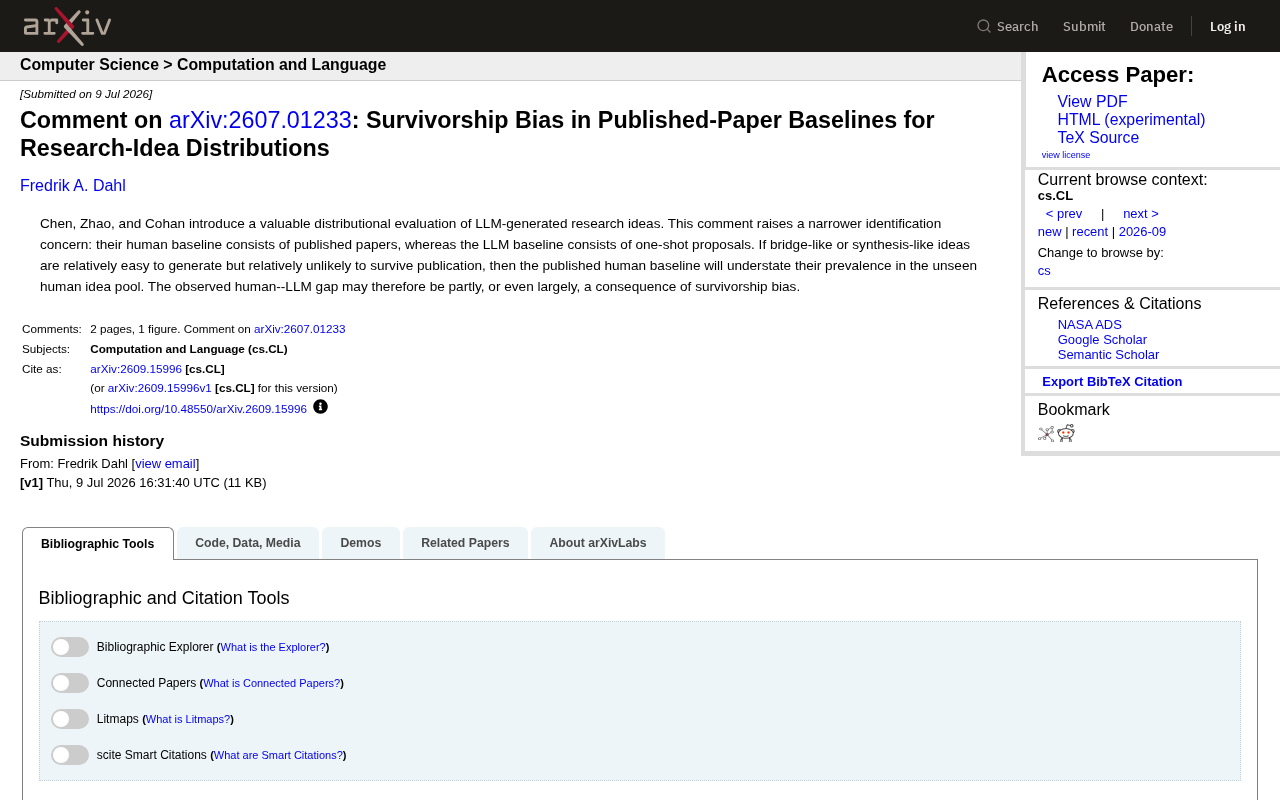
An arXiv commentary challenges the methodology of a distributional evaluation of LLM-generated research ideas, pointing out a fundamental baseline asymmetry: the human baseline consists of published papers that have survived rigorous peer review, while the LLM baseline is unfiltered one-shot output. The commentary argues that bridge-like and synthesis-style ideas are systematically underrepresented in published literature due to high publication barriers, causing the human baseline to underestimate true human creative diversity. The observed distributional gap between humans and LLMs may therefore reflect sampling inequality rather than genuine capability differences — a reminder that baseline comparability often matters more than evaluation metrics themselves.
A Hidden Flaw Behind a Seemingly Rigorous Evaluation
A recent commentary published on arXiv (arXiv:2609.15996) raises a pointed and specific challenge against a distributional evaluation by Chen, Zhao, and Cohan on "large language models generating research ideas." The original study attempts to measure, from a statistical distribution perspective, the differences between research ideas generated by LLMs and those produced by human researchers — a contribution the commentary authors acknowledge as "valuable." Yet the commentary identifies what may be a overlooked, systemic flaw in how the baselines were constructed: survivorship bias.
The critique does not reject the original study's methodological value. Rather, it zeros in on a narrower but critical "identification concern": when we place human research ideas and LLM-generated research ideas side by side for comparison, what exactly are we comparing? If the two sets of samples are drawn through fundamentally different selection mechanisms, how much of the observed difference reflects a genuine capability gap — and how much is simply an artifact of how the samples were collected?
An Uneven Baseline: Published Papers vs. One-Shot Proposals
The structure of the problem the commentary identifies is straightforward. In the original study, the human baseline consists of published papers, while the LLM baseline consists of the model's one-shot proposals. These two sources differ fundamentally in how they are generated and filtered.
Published papers survive a long and rigorous selection process: from an initial spark of an idea, through experimental validation, peer review, and multiple rounds of revision, only a small fraction of ideas ultimately "survive" and enter the pool of publicly available publications. LLM one-shot proposals, by contrast, have undergone none of this filtering — they are raw ideas produced directly by the model.
In other words, the human baseline consists of "survivors," while the LLM baseline represents "all entrants." Comparing the cream of the crop from a heavily filtered human process against unfiltered raw LLM output means the comparison starts from an unequal footing.
Survivorship Bias became widely known through World War II aircraft armor research: statistician Abraham Wald pointed out that analysts were studying only the bullet-hole patterns on planes that returned safely, ignoring the planes that were shot down and never came back — which actually contained the most critical information. This mode of thinking has been broadly applied in scientific research: when we can only observe "success cases," our judgments about the overall population become systematically skewed toward optimism or toward particular patterns. In academic publishing, this bias is especially insidious. Acceptance rates at top venues are consistently low (often below 20% at leading AI conferences), and large volumes of research sink into the "file drawer" unpublished, never entering any evaluation's purview. This means "published literature" is not a representative sample of what researchers actually produce — it is an elite subset that has passed through rigorous social filtering.
Why Bridge-Like Ideas Are Most Likely to "Disappear"
The commentary goes further, offering a concrete mechanistic hypothesis that makes the survivorship bias problem testable. The authors argue that certain types of ideas — specifically bridge-like or synthesis-like ideas — may be relatively easy to generate but relatively unlikely to survive the publication process.
This is not hard to understand in practice. Cross-domain bridge ideas or synthesis-oriented ideas often fail peer review because they are difficult to validate conclusively within a single paper, don't fit cleanly into a specific subfield's reviewer preferences, or are dismissed as lacking sufficient novelty. They are easy to conceive but hard to publish.
If this hypothesis holds, the consequences are direct: the published human baseline will systematically underrepresent this type of idea relative to its actual prevalence in the true (but unobservable) pool of human creative output. Researchers may generate many bridge-like ideas in their minds, but most never become papers — and therefore never enter any evaluation's field of view.
"Bridge-like ideas" refer to ideas that connect two or more previously independent research fields, linking their methods or concepts — for example, applying computer vision techniques to genomics, or reinterpreting immune system dynamics through game-theoretic frameworks from economics. The barrier to generating such ideas is relatively low: researchers or language models with basic familiarity across multiple fields can readily produce "could method A from field X work in field Y?" style connections. However, these ideas face unique obstacles at the publication stage: they are difficult to slot into a specific subfield's journal or conference, reviewers who specialize in a single domain tend to be conservative about the novelty of cross-disciplinary contributions, and a single paper rarely has room to provide sufficiently deep validation in two separate fields simultaneously. This asymmetry — easy to generate, hard to publish — is precisely how survivorship bias manifests at the level of idea types.
The Human–LLM Gap May Be a Sampling Artifact
Putting this logic together, the commentary arrives at a thought-provoking conclusion: the differences between humans and LLMs observed in the original study may be partly — or substantially — a product of survivorship bias, rather than a true reflection of the two parties' creative generation capabilities.
If LLMs produce an "excess" of bridge-like and synthesis-like ideas, while the human baseline systematically filters out precisely those types of ideas, then the gap between the two distributions becomes artificially inflated. Researchers might conclude that LLM idea distributions are "anomalous" or "different from humans" — when the truth may simply be that humans are equally capable of producing these ideas, but those ideas never made it through the publication filter.
This is a reminder that in evaluating generative AI's creativity, the choice of baseline and the comparability of samples on both sides often determine conclusions more than the evaluation metrics themselves. A cleverly designed distributional evaluation, if built on an uneven baseline, will have significantly limited interpretive validity.
Methodological Implications for AI Capability Evaluation
This academic exchange around an arXiv paper, though focused on a specific technical detail, touches on a pervasive challenge in the broader field of AI evaluation. As LLMs are increasingly applied to higher-order cognitive tasks such as generating research ideas and proposing hypotheses, fairly measuring how they compare to humans becomes a critical methodological challenge.
The commentary offers at least several layers of insight: first, samples from both sides of a comparison must have undergone comparable filtering processes — otherwise survivorship bias quietly distorts the conclusions; second, for a "hidden" population like the true pool of human creative ideas, researchers must be especially wary of using only the visible slice of "published work" to represent the whole; third, any study claiming to have found a "human–AI gap" should carefully decompose the possible sources of that gap (capability difference vs. sampling difference).
It is worth acknowledging that this kind of academic dialogue, conducted in the form of a commentary, is precisely how science's self-correcting mechanism works. It does not overturn the original study, but through a precise identification concern, it pushes the entire field to hold evaluation design to a higher standard of rigor. For practitioners focused on assessing AI research capabilities, this "survivorship bias" perspective is worth incorporating into future experimental design.
The "Identification Problem" is a core concept in econometrics and causal inference. It asks whether a research design can cleanly separate the target effect (here: the true capability gap between humans and LLMs) from other confounding factors (here: differences in sampling mechanisms). When identification problems are not properly addressed, even statistically significant results with large sample sizes may not support causal interpretation. In AI evaluation, this issue is particularly acute because researchers are often forced to use "observable human outputs" (such as published papers, competition answers, or annotated data) as proxies for human capability — and these proxies inherently carry the imprints of various social and institutional selection processes. More rigorous future evaluation designs may need to draw on the logic of randomized controlled trials — for example, directly collecting researchers' raw idea records before any publication decisions are made, in order to construct a human baseline that is genuinely comparable to LLM output.
Related articles

Letting AI Build AI Tools: A 7-Day, 31-Commit Bootstrapping Post-Mortem
An engineer ran a fully autonomous AI-builds-AI pipeline for 7 days, 31 commits, with a 1-in-6 success rate. This post-mortem covers 5 failure types, 11 structural rules, and how every mistake became a permanent immunity gate.

Building an AI-Powered E-Commerce Business from Scratch: A Real-World Account of Multi-Agent Architecture for Print-on-Demand
A blogger builds a print-on-demand e-commerce company from scratch using AI agents — documenting specialized Agent profiles, GPT-5.6 vs Claude Fable multi-model orchestration, and reusable skill accumulation.

AI Agent Earns $10K in One Week: 3 Key Upgrades Explained
A blogger shares how he earned $10K in a week with an AI Agent — not by adding more skills, but through verification, approval gates, and subagents to raise trust and enable true automation.