SVD (Singular Value Decomposition) for Beginners: From Theory to Practical Applications in Image Compression and Recommendation Systems

A beginner's guide to SVD covering math principles and real-world applications in ML.
This article provides a beginner-friendly introduction to Singular Value Decomposition (SVD), inspired by a software engineer's journey into ML mathematics. It explains SVD's mathematical principles, geometric interpretation, and the Eckart-Young-Mirsky optimality theorem, then explores practical applications in image compression, noise removal, recommendation systems, and NLP's Latent Semantic Analysis.
From Software Engineer to Machine Learning Explorer
A software engineer with 8 years of experience shared his machine learning journey on Reddit—a story that likely resonates with many technical professionals. He admitted that he had long been curious about how AI actually works: "How does AI actually do those things?" To truly understand the underlying principles, rather than jumping straight into existing frameworks and APIs, he chose to "take a step back" and tackle the mathematics behind machine learning from scratch.
He spent months systematically studying linear algebra, calculus, probability theory, and various mathematical and theoretical foundations. In his own words: "The deeper I dig, the more I see its beauty. How small concepts combine into larger concepts, and how they apply to the real world." This bottom-up approach to learning through foundational mathematics, while challenging, often leads to much deeper understanding.
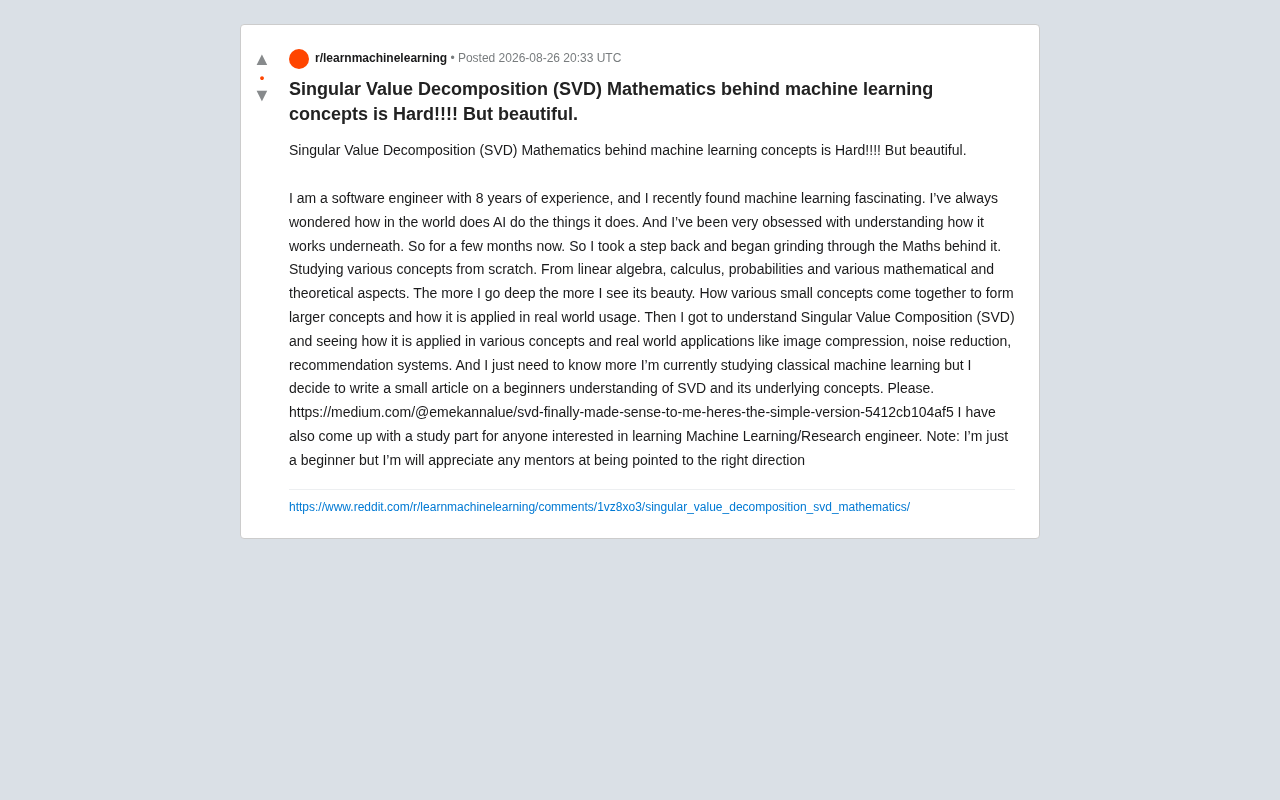
Among the many mathematical tools he encountered, Singular Value Decomposition (SVD) sparked an intense desire to explore further. He wrote a beginner-friendly introductory article attempting to explain this concept that is both "difficult" and "beautiful" in simple terms.
Definition and Mathematical Principles of SVD
Singular Value Decomposition is one of the most important matrix factorization methods in linear algebra. Matrix decomposition, as a mathematical tool, has a core idea of breaking down complex matrices into combinations of simpler-structured matrices—similar to factoring integers into products of prime numbers—thereby revealing the intrinsic properties of matrices. The core idea of SVD is: any matrix, regardless of its shape, can be decomposed into the product of three special matrices.
Expressed mathematically, for any m×n matrix A, SVD decomposes it as:
A = U · Σ · Vᵀ
Where:
- U is an m×m orthogonal matrix whose column vectors are called "left singular vectors"
- Σ is an m×n diagonal matrix with values on the diagonal called "singular values," arranged in descending order
- Vᵀ is the transpose of an n×n orthogonal matrix, whose row vectors are called "right singular vectors"
It's worth understanding what orthogonal matrices mean at a deeper level: orthogonal matrices are a special class of square matrices whose column vectors are mutually orthogonal with unit length, satisfying the condition UᵀU = I (identity matrix). Geometrically, orthogonal matrices represent rotation or reflection operations—they change a vector's direction without changing its length. This property gives SVD decomposition an elegant geometric interpretation: any linear transformation can be understood as a three-step operation: first rotate (Vᵀ), then scale along coordinate axes (Σ), and finally rotate again (U). This means no matter how complex the original transformation is, SVD can decompose it into a combination of these three intuitive steps.
Why SVD Is So Important in Machine Learning
The beauty of SVD lies in its ability to reveal the intrinsic structure of matrices. The magnitude of singular values intuitively reflects how much "information" exists in each direction—the largest singular values correspond to the most important, dominant directions of variation in the data, while smaller singular values typically correspond to noise or secondary information.
This property makes SVD a natural tool for dimensionality reduction, denoising, and compression. When we retain the largest few singular values and discard the smaller ones, we can approximately reconstruct the original matrix with much less data—this is the theoretical foundation for many practical applications. The effectiveness of truncated SVD has rigorous mathematical guarantees: the Eckart-Young-Mirsky theorem proves that among all matrices of rank k, the truncated approximation formed by the first k singular values from SVD is the best approximation of the original matrix in the Frobenius norm sense. In other words, if you can only use k "components" to approximate a matrix, no other method can do better than truncated SVD. This optimality guarantee is the fundamental mathematical reason why SVD is so popular in practical applications.
Real-World Applications of SVD
As this engineer observed, SVD is not abstract mathematics confined to paper—it is widely applied across multiple practical scenarios.
Image Compression: Preserving Key Information with Less Data
A grayscale image is essentially a numerical matrix. By performing SVD on the image matrix and retaining only the first k largest singular values, we can reconstruct an image that is visually nearly indistinguishable from the original using far less data than the original. The larger the singular values retained, the richer the image details preserved; this also explains why just a few principal components can carry most of the "recognizable information" in an image.
Take a 1000×1000 grayscale image as an example: it originally requires storing 1 million pixel values. Retaining the first 50 singular values requires storing only about 100,000 values (50×1000 + 50 + 50×1000), yet can often reconstruct an image with extremely high visual quality—achieving a 10:1 compression ratio with almost no perceptible loss in image quality. The Eckart-Young-Mirsky theorem guarantees the mathematical optimality of this truncation strategy: no other approximation of the same rank can do better.
Noise Removal: Separating Signal from Interference
In signal processing and data analysis, noise typically manifests as smaller singular values. By truncating these small singular values, SVD can effectively separate signal from noise, achieving data denoising.
This principle has a deep connection to Principal Component Analysis (PCA). From a mathematical perspective, PCA is actually equivalent to performing eigenvalue decomposition on the data covariance matrix, which has a direct correspondence with performing SVD on the data matrix itself. Specifically, if we perform SVD on a centered data matrix X to get X = UΣVᵀ, then the right singular vectors V are the principal component directions of PCA, and the squares of the singular values divided by the number of samples give the variance corresponding to each principal component. This means SVD provides a numerically more stable and computationally more efficient way to implement PCA, avoiding the potential numerical precision loss from explicitly computing the covariance matrix. In practice, the vast majority of PCA implementations (including the one in scikit-learn) use SVD under the hood.
Recommendation Systems: Predicting User Preferences
SVD plays a central role in collaborative filtering recommendation systems. The classic Netflix Prize competition made extensive use of matrix factorization methods. In 2006, Netflix launched this famous competition, offering a $1 million prize to any team that could improve their recommendation system's accuracy by 10%. The competition lasted nearly three years, attracted thousands of teams worldwide, and was ultimately won by the BellKor's Pragmatic Chaos team in 2009.
The far-reaching impact of this competition was that it proved the power of matrix factorization methods (especially SVD and its variants like SVD++, temporal SVD, etc.) on large-scale sparse data. User-item rating matrices are typically large and sparse. Through SVD, users and items can be mapped into a low-dimensional "latent factor" space, enabling prediction of user preferences for unrated items. These latent factors might correspond to abstract dimensions such as "action movie preference," "art film inclination," or "pacing preference"—they are not manually defined labels but hidden patterns automatically discovered by the algorithm from massive rating data.
Natural Language Processing: Latent Semantic Analysis
SVD also has a classic application in natural language processing—Latent Semantic Analysis (LSA), a technique born in 1988. Its core approach is to construct a "term-document" matrix where each element represents the frequency of a particular word in a particular document (usually weighted by TF-IDF). Performing SVD on this high-dimensional sparse matrix and retaining the first k singular values maps both words and documents simultaneously into a k-dimensional semantic space.
In this low-dimensional space, semantically similar words end up close to each other even if they never co-occur—for example, "automobile" and "car" would be mapped to nearby positions. LSA can be viewed as a conceptual predecessor to modern word embedding techniques (such as Word2Vec and GloVe), as they all attempt to capture semantic relationships using low-dimensional dense vectors. Understanding how LSA works also helps explain why modern large language models can "understand" semantic associations between words.
The Value of Understanding AI Through Mathematical Foundations
This engineer's learning approach actually reflects a question worth pondering: In an era where large models and ready-made tools are readily available, is it still necessary to learn from mathematical foundations?
The answer is yes. While calling APIs can quickly build products, truly understanding model behavior, diagnosing problems, and achieving innovation requires a solid mathematical foundation. SVD is just one example—behind it lies a connected chain of core machine learning techniques including PCA, Latent Semantic Analysis (LSA), matrix completion, and more. Understanding SVD opens the door to all these advanced concepts.
Furthermore, SVD's core idea—decomposing complex structures into superpositions of simple components—permeates every aspect of modern machine learning. From Low-Rank Adaptation (LoRA, a technique for efficiently fine-tuning large models) in deep learning to low-rank approximations in attention mechanisms, the spirit of SVD is everywhere. Mastering this core tool not only helps understand current technology but also builds a solid foundation for understanding new methods that may emerge in the future.
Advice for Machine Learning Beginners
From this engineer's sharing, we can distill several valuable pieces of advice for machine learning learners:
- Don't rush: "Taking a step back" to build solid mathematical foundations often gets you further than jumping straight into coding. Linear algebra, calculus, and probability theory are the three mathematical pillars of machine learning, with linear algebra being particularly central.
- Understand the connections between concepts: As he said, "how small concepts combine into larger concepts"—the knowledge system of machine learning is highly interconnected. SVD connects eigenvalue decomposition, PCA, LSA, matrix completion, low-rank approximation, and a series of other concepts, forming a tightly-knit knowledge network.
- Combine theory with application: When learning SVD, connecting it with practical cases like image compression and recommendation systems greatly deepens understanding. Implementing a simple image SVD compression in Python is often more effective than reading a textbook ten times.
- Stay humble and open: He admitted he's "just a beginner" and actively sought mentorship—this mindset is especially valuable in the rapidly evolving field of AI.
Conclusion
Mathematics is indeed "difficult," but as this engineer reflected, it is also "beautiful." Singular Value Decomposition is the perfect embodiment of this "difficult yet beautiful" nature: a concise decomposition formula that contains profound insights into data structure and supports numerous real-world applications from image processing to recommendation systems. For anyone who wants to truly understand AI rather than merely use it, the journey into these mathematical foundations, while arduous, will ultimately reward you with moments of clarity, understanding, and joy.
Related articles

AI-Powered SRC Vulnerability Hunting: A Hands-On Guide to Building the Hermes Agent Workbench
Based on a hands-on Bilibili video: how to build an AI-powered SRC vulnerability hunting workbench—three-step method, four report elements, Agent mode vs web chat, and tool selection.

CLI-Anything Complete Beginner's Guide: How AI Operates Software — Principles and Practice
A complete beginner's guide to CLI-Anything: how AI Agents operate professional software via the command line, covering the three-layer architecture, CLI Hub installation, DrawIO practice, generator principles, and limits.

Carbon-X: A 14.8B Open-Source Model That Handles DNA and Text Simultaneously
Carbon-X is a 14.8B open-source multimodal model on Hugging Face where DNA and text share a token stream. 6-mer tokenization, 302B token mid-training, deployable on a single 80GB GPU, 66.7% average on five DNA benchmarks, Apache 2.0 license.