SwarmRSI: How a Swarm of Research Agents Achieves Recursive Self-Improvement

SwarmRSI enables a swarm of research agents to achieve recursive self-evolution through a shared graph, setting new SOTA on multiple benchmarks and producing real programs adopted by biologists.
SwarmRSI is a swarm collaboration framework for research agents that aims to solve two major flaws of single-agent systems through recursive self-improvement: difficulty in attributing failed experiments and waste of intermediate results. Its core is a shared graph structure that records all agents' hypotheses, programs, experimental evidence, and unresolved needs, around which three modules are designed: feedback-guided swarm mutation, complementary swarm recombination, and recursive swarm evolution. It comprehensively sets new SOTA across 118 tasks on three benchmarks—OpenProblems, NatureBench, and MLEBench Lite—and cross-task transfer experiments show that inherited research states can raise the average base value on new tasks from 12.01 to 21.89. Two generated programs have been used by biologists for intestinal and splenic immunity research, revealing new clues such as the lack of consistent changes in markers like B220 across microenvironments.
SwarmRSI: How a Swarm of Research Agents Achieves Recursive Self-Improvement
While single AI research agents are still struggling with the question of "did the experiment fail because the hypothesis was wrong or because the code was wrong," a research team has set its sights on a grander proposition: letting a group of research agents share experimental memory, borrow useful components from each other's failed programs, and even transfer accumulated research states to entirely new tasks. This is the core idea behind the SwarmRSI framework—achieving Recursive Self-Improvement (RSI) through collective collaboration.
According to an interpretation by the Bilibili AI Frontier Podcast, this paper comprehensively sets new SOTA across 118 tasks on three benchmarks—OpenProblems, NatureBench, and MLEBench Lite. More importantly, the programs it generates have already been used by biologists for real research on intestinal and splenic immunity. This means the output of AI research agents is no longer limited to climbing leaderboards but is beginning to produce genuine scientific value.
Two Structural Flaws of Single-Agent Research Systems
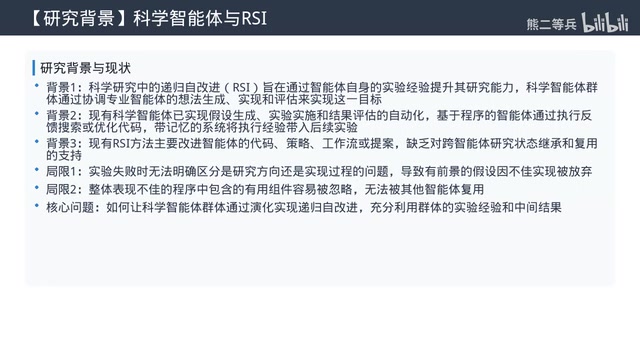
The paper precisely identifies two core pain points of current research agents. First, the attribution dilemma of failed experiments: when an experiment does not produce good results, researchers cannot determine whether the problem lies in an unreasonable hypothesis itself or in a flawed code implementation. Many promising hypotheses may be permanently abandoned because of one poor implementation. Second, the waste of intermediate results: programs that perform poorly overall often contain components that excel at a particular subtask, but because the overall score is low, these components are simply discarded and cannot be reused by other agents.
The root of these two pain points is that most existing single-agent systems advance in a single thread—if one direction doesn't work, they move to the next, without retaining intermediate results for other paths to reference. The authors of SwarmRSI argue that these two problems essentially stem from two interdependent relationships in the research process: the value of a hypothesis depends heavily on its implementation and the rigor of testing; the value of an intermediate result depends on whether it can be combined with subsequent findings or implementations.
Shared Graph: Turning Every Experiment into Inheritable Research Assets
The core of SwarmRSI is a shared graph structure that records all inheritable research states—each agent's hypotheses, programs, experimental evidence, and unresolved needs. The research state at each step is assembled from the shared graph, and all agents jointly maintain this ever-growing research knowledge base.
Around the shared graph, the framework designs three core modules:
Feedback-Guided Swarm Mutation
Agents modify hypotheses or programs based on swarm experimental feedback. Modifications fall into two modes: H-mutation (modifying the hypothesis) and P-mutation (not changing the hypothesis, only fixing the implementation). This design directly addresses the first pain point—by distinguishing the two mutation modes and referencing other agents' feedback to determine the direction of modification, the system can make wiser decisions upon failure. According to the podcast's interpretation, on NatureBench tasks, removing H-mutation reduces the proportion of tasks matching SOTA by 10 percentage points, while removing P-mutation reduces it by 13.3 percentage points, indicating that the two modes are complementary and that program repair contributes more.
Complementary Swarm Recombination
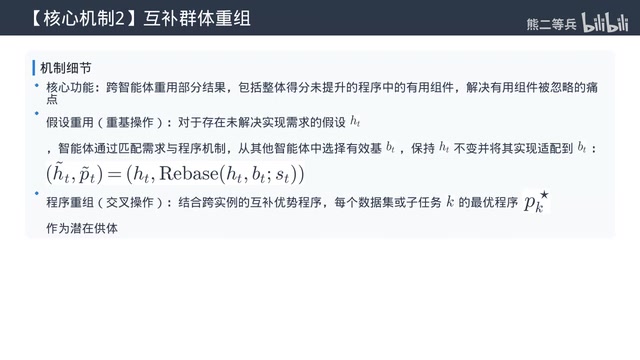
Addressing the second pain point, the recombination module provides two operations: hypothesis reuse (adapting a base program from another agent's program that matches an unresolved need onto the current hypothesis) and program recombination (cross-combining advantageous components of different programs on complementary subtasks). A program that performs poorly overall will not have its components discarded as long as it excels at some subtask. Ablation experiments show that disabling recombination operations drops the proportion of tasks exceeding SOTA from 15.6% to 7.8%, nearly halving it.
Recursive Swarm Evolution
This module decides whether the next step is to modify the hypothesis or the program, using a Discounted UCB metric to score two frontier sets while comprehensively considering token cost, number of experiments, and pressure from unresolved needs. Every attempt, successful or not, updates the shared graph, and the next agent continues from the updated state—this is precisely the embodiment of "recursion": every experiment optimizes the starting point of subsequent agents.
Discounted UCB is a classic variant of the multi-armed bandit algorithm used to balance exploration and exploitation. Standard UCB selects actions by computing an "average reward + confidence upper bound" for each option, whereas Discounted UCB applies exponentially decaying weights to historical rewards, making recent observations more important than earlier ones. In SwarmRSI, Discounted UCB is used to score the two frontier sets—"modify hypothesis" and "modify program"—taking into account token cost, number of experiments, and pressure from unresolved needs. The significance of the discount mechanism is that as the shared graph grows, statistical information from early experiments may become outdated, and recent feedback better reflects the quality of the current hypothesis or program; thus the system should trust new data more. This design gives swarm evolution decisions dynamic adaptability and prevents them from being dragged down by stale experience.
Multi-Benchmark SOTA and the Surprise of Cross-Task Transfer
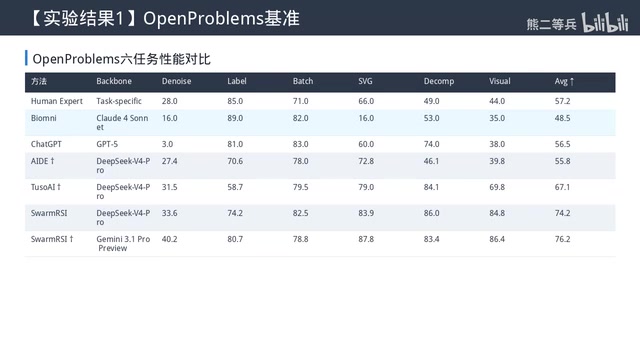
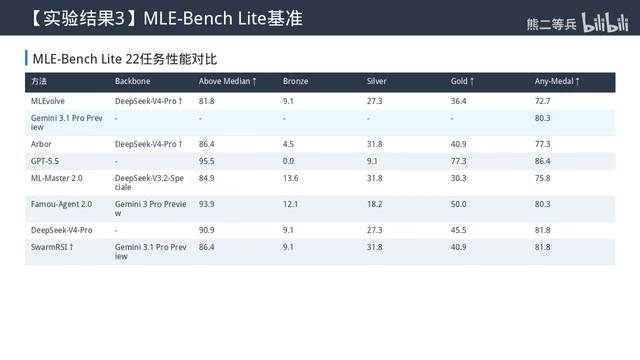
According to the podcast, SwarmRSI leads on all three benchmarks. With DeepSeekAd V4 Pro as the backbone, OpenProblems averages a score of 74.2, surpassing the previous SOTA of 67.1; on NatureBench the proportion of tasks matching SOTA is 21.1 percentage points higher than Claude Code with the same backbone; and the medal rate on MLEBench Lite reaches 81.8%. Switching to Gemini 3.1 Pro Preview further raises the OpenProblems score to 76.2, showing that performance does not depend on a specific model.
Even more noteworthy is the search trajectory analysis: subsequent optimization converts 35% of failed implementations into new best valid programs, whereas the comparison methods AEDA and ARBOR achieve only 12% and 5%, respectively. Among the 90 NatureBench tasks, 77% of the final best programs come from at least one recombination, crossover, or feedback-triggered update.
What truly demonstrates the potential of "recursion" is the cross-task transfer experiment: research states inherited from three source tasks raise the average base value on 12 held-out NatureBench tasks from 12.01 under cold start to 21.89, and the proportion of tasks matching SOTA jumps from 41.7% to 86.1%. This means the research experience accumulated by the swarm is transferable—the more tasks solved, the higher the starting point for subsequent new tasks.
Cross-task transfer in this context refers to injecting the shared graph state accumulated on a set of source tasks (including hypotheses, program components, experimental evidence, etc.) as a prior into the research starting point of an entirely new target task. Unlike traditional transfer learning, what is transferred here is not model weights but structured research intermediates: which implementation approaches are effective, which subtask components are reusable, and which unresolved needs deserve attention. In the experiments, the research states inherited from three source tasks raised the cold-start base value on 12 held-out tasks from 12.01 to 21.89, and the proportion of tasks matching SOTA rose from 41.7% to 86.1%. This verifies the transferability of research experience—the more tasks solved, the richer the shared graph, and the higher the starting point for subsequent new tasks, forming a positive cycle.
Biologists Are Already Using It
According to the podcast and the paper's case studies, two programs generated by SwarmRSI have been actually adopted by biologists. In a study of immune expression related to intestinal cell infection, the generated program subtracts the mean of each infected cell's healthy neighbors before dimensionality reduction; the processed representation's MHC-II score on day 10 of worm infection is significantly better than that of Salmonella infection, with Spearman correlation coefficients of 0.77 and 0.69 after covariate adjustment, higher than RNA PCA's 0.65 and 0.40. In spleen spatial transcriptomics analysis, the program combines phenotype-derived anatomical priors with an anatomy-constrained Markov random field, raising the metric from 0.045 to 0.102.
An unexpected finding: in the manually annotated marginal zone, 20%-21% of B cells reside in a myeloid-erythroid-rich microenvironment; after matching location and phenotype, the previously reported changes in B220 and CD79B levels did not show a consistent trend across the three images, and the B220 effect even changed sign. Such clues, which human researchers might overlook, precisely reflect the unique value of AI research agents.
Spearman correlation coefficient is a non-parametric rank correlation coefficient used to measure the strength of the monotonic relationship between two variables, ranging from -1 to 1, with values closer to ±1 indicating a stronger monotonic relationship. Unlike the Pearson correlation coefficient, it does not require variables to follow a normal distribution or have a linear relationship, making it suitable for biomedical data that are often non-normal, contain outliers, or involve ordinal variables. In this paper's intestinal immune expression study, the Spearman correlation coefficients between the MHC-II score of the representation processed by SwarmRSI-generated programs and variables such as days of infection reached 0.77 and 0.69, higher than the RNA PCA baseline's 0.65 and 0.40. This metric was chosen to evaluate representation quality because it focuses on rank consistency rather than absolute values, better matching the needs of downstream biological analyses for the relative order of samples.
Limitations and Outlook
The paper's failure analysis annotates 644 failed attempts, of which 93.3% are "faithfully implemented modifications that brought no improvement" and only 6.7% are implementation or execution issues. This indicates that most failures stem from modifications whose ideas themselves lack value, and future work needs more precise mechanisms for predicting the value of modifications. In addition, the current framework still relies on a relatively high token budget and is mainly applicable to coding-type research tasks with clear evaluation metrics; cross-domain knowledge reuse and division of labor among heterogeneous backbones are also directions worth exploring.
From a broader perspective, the "swarm collaboration + knowledge accumulation" model demonstrated by SwarmRSI offers lessons for fields such as software engineering, drug discovery, and materials design, which require extensive trial and error and whose intermediate results have reuse value. Recursive self-improvement has expanded from optimizing the capabilities of a single agent to the evolution of swarm research states—this may be an important step toward AI-assisted research becoming a mainstream paradigm.
One-line Summary
SwarmRSI enables a swarm of research agents to achieve recursive self-evolution through a shared graph structure, setting new SOTA on multiple benchmarks and producing real programs adopted by biologists.
Paragraph Summary
SwarmRSI is a swarm collaboration framework for research agents that aims to solve two major flaws of single-agent systems through recursive self-improvement: difficulty in attributing failed experiments and waste of intermediate results. Its core is a shared graph structure that records all agents' hypotheses, programs, experimental evidence, and unresolved needs, around which three modules are designed: feedback-guided swarm mutation, complementary swarm recombination, and recursive swarm evolution. It comprehensively sets new SOTA across 118 tasks on three benchmarks—OpenProblems, NatureBench, and MLEBench Lite—and cross-task transfer experiments show that inherited research states can raise the average base value on new tasks from 12.01 to 21.89. Two generated programs have been used by biologists for intestinal and splenic immunity research, revealing new clues such as the lack of consistent changes in markers like B220 across microenvironments.
Related articles

WorkBuddy Full Tutorial: Build an AI Office Automation Agent from Scratch
A complete WorkBuddy tutorial: installation, three working modes, multimodal picture book video practice, expert team agent building, and workflow configuration for low-cost AI office automation.

WorkBuddy Agent Complete Guide: From Beginner to Automation in 7 Days
Based on Bilibili's 256-episode WorkBuddy masterclass, this systematically breaks down Tencent's AI office workbench core capabilities: Agent principles, Skill encapsulation, cross-platform connectors, scheduled automation, knowledge bases, and zero-code development, with learning path recommendations.

8 AI Accounts, 7 Failed: An Honest Review of Using AI to Get Work Done
Only 1 of 8 AI-run Bilibili accounts succeeded. We break down the real difference between "performing AI" and "using AI to get work done."