Swift1.5-Qwen3.8-Flash-Next Benchmarked: 60% Faster Inference, Near-Zero Quality Loss

Swift-1.5-Qwen3.8-Flash cuts tokens and latency to 40% via RL with virtually no quality loss.
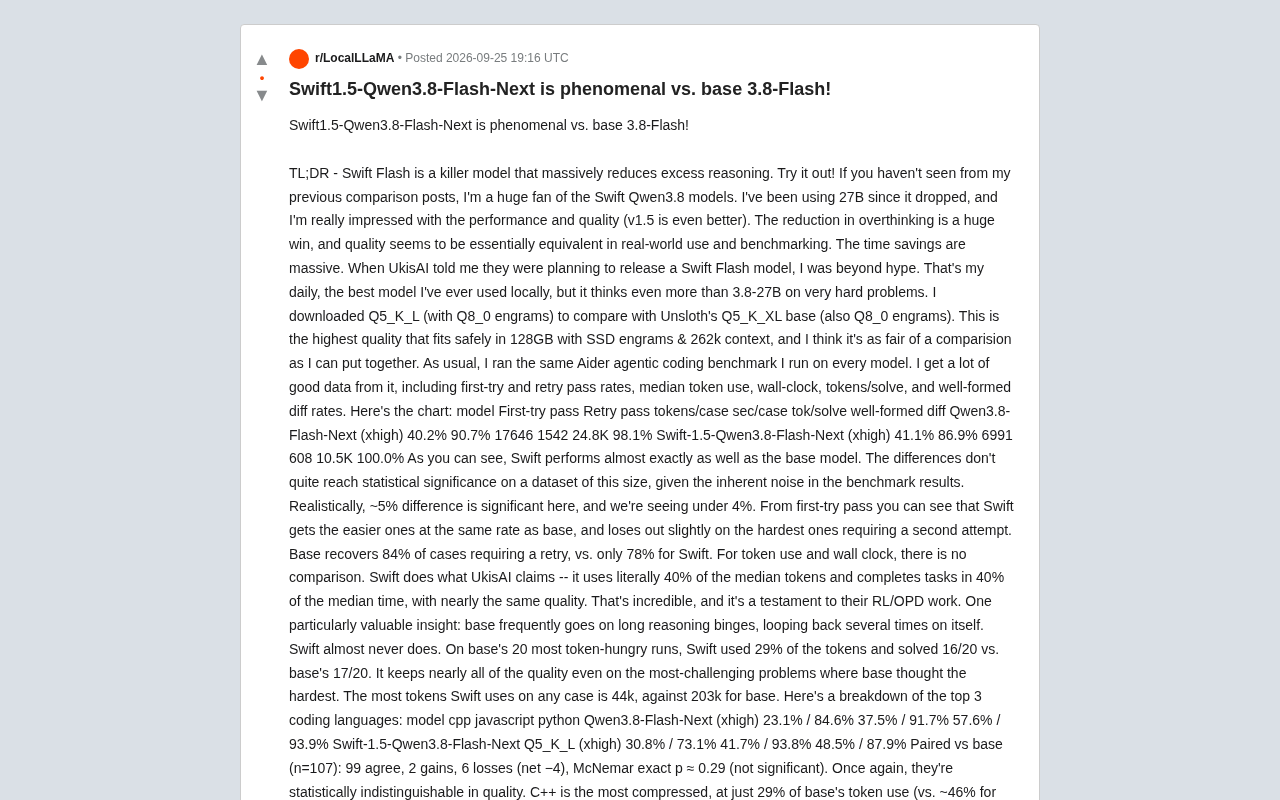
Swift-1.5-Qwen3.8-Flash-Next, trained by UkisAI with reinforcement learning to reduce overthinking, was benchmarked against the base model on the Aider agentic coding suite. Results show median token usage and wall-clock time at just 40% of the base model, with first-pass rate slightly higher (41.1% vs 40.2%) and retry-pass rate marginally lower (86.9% vs 90.7%) — neither difference statistically significant. On the 20 most token-heavy cases, Swift used 29% of the tokens and solved 16/20 vs 17/20. Peak tokens per case: 44K vs 203K. C++ saw the most aggressive compression but also the most quality regressions, worth noting for heavy C++ users.
The local LLM community has been buzzing about Swift-1.5-Qwen3.8-Flash-Next, which has drawn attention for its dramatic reduction of "overthinking" behavior. A Reddit user who regularly works with the Swift model series ran a systematic comparison between it and the base Qwen3.8-Flash-Next using the Aider agentic coding benchmark. The conclusion is striking: the Swift variant compresses both reasoning token usage and wall-clock time to roughly 40% of the original — while maintaining nearly identical output quality.
Core Finding: Think Less, Same Quality
The Swift version's biggest selling point is tackling a common pain point of local reasoning models — they think too much. The base Qwen3.8-Flash was described by the tester as "the best model I've run locally," yet when faced with hard problems, it would spiral into lengthy reasoning loops, sometimes generating even more verbose output than larger 27B models.
Swift-1.5 addresses this directly through reinforcement learning (RL) optimization. Looking at the overall benchmark results, pass rates between the two are nearly identical:
| Model | First-pass % | Retry-pass % | Tokens/case | Sec/case | Tokens/solution | Valid diff rate |
|---|---|---|---|---|---|---|
| Qwen3.8-Flash-Next (xhigh) | 40.2% | 90.7% | 17646 | 1542 | 24.8K | 98.1% |
| Swift-1.5-Flash-Next (xhigh) | 41.1% | 86.9% | 6991 | 608 | 10.5K | 100.0% |
On first-pass rate, Swift (41.1%) actually edges out the base model (40.2%), showing they're evenly matched on simpler tasks. The gap mainly shows up on the hardest problems that require a second attempt — the base model recovers 84% of retry cases versus Swift's 78%. However, the tester notes that given the noise inherent in benchmarks of this scale, only differences above ~5% are statistically meaningful. The actual gap is under 4%, which doesn't reach significance.
The Swift model series is trained by the UkisAI team using reinforcement learning. The core idea is to apply a penalty signal to the length of a reasoning model's Chain-of-Thought, guiding the model to shorten its internal reasoning steps without sacrificing answer accuracy. This is fundamentally different from distillation or quantization: those techniques operate on model weights, while Swift's optimization targets reasoning behavior — the parameter count stays the same, but the model's habit of "how long to think" is reshaped. Overthinking is a widespread problem in current chain-of-thought models: after arriving at the correct direction, the model continues to second-guess itself and re-verify, generating large amounts of redundant tokens that contribute little to the final answer, slowing response time and consuming more context window.
Efficiency Is the Real Killer Feature
If quality is a draw, efficiency is a blowout. Swift's median token usage is just 40% of the base model's, and wall-clock time per task is similarly only 40%. For local deployment, that translates to cutting more than half of your waiting time on equivalent coding tasks.
The extreme cases are even more telling. The tester pulled the 20 runs where the base model consumed the most tokens and compared them directly: Swift used only 29% as many tokens, yet still solved 16 of those problems — compared to the base model's 17. In other words, even on the problems that are hardest for the model, Swift barely falls behind.
Perhaps the most concrete number: Swift's per-case token ceiling was 44K, while the base model peaked at 203K. That order-of-magnitude difference matters enormously for local deployment scenarios where VRAM and context length are both constrained.
Per-Language Results: Watch Out for C++
The tester also broke down results across C++, JavaScript, and Python:
| Model | C++ | JavaScript | Python |
|---|---|---|---|
| Qwen3.8-Flash-Next | 23.1% / 84.6% | 37.5% / 91.7% | 57.6% / 93.9% |
| Swift-1.5-Flash-Next Q5_K_L | 30.8% / 73.1% | 41.7% / 93.8% | 48.5% / 87.9% |
For JavaScript and Python, Swift's token compression is about 46% of the base model's, with quality roughly on par. C++ sees the most aggressive compression — token usage drops to just 29% of the base — but at a cost: 3 of the 6 quality regressions occurred in C++ cases.
From paired statistics (n=107): 99 outcomes matched, 2 favored Swift, 6 favored the base model, net difference of -4, McNemar exact test p≈0.29 — again, not statistically significant. The overall conclusion is that quality is "statistically indistinguishable" between the two. That said, heavy C++ developers should take note: the aggressive compression in that language brings quality variance worth watching — loosening the reasoning budget for C++ tasks may be worth it for stability.
Test Conditions and Reproducibility
To ensure a fair comparison, the tester selected the highest-quality quantization configurations that fit safely within 128GB of memory and support a 262K context: Q5_K_L (Q8_0 attention layers) for Swift, and Unsloth's Q5_K_XL (also Q8_0 attention layers) for the base model, with both stored on SSD. Both ran against the same Aider agentic coding benchmark, collecting first-pass/retry-pass rates, median tokens, wall-clock time, tokens-per-solution, and valid diff rate across multiple dimensions.
What makes this methodology valuable is that it doesn't just ask "is it correct?" — it also asks "how fast and how cheap?" which is exactly what local deployment users care about. Swift's 100% valid diff rate means every generated patch is correctly formatted, which is a meaningful reliability boost for agentic workflows that automatically apply code changes.
The Aider Polyglot Benchmark is designed to evaluate LLMs on real-world code editing: the model must read existing code, understand requirements, and generate a valid unified diff patch. Unlike pure code generation tasks, it requires output to strictly conform to the unified diff format so that Aider can automatically apply changes to files — hence the "valid diff rate" metric. Q5_K_L and Q5_K_XL are both mixed-precision GGUF quantization formats: Q5_K means most weights are stored at 5-bit precision, while the _L/_XL suffix indicates attention layers are kept at higher precision (Q8_0), balancing compression ratio and accuracy. These configurations can fully accommodate 8B-class models with very long context on Apple Silicon machines with 128GB unified memory.
What This Means for Local Model Users
The benchmark results for Swift-1.5-Qwen3.8-Flash-Next validate UkisAI's claims about RL-based reasoning path optimization. For developers running large models locally, "same quality, twice the speed, half the tokens" is essentially the ideal upgrade path — it directly addresses the two most painful aspects of local inference: latency and resource consumption.
Of course, this is ultimately one user's test on a specific benchmark with a limited dataset, and many of the observed differences don't reach statistical significance. The quality variance in C++ also reminds us that aggressive reasoning compression isn't cost-free across all tasks. But the broader trend is clear: using training-time methods to eliminate wasteful reasoning — rather than simply scaling up parameters — is becoming an important direction for improving the practical utility of local models. For efficiency-focused local deployers, the Swift series is worth trying.
Related articles

"Black October": Did AI Uncover 3% of All Critical Vulnerabilities Ever?
A Reddit post claims 3% of all critical software vulnerabilities ever were found in the past month, dubbed 'Black October.' We break down the statistical issues, how AI-assisted code auditing accelerates discovery, and how developers should respond.

Microsoft Project Gecko: Using AI to Bridge Language Gaps for African Farmers
Microsoft's Project Gecko launches PharmaChat, letting African farmers ask questions in their native language and get precise video clips and farming book chapters via AI. The project also releases three interactive manuals to advance inclusive AI.

Musk's Space Dominance: How Starlink Throttling Undermines Ukraine's Defense
SpaceX's Starshield throttling disabled Ukraine's high-speed interceptor drones, exposing how Musk's private control over low Earth orbit communications affects battlefield dynamics and national security, and highlighting the risks of commercial space militarization and space governance dilemmas.