SwiftUI Agent Skill: Teaching AI Coding Tools to Write Idiomatic SwiftUI Code
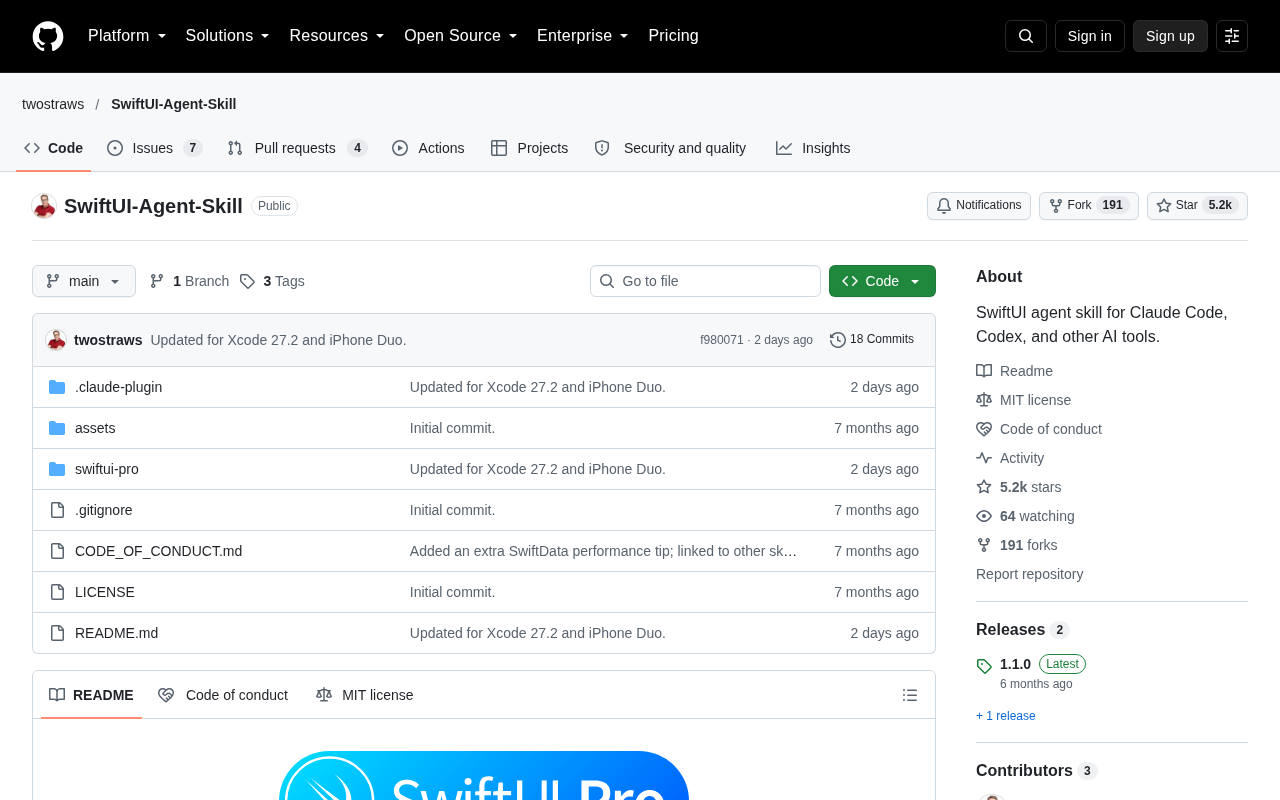
Paul Hudson's SwiftUI-Agent-Skill gives AI coding tools expert-level SwiftUI knowledge, earning 5,200+ Stars at launch.
SwiftUI-Agent-Skill, an open-source project by Hacking with Swift founder Paul Hudson, provides Claude Code, Codex, and other AI coding tools with a structured SwiftUI "skill pack" — quickly amassing over 5,200 Stars. Agent Skills package domain expertise into AI-readable rule files, compensating for LLMs' outdated knowledge of SwiftUI state management, view decomposition, and new APIs. The tool-agnostic project is reusable across multiple AI assistants, reflecting the trend of decoupling the knowledge layer from the tooling layer in AI-assisted development.
The open-source project SwiftUI-Agent-Skill, released by renowned Swift community developer Paul Hudson (twostraws), quickly gained massive attention after launch — accumulating over 5,200 Stars and 191 Forks, with 88 new stars on its first day. The project has a clear mission: to provide Claude Code, Codex, and other AI coding tools with a specialized "skill pack" for SwiftUI, helping AI generate code that is more idiomatic and aligned with best practices.
What Is an Agent Skill
"Agent Skill" is a concept that has been gradually taking shape within the AI coding tool ecosystem. At its core, it's a set of structured domain knowledge and rules that an AI agent can reference when executing specific tasks. Unlike simply stuffing requirements into a prompt, a Skill encapsulates the conventions, common pitfalls, and recommended patterns of a particular tech stack into a reusable module — so that AI tools automatically consult these guidelines when working on related tasks.
This approach is especially valuable for frameworks like SwiftUI. SwiftUI iterates quickly and its APIs change frequently, while general-purpose LLMs often have stale training data, making them prone to generating outdated or discouraged patterns. Through a continuously maintained Skill file, developers can "inject" the latest, battle-tested practices directly into the AI's workflow.
From an implementation standpoint, Agent Skills typically exist as Markdown or YAML files placed in the project root or a specific path (such as .claude/ or .github/). AI tools automatically read these files at task startup and inject their contents as context into the reasoning process. This resembles a "System Prompt," but Skill files place greater emphasis on version control, team sharing, and being committed alongside the codebase. Claude Code calls this type of file CLAUDE.md, Cursor has .cursorrules, and different platforms use different names — but the core idea is consistent: use externally attached structured text to fill the knowledge gaps that LLMs have in specific domains.
Why SwiftUI Needs a Dedicated Skill
SwiftUI's declarative syntax may look simple, but writing high-quality, maintainable code is far from trivial. State management (@State, @Binding, @Observable), view decomposition, performance optimization, and lifecycle handling all come with a wealth of established best practices — and these are precisely the areas where general-purpose models are most likely to go wrong.
As the founder of Hacking with Swift, Paul Hudson has spent years deeply focused on Swift and SwiftUI education, giving him an intimate understanding of the community's common mistakes. The Skill he curated essentially distills years of teaching and real-world experience into an AI-readable rule set. This is the core reason the project gained traction so quickly — it's backed by authoritative, proven knowledge rather than generic guidelines.

@Observable is a new macro introduced in Swift 5.9 (Xcode 15) alongside the Observation framework, designed to replace the verbose ObservableObject + @Published combination. The old approach required classes to conform to the ObservableObject protocol and decorate every observed property with @Published, whereas the new @Observable macro lets SwiftUI automatically track property changes with just a single annotation on the class declaration — dramatically reducing boilerplate and improving performance. Since this change landed in late 2023, general-purpose LLMs with earlier training cutoffs are highly likely to generate the deprecated pattern. This is a prime example of where a dedicated Skill file can significantly elevate code quality.
Cross-Tool Compatibility
One notable design decision in this project is its tool-agnostic approach. The project description explicitly states it works with Claude Code, Codex, and "other AI tools." This means the SwiftUI knowledge isn't locked to any specific platform — developers can reuse the same skill definition regardless of which AI coding assistant they use.
This reflects a broader trend in the AI coding ecosystem: the knowledge layer and the tooling layer are gradually decoupling. As more and more coding agents support pluggable skill or rules files, community projects like SwiftUI-Agent-Skill have the potential to become a standardized bridge connecting "human expert knowledge" with "AI execution capability."
Behind this decoupling is an ongoing competition to establish de facto standards among major AI coding tools. Anthropic's Claude Code centers on CLAUDE.md as its primary configuration entry point, OpenAI's Codex CLI supports similar instruction files, and JetBrains AI and GitHub Copilot are progressively adding support for customizable rules. While formats haven't yet unified across platforms, the pattern of "writing domain conventions into a file for AI to automatically load" has been widely adopted. SwiftUI-Agent-Skill's decision not to bind to a single platform means the community can contribute to and iterate on a single shared body of content, avoiding the fragmentation that comes from scattering knowledge across proprietary formats.
What This Means for Developers
For iOS/macOS developers, incorporating such a Skill offers several direct benefits:
- Less rework: AI-generated code more closely matches recommended patterns, saving significant time on manual corrections.
- Unified team standards: Teams can build on a shared Skill as a foundation and extend it with their own conventions, keeping AI output consistently styled.
- Staying current with the framework: A Skill maintained by an active community can reflect SwiftUI's latest changes relatively quickly.
Of course, a Skill is no silver bullet. It's more of a "guide" for AI output than a "guarantee" — final code quality still depends on the underlying model's capabilities and the developer's review. But as a near-zero-cost enhancement, the return on investment is exceptional.
Conclusion
The rapid rise of SwiftUI-Agent-Skill reflects a broader shift in AI coding: moving from "general capability" toward "deep domain expertise." When general-purpose LLMs encounter highly specialized, fast-moving tech stacks, structured knowledge packages maintained by domain experts are becoming an essential complement. For developers who want AI tools to truly write good SwiftUI code, this is an open-source project worth trying right now.
Related articles

Getting Started with Codex: How OpenAI's Coding Agent Differs from ChatGPT
Codex is OpenAI's AI coding agent that autonomously reads, modifies code, and runs tests. Learn how it differs from ChatGPT and why developers need to master it.

Gemini Agent Launches: Argon Model Too Powerful to Release, Weekly AI Roundup
Google launches Gemini Agent for workplace use, supports Gemini 4 Argon and Claude Opus 5.5, but Argon stays unreleased over safety concerns. Weekly AI roundup covering Odyssey 3, OpenAI revenue, and Arena's $200M raise.

Sophos Cuts Threat Response Time by 96% with OpenAI Daybreak
Sophos CTO reveals how OpenAI Daybreak and custom security agents cut MDR average response time from 38 minutes to 89 seconds—a 96% reduction. A look at the plan-execute-observe loop architecture.