Symfony PHP Framework In-Depth: A Mature Ecosystem and Engineering Practices
With its component-based architecture and LTS strategy, Symfony is an infrastructure-level framework in the PHP ecosystem, suited to long-term enterprise projects.
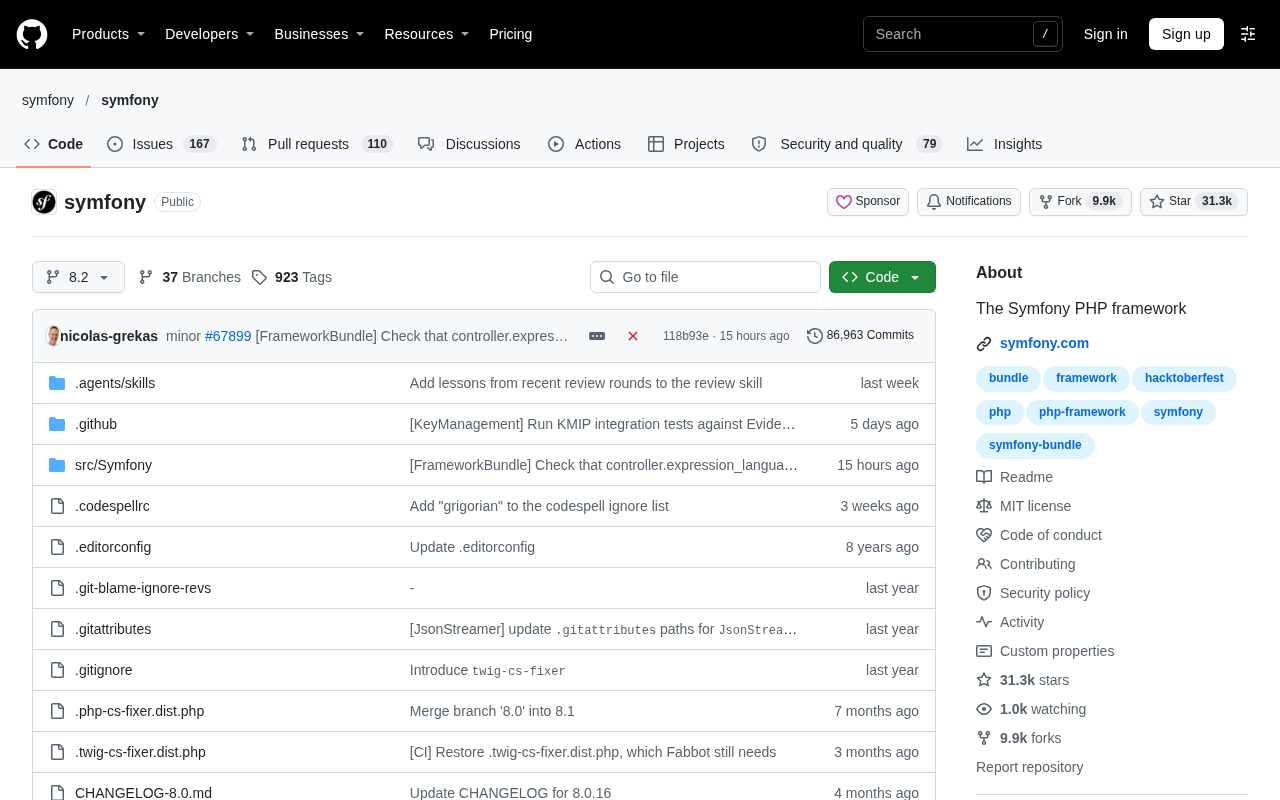
This article interprets the positioning and value of the Symfony PHP framework. Symfony is not a traditional all-in-one framework but consists of dozens of decoupled components that can be introduced as needed, making it PHP ecosystem infrastructure. With over 31,000 stars and 9,937 forks on GitHub and a fork-to-star ratio of nearly one-third, it shows deep usage. Its disciplined LTS strategy offers a predictable upgrade path for enterprises, though its steep learning curve makes it better suited to medium-to-large teams and long-term maintained enterprise applications.
Symfony PHP Framework In-Depth: A Mature Ecosystem and Engineering Practices
On GitHub, the symfony/symfony repository has long been one of the most closely watched projects in the PHP ecosystem—with over 31,000 stars, nearly 10,000 forks, and a star count that continues to grow daily. For a framework that has been around for many years, this sustained attention is itself a signal worth analyzing: it shows that the problems Symfony solves have not become obsolete. On the contrary, they have become increasingly important as enterprise-grade PHP applications grow more complex.
What Is Symfony: More Than a Framework, a Component System
Symfony is first and foremost a PHP framework, but its positioning differs from that of a traditional "all-in-one framework." It is composed of dozens of decoupled components, and developers can either adopt the full framework as a whole or pull in individual components as needed into any PHP project. This architectural choice extends Symfony's applicability far beyond the scenario of "writing a website with Symfony."
Judging from the repository's metadata, the project uses PHP as its primary language, and both its star count and fork count place it in the top tier of PHP projects. The fork count is close to ten thousand, indicating that a large number of teams have made customized modifications on top of Symfony—which is itself evidence of deep usage in enterprise projects.
The Engineering Value of Component-Based Design
Composability: A Development Approach That Takes What You Need
Symfony's core design philosophy is "composability." Capabilities such as routing, dependency injection, event dispatching, forms, validation, caching, and console are all split into independent components, each with its own release cadence and testing system. For teams, this means finer-grained technology choices: there is no need to commit to an entire framework just to use a single feature.
This model has had a broad impact on the PHP ecosystem—many other well-known PHP projects (including some mainstream frameworks and content management systems) directly depend on Symfony components. Symfony is therefore often described as "the infrastructure of the PHP ecosystem" rather than merely a competing framework.
The Dependency Injection Container is the core hub of Symfony's component system and the key to understanding its composability. It is responsible for managing the creation of objects and their dependencies within an application: instead of manually calling new to create services in code, developers declare services and their dependencies through configuration (YAML, XML, or PHP), and the container automatically handles instantiation and injection at runtime. The direct benefit of this mechanism is decoupling—classes depend only on interfaces rather than concrete implementations, making it easy to substitute mock objects during testing. Symfony's container also supports Service Tags and Compiler Passes, which allow services to be collected and rewritten during the container compilation phase. This is the underlying mechanism that enables many advanced components (such as event listeners and route loaders) to be registered automatically. Understanding how the container works is the first step toward mastering Symfony's architecture.
Long-Term Support and Stability
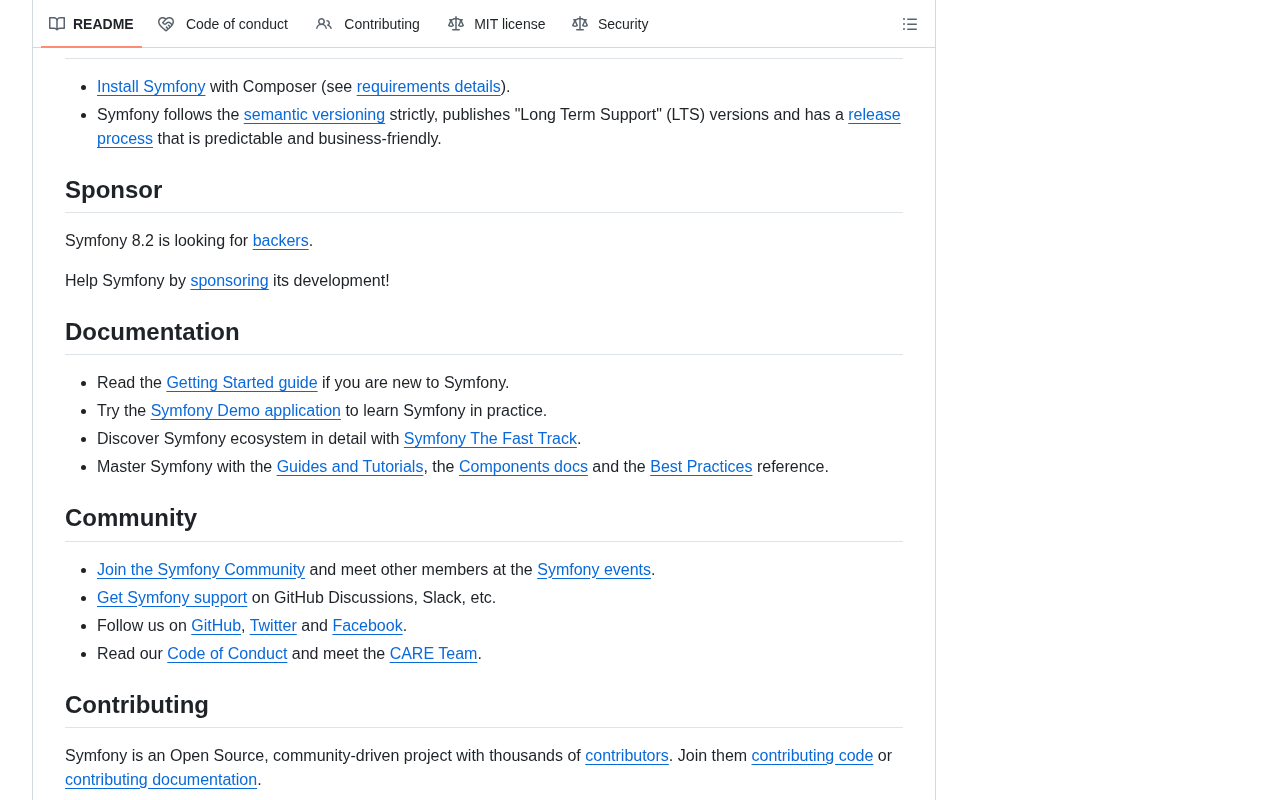
The Symfony community is known for its disciplined release cycle and Long-Term Support (LTS) versions. For enterprise projects, LTS versions mean a longer maintenance window and a more predictable upgrade path. Combined with the data of nearly ten thousand forks, it can be inferred that a large number of organizations use it as a long-term technical foundation rather than a short-term experimental choice.
LTS (Long Term Support) versions are an important concept in Symfony's release strategy. Symfony follows a fixed release cadence: an LTS version is released every two years and provides up to three years of bug fixes and security support, while regular standard versions are maintained for only about eight months. This dual-track system allows enterprises to choose a version based on their project cycle—teams seeking stability and a predictable upgrade path lock onto LTS, while projects that need new features follow the standard releases. After release, LTS versions also go through multiple maintenance phases (regular bug fixes, security fixes), and the official team clearly marks the time window for each phase to help teams plan upgrades. For enterprise systems that need to evolve over the long term, this transparent version lifecycle management is a key safeguard against technical debt risk.
The Community Ecosystem as Seen Through Repository Popularity
Over 31,000 stars, 9,937 forks, and 89 new stars in a single day—this set of figures needs to be understood against the broader backdrop of the PHP ecosystem. The PHP language itself has gone through years of "decline" discussions, but the activity in Symfony's repository shows that serious backend engineering needs remain firmly in place, and Symfony is one of the main options for meeting those needs.
More noteworthy is the ratio of forks to stars. A fork-to-star ratio of nearly one-third is uncommon among large framework projects, and it usually means that users are not just "liking and bookmarking" but actually pulling down the code to do secondary development, submit patches, or build derivative projects. This is a positive signal for a framework's long-term health.
The fork-to-star ratio is a commonly used observational metric for assessing the depth of usage of an open-source project. A star usually represents attention or bookmarking—low barrier, shallow behavior; a fork means the user has copied the code to their own account, often to submit patches, do customized development, or build derivatives based on the original project. Therefore, the higher the fork-to-star ratio, the greater the proportion of actual participation and secondary development. In large framework projects, this ratio is usually low (many users merely bookmark), and Symfony's ratio of nearly one-third is indeed rare, which indirectly confirms its deep embedding in enterprise environments. Of course, this metric also has limitations: forks may include a large number of experimental or abandoned copies and cannot be fully equated with the number of active contributors; it should be judged in combination with data such as commit frequency and PR merge rates.
Who It Is For: Scenarios and Trade-offs
Symfony has a relatively steep learning curve, and its conceptual system (dependency injection container, service tags, event subscribers, etc.) takes time to digest. It is better suited to medium-to-large teams, enterprise applications that require long-term maintenance, and projects with high requirements for architectural standardization. For small scripts or prototype validation, lighter-weight solutions in the PHP ecosystem may be more appropriate.
Another practical consideration is ecosystem compatibility: because a large number of PHP projects depend on Symfony components, knowledge of Symfony often carries over to debugging and extending other technology stacks, which increases the return on learning investment.
Conclusion
The sustained popularity of symfony/symfony is no accident. Its component-based architecture, disciplined version strategy, and deep ecosystem penetration together form its irreplaceable position in the PHP world. For teams that need to build backend systems capable of long-term evolution, Symfony remains an option worthy of serious evaluation; and for developers who want to understand modern PHP engineering practices, reading its component designs is itself a high-quality architecture lesson.
One-line Summary
With its component-based architecture and LTS strategy, Symfony has become an infrastructure-level framework in the PHP ecosystem, suited to long-term enterprise projects.
Paragraph Summary
This article provides an in-depth interpretation of the positioning and value of the Symfony PHP framework. Symfony is not a traditional all-in-one framework but is composed of dozens of decoupled components, and developers can introduce individual components into any PHP project as needed—this composability makes it the infrastructure of the PHP ecosystem. Its GitHub repository has over 31,000 stars and 9,937 forks, with a fork-to-star ratio of nearly one-third, indicating deep usage rather than shallow attention. Symfony is known for its disciplined LTS long-term support version strategy, which provides a predictable upgrade path for enterprise projects. The article also points out that its learning curve is relatively steep, making it better suited to medium-to-large teams and long-term maintained enterprise applications, while knowledge of its components can be transferred to a large number of other PHP projects that depend on Symfony.
Related articles
 Tech Frontiers
Stylome Bot Slammed as Useless Junk: Why Do AI Detection Tools Keep Failing?
Reddit users test the Stylome AI detection bot: Gemini-rewritten text judged human-written, consistently low confidence. An analysis of AI text detection's technical dilemmas, privacy concerns, and credibility crisis in community governance.
 Tech Frontiers
When AI Becomes a Productivity Divide: Clarity or "AI Psychosis"?
A civil engineer's deep use of agentic AI boosted efficiency but bred contempt for peers who refuse to learn. Is this clarity or AI psychosis? An analysis of the cognitive and psychological challenges behind the AI productivity divide.
 Tech Frontiers
Opus 5.5 Benchmark Scores Climb, Community Says Its "Weights Are Blessed"
Reddit community discusses Opus 5.5's rising scores on the Benchmaxxing Bench, with users describing its performance as "weights are blessed." This article interprets the community reaction and cautions against conflating benchmark scores with real capability.