Synopsys Partners with OpenAI and Amazon as Custom Silicon Becomes the New AI Battleground

Synopsys shifts from selling EDA software to collecting chip royalties, emerging as a quiet winner of the AI arms race.
Synopsys stock jumped roughly 13% after announcing a $1 billion multi-year deal with Amazon and a strategic partnership with OpenAI at its investor day. The Amazon deal's standout feature is a new business model: Synopsys moves from one-time licensing to ongoing royalties tied to chip shipment volumes, binding its revenue to customers' commercial success. OpenAI, meanwhile, is partnering with Synopsys to develop custom chips and reduce dependence on NVIDIA and AMD. Management also highlighted the integration of its $35 billion Ansys acquisition as a play on physical AI and digital twins. As demand for custom silicon surges with the AI wave, Synopsys's unmatched position in EDA and semiconductor IP positions it as a long-term, high-conviction beneficiary of the AI infrastructure buildout.
EDA Giant Steps Into the Spotlight of the AI Arms Race
Chip design software leader Synopsys saw its stock surge roughly 13% on the day it announced two strategic partnerships — with Amazon and OpenAI — at its investor day, rocketing to the top of the Nasdaq 100 leaderboard and closing at its highest level in months. Amid the AI arms race sweeping the entire tech industry, a player that had long been overlooked is stepping into the light: virtually every AI chip ever made owes its existence to Synopsys's tools.
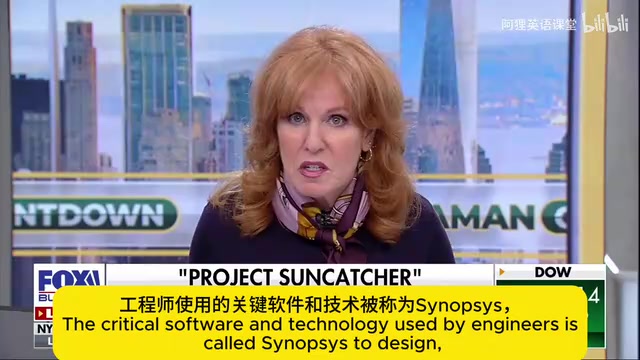
In an exclusive interview with Fox Business, Synopsys CEO Sassine Ghazi put it plainly: "You cannot design any chip or any intelligent system without using our software." That's not hyperbole. From silicon design and system design to the validation of materials, structures, and fluid dynamics, Synopsys's EDA (Electronic Design Automation) software permeates the entire chip manufacturing chain. Even Google's recently launched experimental satellite — carrying four TPUs (Tensor Processing Units) as part of Project Suncatcher, a space-based data center initiative — relied on Synopsys for its chip design.
There's a certain irony here: at a time when the market once feared that software would be displaced by AI-driven programming, Ghazi's company has offered the opposite proof — in the AI era, EDA software has become infrastructure-grade necessity.
What is EDA? Electronic Design Automation (EDA) refers to a category of software tools used to design and verify complex integrated circuits and electronic systems. Modern chips contain tens of billions of transistors — far beyond what any human could lay out manually — making EDA tools the core infrastructure of chip design. The industry has long been dominated by three companies: Synopsys, Cadence, and Siemens EDA (formerly Mentor Graphics), which together command more than 70% of the global EDA market. Synopsys's toolchain covers the entire chip development workflow, from RTL (register-transfer level) logic design, synthesis, and timing analysis, to physical layout, routing, and yield simulation. In other words, NVIDIA's H100, AMD's MI300X, and Apple's M-series chips all go through repeated iteration and verification using EDA tools — led by Synopsys — before they ever reach a TSMC production line. That's why CEO Ghazi can say with full confidence that "no chip can bypass us" — it's not a marketing line, it's a structural reality of the industry.
Amazon's Billion-Dollar Deal: From Selling Software to Collecting Royalties
The Amazon partnership is a multi-year agreement valued at $1 billion, aimed at accelerating the engineering process for Amazon's custom chips and AWS infrastructure. But what truly excited investors wasn't the size of the deal — it was the shift in business model it represents.
Ghazi explained one of the most important trends in the chip industry today: custom silicon. "You need to optimize chip design for different applications. The chips needed to run Google Search, to run frontier models from Anthropic or OpenAI, to power Microsoft's technology stack — they're all different." For Synopsys, this means companies like Amazon "cannot build these custom chips without Synopsys's IP."
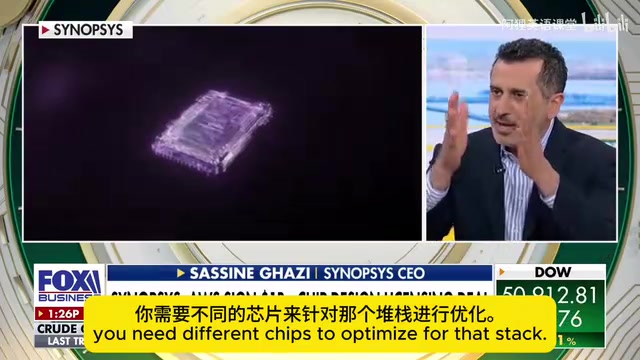
This has opened an entirely new business line for Synopsys: developing custom IP for clients and then collecting royalties on an ongoing basis. "This $1 billion represents a commitment across multiple generations of their chips — and then, as those chips go into high-volume production, we earn royalties on top of that $1 billion." This kind of recurring revenue offers the visibility and durability that capital markets prize: as Amazon scales up production, Synopsys's revenue scales with it.
What is semiconductor IP? In the chip context, IP (Intellectual Property Core) refers to reusable functional modules — such as processor cores, interface controllers, and memory controllers — that have been pre-verified and are ready to integrate. Chip designers license these IP blocks to dramatically shorten development timelines and avoid reinventing the wheel. Synopsys is one of the world's largest semiconductor IP vendors; its DesignWare IP library covers hundreds of interface standards including USB, PCIe, and DDR. The traditional licensing model charges a one-time license fee, whereas the royalty model collects ongoing payments based on chip shipment volumes or revenue — deeply tying the vendor's fortunes to the commercial success of the chip product. For Synopsys, this means moving from project-based revenue to recurring revenue, significantly improving financial predictability. For Amazon, it means lower upfront costs, but an ongoing obligation to pay royalties tied to the shipment volume of its custom chips like Trainium and Inferentia. It's a structural arrangement that aligns the interests of supplier and customer at a fundamental level.
The Hidden Force Behind OpenAI's Custom Chips
The other partnership points to OpenAI. No introduction needed: OpenAI is actively working to reduce its dependence on "blue-chip chip makers" like NVIDIA and AMD — vendors with constrained supply and large delivery commitments to many other customers. Having its own chips means more optionality.

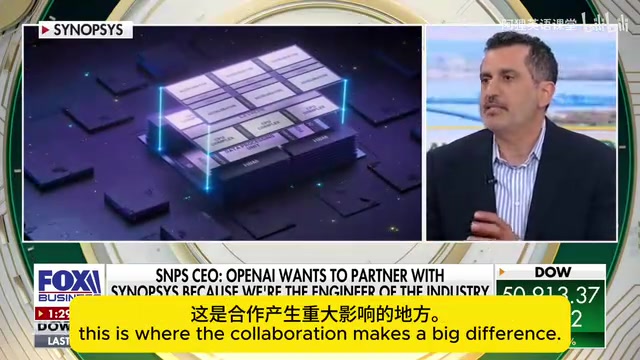
Ghazi frames this with a broader thesis: for the intelligence and reasoning capabilities of frontier models to truly penetrate every industry, they must be deeply integrated with that industry's specific workloads. "OpenAI recognizes this. They want to work with Synopsys because we are the engineering software leader across every engineering discipline." In his view, systems companies that buy chips from NVIDIA, AMD, and Broadcom while also developing their own silicon are doing so to tightly co-optimize software and hardware — and Synopsys is the indispensable enabler of that step.
When asked whether a potential IPO wave from OpenAI, Anthropic, and others might shift the landscape, Ghazi was optimistic: once these companies go public, their balance sheets will be stronger, enabling them to "do more chips, more models" — which he sees as a further expansion opportunity for Synopsys.
Supply Chain Confidence and the Ansys Integration
When pressed on whether memory shortages and energy constraints could disrupt delivery timelines, Ghazi pointed to a collaborative model. Using the Amazon partnership as an example, the two companies jointly decide on tradeoffs around memory voltage solutions and how to tailor interconnect schemes for different memory suppliers — Micron, Samsung, SK Hynix — or different foundries.
Despite Synopsys stock falling roughly 10% over the past year amid investor concerns about integration risk from its $35 billion acquisition of Ansys, Ghazi listed the Ansys integration alongside the two AI partnerships as one of three highlights of investor day. He emphasized that physical AI requires digital twins of devices and the real world: "You cannot build it without the intelligence of how to build it" — and that, he argued, is precisely the strategic rationale for the Ansys acquisition.
What is Ansys? Ansys is a world-leading engineering simulation software company whose products span structural mechanics, fluid dynamics, electromagnetics, thermal management, and other multi-physics simulation domains. Synopsys acquired Ansys for $35 billion (the deal cleared regulatory approval in 2024), making it one of the largest acquisitions in EDA history. The strategic logic: as chip packaging density increases and heterogeneous integration (chiplets) becomes mainstream, chip design is no longer purely an electrical problem — it also involves heat dissipation, mechanical stress, fluid cooling, and other complex physical phenomena that EDA tools alone cannot fully address. By combining Ansys's multi-physics simulation capabilities with Synopsys's chip design tools, the combined company can deliver a full-stack digital twin from chip level to system level — simulating how a physical product will behave in the real world before it's ever manufactured. This is particularly critical for data center cooling design, automotive-grade validation of autonomous driving chips, and the "physical AI" scenarios Ghazi referenced.
An Underrated AI Winner
The Synopsys story reveals a logic that the AI era has often overlooked: when the giants race to build their own chips and chase compute capacity, the ones who reliably win tend to be the providers of picks and shovels — the foundational tool vendors. Whether it's Google's space-bound TPUs, Amazon's custom silicon, or OpenAI's homegrown chips, none of them can bypass the design and verification stage where Synopsys is indispensable.
A business model shifting from one-time software licenses to ongoing royalty streams, layered on top of the broader custom silicon megatrend, is anchoring Synopsys as a durable, long-cycle beneficiary of the AI buildout. As one observer put it: a software company has just proven that it doesn't just coexist with the AI wave — it can thrive quite handsomely within it.
Related articles

Amphibious Transforming Drone: Beyond 100x Power Savings, What Are the Real Needs?
Is the amphibious transforming drone just a gimmick? Starting from the 100x power difference of the M4 Morphobot, explore real application scenarios and thesis topic ideas, analyzing boundary conditions where pure drones and pure ground robots both fail.

Warhound Raises $200 Million: Genetically Engineered "War Dogs" Paired with Anduril Gear
Warhound raises $200M, backed by Ben Lamm and Palmer Luckey, to genetically engineer dogs for military and law enforcement use and equip them with Anduril gear. This article analyzes its technology direction, funding logic, and ethical controversy.

Claude API Comes to Google Cloud: IAM Integration and SDK Access Guide
Anthropic hosts the full Claude API on Google Cloud with IAM-controlled permissions and unified billing. This guide covers the Vertex AI and Anthropic-hosted entry points, IAM role configuration, and SDK access.