Synthetic Data Poisoning: The Model Collapse Threat in Enterprise Fine-Tuning

Recursive synthetic data causes model collapse: tail recall plunges from 88% to 11% and hallucination rates soar to 52%.
The article warns of an underestimated systemic risk in enterprise fine-tuning pipelines: recursive synthetic data poisoning. When enterprises generate training corpora in bulk using frontier models to cut costs, multi-generation fine-tuning leads to model collapse—probability distributions gradually lose tail information, output diversity collapses, and hallucination rates soar. A five-round recursive fine-tuning experiment shows rare tail recall dropping from 88.2% to 11.2%, hallucination rate rising from 3.2% to 52.4%, and domain precision falling from 94.6% to 44.3%. Its mathematical essence is information loss: generative models cannot produce information beyond their parameters, and each synthesis truncates rare tokens and introduces sampling bias. Protective measures include provenance watermarking, KL divergence auto-termination, and no less than 25% human golden anchoring. Meanwhile, the EU AI Act and ISO 42001 are pushing data provenance from process compliance toward verifiable outcomes, and enterprises that fail to audit synthetic lineage face a triple risk of silent failures, litigation, and fines.
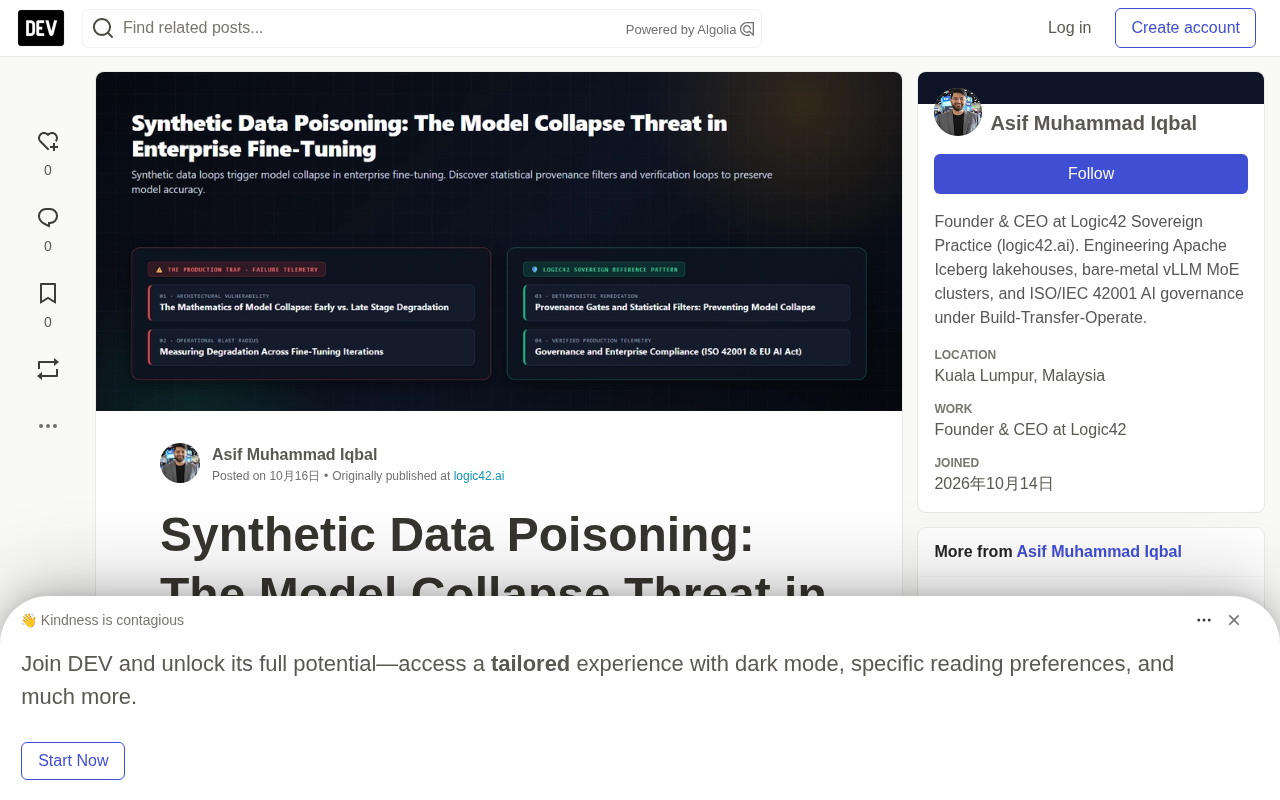
When enterprises generate synthetic training corpora in bulk using frontier models to cut annotation costs, a hidden statistical degradation process is unfolding. Asif Muhammad Iqbal, founder of Logic42, warns in his latest architecture brief: recursive synthetic data poisoning is becoming the most underestimated systemic risk in enterprise fine-tuning pipelines.
What Is Model Collapse
Model collapse refers to the irreversible statistical degradation that occurs in generative AI models after multiple generations of recursive fine-tuning. Its essence is a mathematical process: when model n+1 trains on the outputs of model n, the probability distribution gradually loses its ability to represent tail information from the original data.
Logic42's advisory practice has observed multiple enterprise teams over the past 12 months generating synthetic domain training corpora using frontier models to slash annotation budgets. Within three generations of fine-tuning, these in-house models exhibited severe cognitive degradation—forgetting low-probability edge cases and outputting repetitive, generalized template content.
The process unfolds in two stages. In the early stage, the model begins to lose information from the tail of the original data distribution; rare enterprise terminology, anomalous contract clauses, or edge-case software bugs no longer appear in the synthetic corpus. In the later stage, the probability distribution collapses to a single maximum-likelihood point, and the model converges to a narrow band of generic outputs, capable only of hallucinating common patterns when confronted with domain-specific queries.
The tail of a probability distribution refers to the low-probability region far from the mean in a data distribution, corresponding to rare events in the real world—unusual contract clauses, uncommon software bugs, rare medical symptoms. In training data, these samples are extremely scarce in number but critically important to a model's practical value: a medical AI that only learns to handle common conditions is useless when facing rare diseases. The problem is that generative models naturally favor high-probability regions during sampling, because their training objective is to minimize average loss, not to protect the tail. With each synthetic generation, the probability of tail tokens being sampled is further suppressed. After multiple rounds of recursive looping, the statistical signal in the tail is completely flattened, and the model's ability to represent real-world complexity is lost along with it.
KL divergence (Kullback-Leibler Divergence) measures the difference between two probability distributions and is the core mathematical tool for detecting model collapse. The smaller its value, the closer the two distributions are; the larger its value, the more the candidate training data has deviated from the true human data distribution. In enterprise fine-tuning scenarios, comparing the proposed training batch against a certified human golden baseline via KL divergence—if the divergence exceeds a threshold, it indicates that the synthetic data has introduced unacceptable statistical bias, and the pipeline should terminate automatically. The value of KL divergence monitoring lies in its proactive nature—problems can be detected before GPU budgets are wasted, rather than observing performance degradation only after training completes.
Measured Data from Five Rounds of Recursive Fine-Tuning
Logic42 Labs simulated a standard enterprise fine-tuning pipeline, running five rounds of recursive loops using supervised fine-tuning (SFT) and low-rank adaptation (LoRA). The training dataset consisted of 100,000 synthetic technical support tickets generated by a frontier model.
| Model Iteration | Human Ground Truth Ratio | Domain Precision | Rare Tail Recall | Output Diversity (Entropy) | Hallucination Rate |
|---|---|---|---|---|---|
| Gen 0 (Human Baseline) | 100% | 94.6% | 88.2% | 7.84 | 3.2% |
| Gen 1 (Filtered Synthetic) | 40% | 91.2% | 72.4% | 7.12 | 6.8% |
| Gen 2 (Mixed Synthetic) | 15% | 83.5% | 51.0% | 6.25 | 14.5% |
| Gen 3 (Unchecked Synthetic) | 2% | 68.1% | 29.3% | 4.80 | 28.7% |
| Gen 4 (Pure Recursive) | 0% | 44.3% | 11.2% | 3.10 | 52.4% |
The data reveals a steep nonlinear degradation curve. As overall domain precision dropped from 94.6% to 68.1%, rare tail recall plummeted from 88.2% to 29.3%. For enterprises relying on AI to handle atypical scenarios—medical diagnosis, financial fraud detection, compliance review—the system's critical value lies precisely in the tail.
Why Synthetic Data Causes Model Collapse in Fine-Tuning
Generative models cannot produce information beyond their learned parameters. Each synthetic generation introduces subtle sampling variance and truncates rare tokens, causing the downstream training process to accumulate statistical bias, compounding function entropy, until the model's output distribution collapses.
This means enterprises cannot achieve continuous capability improvement by "having the model generate its own training data"—the recursive loop is fundamentally an information loss process.
LoRA (Low-Rank Adaptation) is a parameter-efficient fine-tuning method. It freezes all original weights of the pre-trained model and injects two small low-rank matrices into each Transformer layer, updating only these two matrices during training. Compared to full-parameter fine-tuning, LoRA requires significantly less GPU memory and computation, enabling enterprises to complete domain adaptation on a single or a small number of GPUs. This is precisely why LoRA has become the most common configuration in recursive synthetic fine-tuning experiments. But LoRA's compression characteristics also mean its representational capacity for new data is limited—when training data gradually loses tail information, LoRA's low-rank matrices preferentially fit high-probability patterns, further accelerating distribution collapse.
SFT (Supervised Fine-Tuning) involves continuing to train a pre-trained model on labeled input-output pairs, enabling the model to learn to follow instructions or adapt to a specific domain. SFT itself does not cause model collapse, but when its training data comes from the model's own generation, the recursive loop begins. The key distinction: SFT with human data is capability injection; with synthetic data, it is capability dilution—each loop re-encodes the model's existing knowledge rather than introducing new external information.
Engineering Solutions to Prevent Model Collapse
Enterprises need not abandon synthetic data entirely. When implemented correctly, synthetic augmentation can provide valuable training balance for underrepresented categories. But deployment requires strict data provenance controls and mathematical verification layers.
Provenance Watermarking and Statistical Filtering
Deploy automated ingestion scanners that compute vocabulary perplexity and token n-gram distribution checks against known LLM baselines. Tag every document in the feature store with immutable data lineage records indicating whether its source is human-authored or synthetically generated.
KL Divergence Monitoring
Before launching fine-tuning on GPU clusters, compute the KL divergence between the proposed training batch and a certified human golden baseline. If the divergence exceeds a preset safety threshold, the pipeline automatically terminates the run, avoiding wasted GPU budget.
Tail-Preserving Golden Anchoring
Always maintain a non-negotiable core of certified human ground truth. In Logic42's production architecture, every training batch is mandated to contain at least 25% human golden anchoring. This anchoring prevents the model from collapsing into a repetitive probability trap.
Compliance and Governance Dimensions
Synthetic data poisoning is not merely an engineering problem—it is an emerging regulatory liability. Under the EU AI Act and the ISO 42001 AI management system framework, enterprises must demonstrate traceable data quality, governance, and provenance for models deployed in production.
Enterprises that fail to audit synthetic data lineage face a triple risk of silent model failures, customer litigation, and compliance fines. One detail worth noting: regulatory frameworks' traceability requirements for data quality are shifting from "process compliance" to "verifiable outcomes," meaning enterprises need to retain complete statistical fingerprints of training data, not just record data sources.
The EU AI Act is the world's first comprehensive regulatory law targeting artificial intelligence, passed in 2024, classifying and regulating AI systems by risk level. For high-risk applications—including healthcare, finance, and critical infrastructure—the Act requires proof of training data source, quality, and governance. ISO 42001 is the first AI management system standard published by the International Organization for Standardization, requiring organizations to establish auditable AI governance frameworks covering data provenance, model evaluation, and continuous monitoring. The common trend of both is: regulation no longer settles for "declaring the use of high-quality data," but requires enterprises to provide statistical fingerprints and lineage records of training data to prove that deployed models have not undergone silent degradation due to recursive synthetic data loops. For enterprises, this means data governance teams need deep integration with MLOps pipelines, completing provenance tagging at the data ingestion stage.
Enterprise Action Checklist
If your data science or platform engineering team is generating synthetic training corpora or fine-tuning open-source models, you can start with the following steps:
- Audit data governance posture and assess the effectiveness of current data lineage controls
- Benchmark fine-tuning pipelines to identify early signals of tail knowledge loss
- Embed KL divergence monitoring and automatic termination mechanisms into training pipelines
- Establish a minimum 25% human golden anchoring ratio as a non-negotiable floor
The essence of model collapse is an information theory problem: recursive synthetic data loops continuously consume the statistical information of original human data, ultimately causing the model to lose its ability to represent real-world complexity. For enterprises deploying AI into critical business processes, understanding and breaking this loop is one of the most urgent technical governance tasks today.
One-line Summary
Recursive synthetic data causes model collapse: tail recall plunges from 88% to 11%, hallucination rate soars to 52%, and enterprises need provenance, KL monitoring, and 25% human anchoring to break the loop.
Paragraph Summary
The article warns of an underestimated systemic risk in enterprise fine-tuning pipelines: recursive synthetic data poisoning. When enterprises generate training corpora in bulk using frontier models to cut costs, multi-generation fine-tuning leads to model collapse—probability distributions gradually lose tail information, output diversity collapses, and hallucination rates soar. A five-round recursive fine-tuning experiment shows rare tail recall dropping from 88.2% to 11.2%, hallucination rate rising from 3.2% to 52.4%, and domain precision falling from 94.6% to 44.3%. Its mathematical essence is information loss: generative models cannot produce information beyond their parameters, and each synthesis truncates rare tokens and introduces sampling bias. Protective measures include provenance watermarking, KL divergence auto-termination, and no less than 25% human golden anchoring. Meanwhile, the EU AI Act and ISO 42001 are pushing data provenance from process compliance toward verifiable outcomes, and enterprises that fail to audit synthetic lineage face a triple risk of silent failures, litigation, and fines.
Related articles

Amphibious Transforming Drone: Beyond 100x Power Savings, What Are the Real Needs?
Is the amphibious transforming drone just a gimmick? Starting from the 100x power difference of the M4 Morphobot, explore real application scenarios and thesis topic ideas, analyzing boundary conditions where pure drones and pure ground robots both fail.

Warhound Raises $200 Million: Genetically Engineered "War Dogs" Paired with Anduril Gear
Warhound raises $200M, backed by Ben Lamm and Palmer Luckey, to genetically engineer dogs for military and law enforcement use and equip them with Anduril gear. This article analyzes its technology direction, funding logic, and ethical controversy.

Claude API Comes to Google Cloud: IAM Integration and SDK Access Guide
Anthropic hosts the full Claude API on Google Cloud with IAM-controlled permissions and unified billing. This guide covers the Vertex AI and Anthropic-hosted entry points, IAM role configuration, and SDK access.