System Design Interview Notes: The Open-Source Study Resource With 24K GitHub Stars

A GitHub notes repo distilling the classic System Design Interview book has earned 24K stars from engineers worldwide.
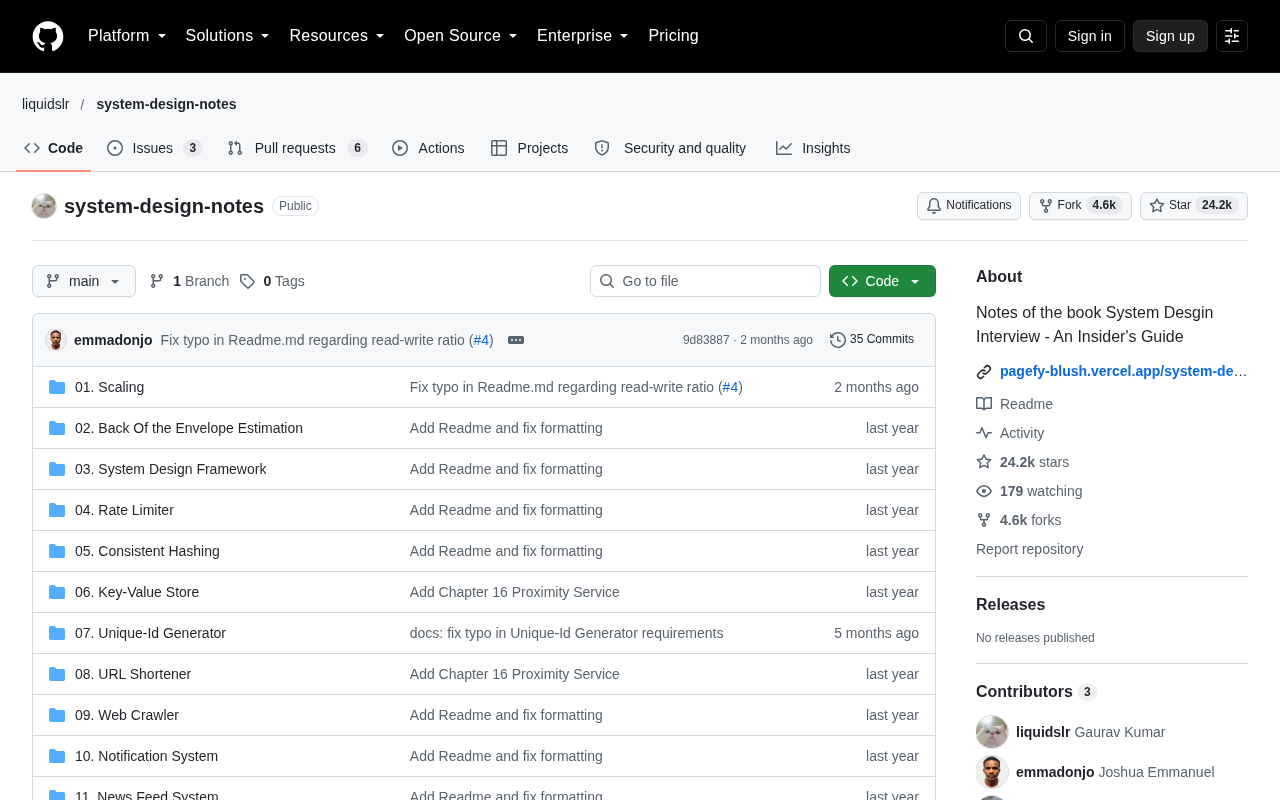
The GitHub repository `liquidslr/system-design-notes` compiles structured reading notes from Alex Xu's *System Design Interview*, distilling core topics like load balancing, database sharding, message queues, and consistent hashing into a fast-reference framework. With 24,172 Stars, 4,572 Forks, and nearly 400 new Stars added in a single day, the project reflects two enduring realities: system design remains a hard gatekeeping hurdle for mid-to-senior engineers, and developers increasingly favor open, collaborative learning materials over paid courses. The notes are best used alongside the original book — for building systematic understanding, quick pre-interview review, and validating concepts against real-world engineering practice.
Project Overview
When it comes to technical interview prep, system design has always been a critical focus for mid-to-senior engineers — and one of the hardest topics to study systematically. A GitHub repository called liquidslr/system-design-notes was created specifically to address this pain point. It compiles structured reading notes from the classic book System Design Interview - An Insider's Guide, helping developers quickly grasp core concepts and problem-solving frameworks for system design.
The project has accumulated 24,172 Stars and 4,572 Forks, with 398 new Stars added in a single day — and the momentum keeps building. These numbers speak clearly: there is a strong and sustained demand for system design learning resources within the developer community.
Why System Design Notes Are So Popular
System Design Interview - An Insider's Guide by Alex Xu is a go-to reference for system design interview prep, known for its step-by-step case-based approach. However, the book is dense and concept-heavy, and many readers find themselves flipping back and forth repeatedly during review.
The value of note-based open-source projects like this one lies in distilling a thick book into something lean — extracting key concepts, architecture diagrams, and problem-solving steps into structured, scannable points that are easy to search and review right before an interview. For engineers preparing for FAANG or other large tech company interviews, this kind of condensed material can significantly boost study efficiency.
Community reception tells an interesting story. The high Star count and consistent daily growth reflect two realities: system design remains a tough gatekeeping hurdle in technical interviews, and developers increasingly prefer open, free, and collaboratively maintained learning materials over paid courses alone.
System design interviews operate on fundamentally different logic than algorithm interviews. Algorithm problems typically have a clearly optimal solution, whereas system design questions are closer to open-ended engineering discussions — interviewers want to see how candidates break down ambiguous requirements, identify bottlenecks, make reasonable trade-offs, and clearly articulate their design intent. The "four-step framework" Alex Xu uses in his book — clarify requirements → estimate scale → high-level design → deep dive — has become a widely recognized answer structure in the industry. Note-style resources shine precisely because they map this framework to specific case studies (such as designing a URL shortener, a notification system, or YouTube), allowing reviewers to pattern-match quickly rather than deriving everything from scratch.
FAANG (Facebook/Meta, Apple, Amazon, Netflix, Google) refers broadly to top-tier North American tech companies, whose system design interviews are known for large-scale problem scopes and multi-dimensional evaluation criteria — making them the primary target audience for this type of study material.
Typical Value and Target Audience
This set of notes is well-suited for several types of readers:
Engineers Preparing for Interviews
For candidates about to face system design interviews, these notes offer a clear revision roadmap. Commonly tested topics — including load balancing, caching strategies, database sharding, message queues, consistent hashing, and CDN design — are all covered in a structured, organized format.
Each of these topics carries concrete engineering meaning: Load Balancing distributes traffic across multiple servers to prevent single-point overload, with common algorithms including round-robin, least connections, and consistent hashing; Database Sharding horizontally splits a single database across multiple nodes to overcome single-machine storage and throughput limits; Message Queues decouple producers and consumers asynchronously to improve system resilience and scalability — Kafka and RabbitMQ being classic implementations; Consistent Hashing is a core algorithm in distributed caching and shard routing that minimizes data migration when nodes are added or removed.
These concepts are deeply interconnected, forming the foundational vocabulary of distributed systems design. In interviews, candidates are typically expected not just to name these patterns, but to explain the trade-offs behind choosing one approach over another in a given scenario — for example, why a read-heavy, write-light workload might favor caching over simply scaling up the database.
Backend Developers Looking to Fill Architecture Knowledge Gaps
Even outside of interview prep, many backend and full-stack developers need to strengthen their understanding of distributed systems and high-availability architecture. Having a classic book's key ideas compiled into notes is essentially a ready-made study outline for self-learners.
Technical Teams Using It as Internal Training Material
With nearly 4,600 Forks, it's clear that many people have cloned the repo to reorganize it internally or share it with their teams. The editable nature of open-source notes makes them a natural fit for internal team learning or engineering book clubs.

Limitations and Recommendations
It's worth being realistic: note-based projects are ultimately a distillation and reprocessing of the original source material. They can serve as an index and framework for review, but they cannot fully replace the detailed reasoning and hands-on experience found in the original book.
A more effective approach is to use the original book to build systematic understanding, then use notes like these for quick review and to identify gaps. Additionally, since the system design landscape and best practices continue to evolve, readers should validate ideas from the notes against real-world projects and current engineering practices.
From an open-source collaboration perspective, the longevity of projects like this also depends on community contributions. As more developers submit Issues and Pull Requests, the breadth and accuracy of the notes are likely to improve over time.
Summary
liquidslr/system-design-notes addresses a genuine pain point in system design learning through a simple format — structured notes from a classic book. Its 24K+ Stars are both a recognition of content quality and a reflection of the developer community's enduring appetite for high-quality, free learning resources. For engineers working through system design interview prep, it's a reference worth bookmarking.
Related articles

CSS Anchor Positioning: A New UI Positioning Approach Without JavaScript
A deep dive into CSS Anchor Positioning: from anchor-name and position-anchor to the anchor() function, position-area shorthand, position-try-fallbacks, anchor-size, and upcoming anchor queries.

New AI Chart Interaction: Continuous Follow-up Questions and Visualization in Conversation
Explore a new AI interaction method for continuously generating charts in conversation. Use the /visualize command to ask follow-up questions and visualize answers in the same chat window, improving data analysis efficiency.

Cursor Merges Into X Subscription: Paid Plans Share Unified Usage Pool, Grok Model Coding Usage Doubled
Cursor joins The X Subscription with a unified usage pool and doubled Grok coding quota. Third-party models shift to API pricing. Existing users can keep or migrate plans.