Systemic Software Collapse: Technical Debt and Engineering Predicaments in the AI Era
Modern software is systemically fragile due to stacked abstractions and AI code generation, while organizational short-sightedness worsens the technical debt vicious cycle.
The article centers on the assertion that "software is breaking down at a systemic level," noting that the problem isn't individual bugs but that modern software relies on layer upon layer of stacked abstractions, making it nearly impossible to fully trace call chains during troubleshooting, with complexity itself becoming the biggest technical debt. AI programming tools lower the barrier to writing code but not to maintenance, creating a scissors gap between code output speed and human understanding, making "getting it to run" easy and "knowing why it runs" harder. At the organizational level, delivery pressure continuously squeezes testing and documentation investment, and technical debt forms a self-reinforcing vicious cycle. Proposed ways out include reducing abstraction layers, treating observability as a first-class citizen, enforcing human-explainability constraints in AI-assisted development, and accepting partial incomprehensibility while establishing engineering practices with smaller replaceable units and strict interface contracts.
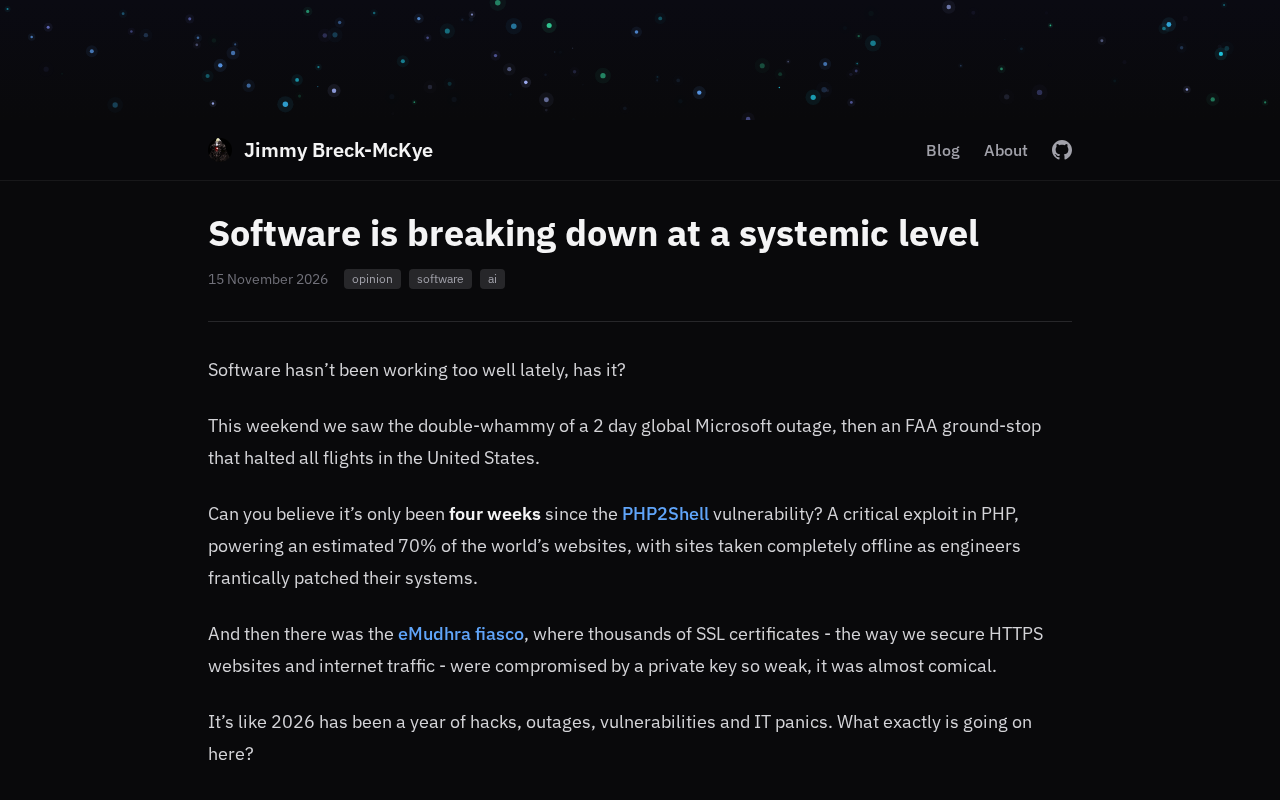
A developer argued in a blog post that "software is breaking down at a systemic level," sparking a heated discussion on Hacker News with 221 points and 122 comments. The headline isn't alarmist—it points to a phenomenon that is being repeatedly observed: from infrastructure to the application layer, software complexity is exceeding humanity's ability to maintain it, and AI's involvement is making the problem even more subtle.
What's Collapsing Isn't Code—It's Systemic Complexity
The core of the discussion isn't "some software has a bug," but rather that the reliability of the entire software ecosystem is declining. The article points to a structural predicament: modern software relies on layer upon layer of stacked abstractions—operating systems, containers, orchestration platforms, cloud services, third-party SDKs—each introducing its own set of failure modes. When problems arise, almost no engineer can fully trace the call chain from application to hardware.
This resonated strongly in the Hacker News comment section. Multiple commenters noted that system troubleshooting has become a "guessing game": logs scattered across multiple platforms, inconsistent monitoring metrics, and root cause analysis dependent on luck. Complexity itself has become the biggest technical debt.
Abstraction Layer is a mechanism in computer science for hiding underlying implementation details and providing simplified interfaces. From CPU instruction sets to operating system system calls, to container runtimes and cloud service APIs, each layer of abstraction allows upper-level developers to avoid understanding lower-level details, thereby improving development efficiency. However, abstraction isn't free: each layer can leak (leaky abstraction, where underlying exceptions penetrate to upper layers) and introduces independent failure modes. When a system is composed of dozens of stacked abstraction layers, the root cause of failures often hides in the edge behavior of one layer, while engineers' debugging tools and mental models typically cover only one or two of them. This is precisely the root of troubleshooting difficulties in modern distributed systems—not that the code itself is wrong, but that interactions between layers produce unpredictable emergent behavior.
AI Code Generation: Cure or Catalyst
An unavoidable variable is the proliferation of AI programming tools. They can rapidly generate code, fill in boilerplate logic, and significantly increase development speed. But the judgment in the comments is quite consistent: AI lowers the barrier to "writing code," not the barrier to "maintaining systems."
When large amounts of AI-generated code enter production environments, fewer people understand that code. A scissors gap emerges between the speed of code output and the speed of human understanding—this is precisely a source of systemic fragility. Some commenters believe that AI makes "getting it to run" easy and "knowing why it runs" harder, and the latter is the key to long-term reliability.
The "scissors gap" between code output and understanding can be understood through the software engineering concept of "cognitive debt." Traditional technical debt refers to design decisions that sacrifice long-term maintainability for short-term speed; cognitive debt refers to the proportion of a codebase that "no one can fully explain the behavior of." AI code generation tools significantly expand this proportion: developers can accept code suggestions without understanding the generated logic, resulting in AI-contributed fragments in the codebase lacking support from human mental models. Unlike test coverage or missing documentation, cognitive debt is difficult to quantify, yet directly determines whether a team can quickly locate problems when failures occur. Countermeasures the industry has begun discussing include: requiring AI-generated code to include explanatory comments, setting higher review thresholds for AI-contributed modules, and prohibiting unverified automatic generation on critical paths.
Vicious Cycles at the Organizational Level
Behind technical problems are organizational problems. An observation that repeatedly appears in the discussion: delivery pressure continuously squeezes quality investment, with testing and documentation being the first to be cut. In the short term, products launch faster; in the long term, maintenance costs rise non-linearly.
This pattern has a self-reinforcing characteristic: the harder the system is to maintain, the slower new people onboard, the more knowledge concentrates among a few veteran employees, the less the team dares to refactor, and the more technical debt rolls up. One commenter's summary is quite representative—the problem isn't that technical debt goes unrecognized, but that the cost of fixing it has become so high that no one dares to touch it.
The non-linear growth of technical debt stems from a feedback loop: rising maintenance costs reduce resources available for new feature development, teams further compress quality investment to meet deadlines, and the system becomes even harder to maintain. This pattern is known in organizational behavior as the compounding effect of "technical debt interest." Unlike financial debt, the "interest rate" on technical debt isn't fixed—the higher the system complexity, the greater the probability that each modification introduces new defects, and the longer it takes to fix them. More insidiously, this growth is almost invisible in the early stages, until after a certain tipping point maintenance costs suddenly consume most engineering resources. The "no one dares to touch it" mentioned in the comments is a typical symptom of this tipping point: the expected risk of refactoring exceeds the team's risk tolerance, and the system enters a state of rigidity.
Where Might the Way Out Be
The directions proposed in the comments fall roughly into several categories: first, reducing abstraction layers and returning to simpler, more understandable architectures; second, treating observability as a first-class citizen rather than an afterthought patch; third, enforcing a "humans must be able to explain" constraint in AI-assisted development.
Some commenters hold a more sober view: the growth of software system complexity is an inevitable result of growing requirements. Rather than fantasizing about returning to a simpler era, it's better to accept "partial incomprehensibility" and establish engineering practices that match it—smaller replaceable units, stricter interface contracts, and more frequent failure drills.
This discussion doesn't provide a final answer, but it accurately describes a shared feeling among engineers today: we are building systems more powerful than ever before, and also harder to control than ever before.
One-line Summary
Modern software is systemically fragile due to stacked abstractions and AI code generation, while organizational short-sightedness exacerbates the vicious cycle of technical debt.
Paragraph Summary
The article revolves around the assertion that "software is breaking down at a systemic level," pointing out that the problem isn't individual bugs but that modern software relies on layer upon layer of stacked abstractions, making it nearly impossible to fully trace the call chain during troubleshooting, with complexity itself becoming the biggest technical debt. AI programming tools lower the barrier to writing code but not the barrier to maintenance, creating a scissors gap between code output speed and human understanding speed, making "getting it to run" easy and "knowing why it runs" harder. At the organizational level, delivery pressure continuously squeezes investment in testing and documentation, and technical debt forms a self-reinforcing vicious cycle. The way out proposed in the comments includes reducing abstraction layers, treating observability as a first-class citizen, enforcing human-explainability constraints in AI-assisted development, and accepting partial incomprehensibility while establishing engineering practices with smaller replaceable units and strict interface contracts.
Related articles

Zero-Code Replication of a $10,000 3D Website with Claude Code: A Six-Tool Breakdown
Bilibili creator Yomi used Claude Code plus five free tools to build a 3D product landing page quoted at $10,000 overseas—zero code. Breakdown of the six-tool division of labor, image-to-3D workflow, and the core collaboration method: "give AI a reference, not 'make it look better.'"
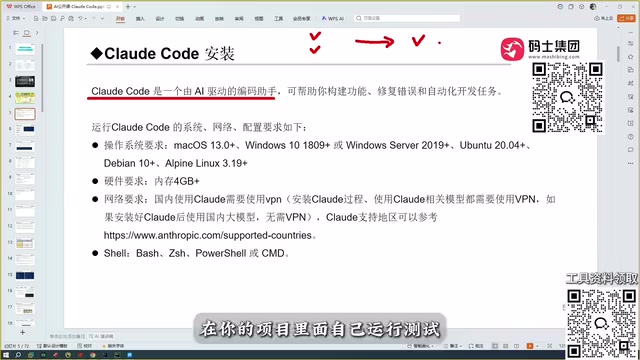
Claude Code in Practice: Install, Connect Models, Calculate Tokens, and Ship a Full-Stack Project with a Single Document
Based on a Bilibili public course demo, this covers Claude Code installation, model connection, token cost calculation, and the practical path of shipping a full-stack project with a single document, plus comparisons with Copilot, Cursor, Trae, and other coding assistants.
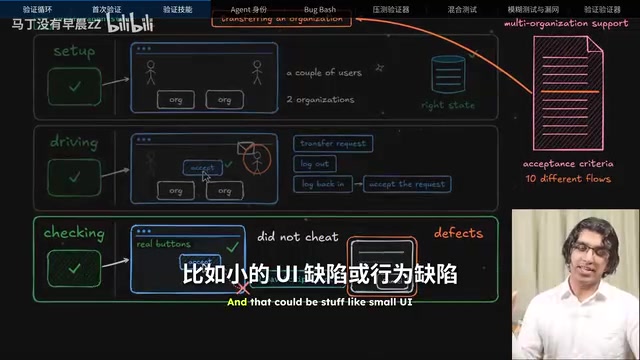
Who Accepts AI-Written Code? A 25-Minute Deep Dive into Verification Loops and the New Code Review Paradigm
After AI writes lots of code, how should Code Review verify it? This article breaks down the Claude Code team's verification loop framework: surface-level end-to-end verification, setup/drive/check three-stage skills, hybrid end-to-end testing and reliability checklists, and how to tighten the loop when issues slip through.