Tailcat: An Open-Source Tool for Using netcat Over Tailscale Networks

Tailcat brings netcat's simplicity to Tailscale networks with built-in WireGuard encryption and NAT traversal.
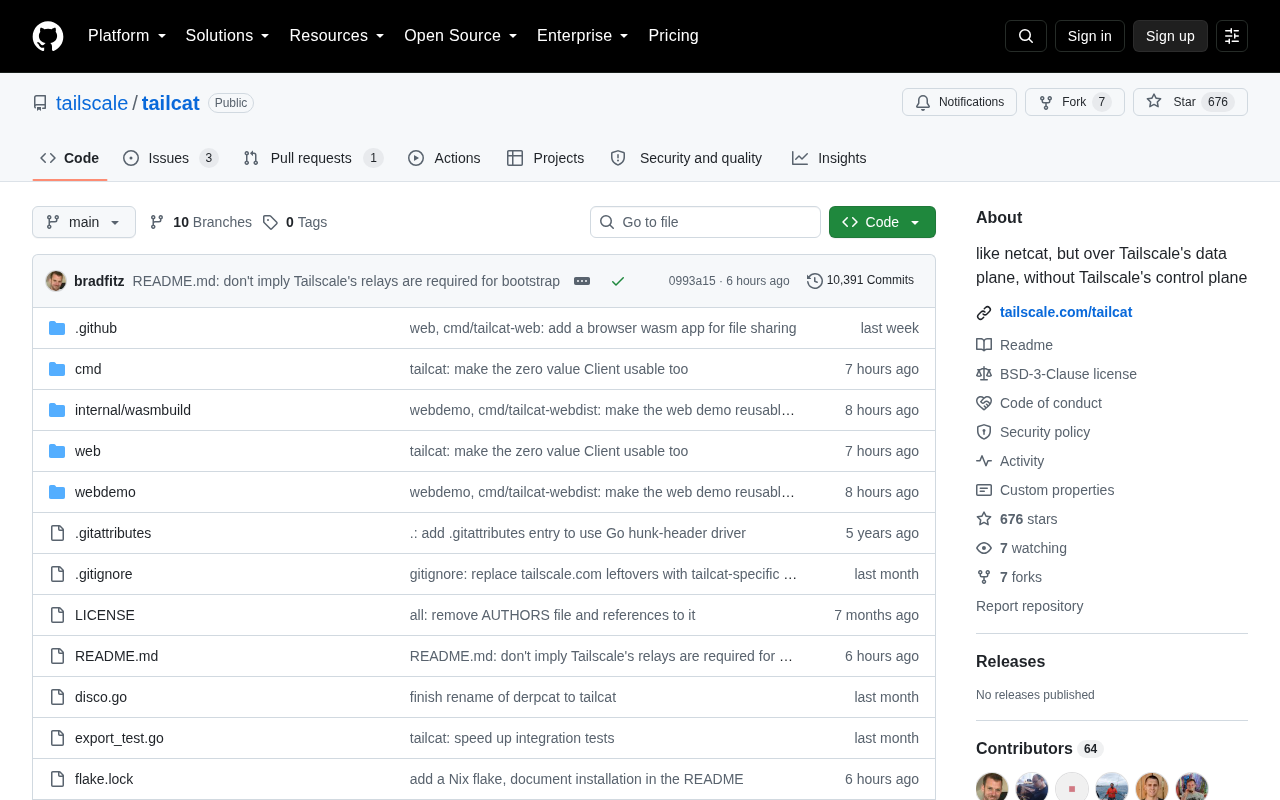
Tailcat is an open-source tool that combines netcat's minimalist networking philosophy with Tailscale's modern data plane. It enables seamless cross-network connections with WireGuard end-to-end encryption and automatic NAT traversal, eliminating the need for port forwarding or SSH tunnels. The project gained significant traction on Hacker News, reflecting growing demand for native tools built around modern overlay network platforms.
When netcat Meets Tailscale
In the toolbox of network engineers and system administrators, netcat (or nc) is practically indispensable. Known as the "Swiss Army knife" of networking, it can read and write TCP or UDP connections, serving use cases like port scanning, data transfer, and debugging network services. Originally released by Hobbit in 1995, its design philosophy is deeply influenced by the Unix tradition — do one thing well and compose with other tools via pipes. Typical uses include: listening on a port as a server (nc -l 8080), connecting to remote services as a client, transferring files, and performing port scans. Due to its versatility, netcat is widely used in penetration testing, network debugging, and system operations, with multiple implementations coexisting today — GNU netcat, ncat (from the Nmap project), and the OpenBSD version.
However, with the rise of Zero Trust architectures and modern overlay networks, traditional netcat has become increasingly inadequate for cross-network and cross-NAT scenarios. Zero Trust is a security model proposed by Forrester Research analyst John Kindervag in 2010, built on the core principle of "never trust, always verify" — rather than relying on network perimeters as the basis of trust, every access request must be authenticated and authorized. This stands in stark contrast to the traditional "castle and moat" model, where anything inside the internal network is trusted by default. Google's BeyondCorp project is a landmark implementation of Zero Trust architecture, while Tailscale brings this concept to small teams and individual developers in a more lightweight fashion.
Recently, an open-source tool called Tailcat sparked lively discussion on Hacker News, garnering 463 upvotes and 90 comments. Its positioning is straightforward: use it like netcat, but running on Tailscale's data plane. This clever combination lets developers enjoy the simplicity of netcat-style connections within the private network built by Tailscale.
How Tailscale's Data Plane Works
To understand Tailcat's value, you first need to understand Tailscale. Tailscale is a modern VPN/overlay network service built on the open-source WireGuard protocol. It establishes encrypted tunnels between all your devices in a peer-to-peer (P2P) fashion, forming a virtual private LAN (tailnet) — even when those devices are on different physical networks and behind different NATs.
WireGuard is a modern VPN protocol developed by Jason A. Donenfeld, merged into the Linux kernel mainline in 2020 (version 5.6). Compared to OpenVPN and IPsec, WireGuard has an extremely small codebase (~4,000 lines vs. hundreds of thousands), making security audits far more feasible. WireGuard uses the Noise Protocol Framework for key negotiation, ChaCha20 for symmetric encryption, Poly1305 for message authentication, Curve25519 for key exchange, and BLAKE2s for hashing. These are all well-vetted primitives in modern cryptography. WireGuard uses UDP transport and has excellent roaming support — when a device's IP changes, as long as correctly authenticated packets can be received, the tunnel automatically recovers without renegotiation.
Separation of Control Plane and Data Plane
Tailscale's architecture employs a separation of control plane and data plane — a classic design pattern in modern networking, widely used in SDN (Software-Defined Networking) and cloud computing:
- Control Plane: Handles coordination, authentication, key distribution, and network topology management, served by Tailscale's centralized service.
- Data Plane: The part that actually transmits user data, using decentralized P2P direct connections where data doesn't pass through Tailscale's servers (when direct connection is possible).
This separation offers multiple benefits: the control plane can be centralized to simplify operations and policy enforcement, while the data plane remains decentralized to reduce latency and avoid single points of failure. In Tailscale's context, this means that even if Tailscale's centralized service is temporarily unavailable, already-established P2P connections continue to work — because keys have already been distributed and data transmission doesn't depend on the central node. This is also the technical foundation that enables Tailcat to plug directly into the data plane.
NAT Traversal Implementation
A core challenge Tailscale solves for P2P connections is NAT traversal. NAT (Network Address Translation) is a ubiquitous technology on the internet that allows multiple devices to share a single public IP, but it also creates difficulties for peer-to-peer connections: devices behind NAT cannot be directly reached from outside. Tailscale uses multiple NAT traversal techniques to solve this, including STUN (Session Traversal Utilities for NAT) for discovering a device's public address and NAT type, and protocols similar to ICE (Interactive Connectivity Establishment) for coordinating connection establishment. When direct connection is impossible (e.g., both parties are behind symmetric NAT), Tailscale forwards traffic through relay servers called DERP (Designated Encrypted Relay for Packets), but data remains end-to-end encrypted.
Tailcat plugs directly into this data plane. Data transmitted through Tailcat inherently enjoys WireGuard's end-to-end encryption protection while being able to traverse NAT, firewalls, and other network obstacles without manual port mapping configuration.
Core Features and Advantages of Tailcat
Simplified Cross-Network Connections
With traditional netcat, establishing a connection between two machines on different networks often requires dealing with public IPs, port forwarding, firewall rules, and other tedious configurations. Tailcat leverages Tailscale's capabilities so that as long as both devices have joined the same tailnet, they can communicate directly as if they were on the same LAN.
This is particularly useful for:
- Quickly transferring files between home networks and cloud servers
- Debugging private services running behind NAT
- Establishing temporary data channels in development environments
- Remotely testing port connectivity
Security Through WireGuard Encryption
Unlike plain netcat's unencrypted transmission, all Tailcat traffic is encrypted via WireGuard. This is a significant advantage in data-sensitive scenarios. You no longer need to wrap an extra SSH tunnel or TLS layer to ensure transmission security, because Tailscale's data plane has encryption built in. Notably, WireGuard's encryption operates at the network layer (Layer 3), meaning that regardless of what protocol data Tailcat is transmitting, it will be transparently encrypted with minimal overhead — WireGuard typically achieves near-line-speed performance on modern hardware.
Preserving netcat's Minimalist Philosophy
Tailcat doesn't try to reinvent the wheel. Instead, it carries forward netcat's lean, focused Unix tool philosophy. It does one thing well — sending and receiving raw data over Tailscale networks — and delegates complex network negotiation to Tailscale. This "compose small tools" approach is exactly what many developers advocate.
Community Response and Ecosystem Positioning
The high level of engagement on Hacker News shows that projects combining mature tools with modern network infrastructure are very well received by the technical community. Discussion in the comments generally focused on several themes:
On one hand, developers acknowledged Tailcat's ability to lower the barrier for cross-network debugging, noting that it fills a practical gap in the Tailscale ecosystem. On the other hand, discussions also touched on comparisons with existing Tailscale commands (like tailscale serve and tailscale funnel), and which approach is more appropriate for specific scenarios.
One detail worth noting: Tailcat represents a trend — an increasing number of native tools are emerging around modern network platforms like Tailscale. Tailscale offers rich developer interfaces that allow third-party tools to easily plug into its network. The tsnet library (in Go) lets developers embed Tailscale directly into applications without installing the full Tailscale client. Tailscale also provides a local API, MagicDNS functionality (access devices directly by hostname), ACL (Access Control List) policy language, and more. Tailscale is no longer just a VPN — it's gradually becoming a programmable and extensible network infrastructure layer, making "connecting any two devices" as simple as calling a local service.
Who Is Tailcat For?
Tailcat isn't for everyone. If you're already using Tailscale to manage your device network and frequently need to perform port testing, ad-hoc data transfers, or network debugging, Tailcat will be a handy addition to your toolkit.
For users not on Tailscale, Tailcat's value is diminished — after all, its core capability entirely depends on Tailscale's data plane. In that case, traditional netcat with SSH tunnels, or other overlay network solutions (like Nebula or ZeroTier), may still be more practical choices. It's worth mentioning that Tailscale's control plane has an open-source alternative called Headscale, which allows users to self-host the control server, extending Tailcat's applicability to some degree.
Conclusion
Tailcat is a quintessential example of an elegant tool "standing on the shoulders of giants." It doesn't try to solve every problem but instead focuses on seamlessly grafting the classic netcat experience onto the secure, user-friendly modern network that Tailscale provides. For developers in the Zero Trust era, these small but well-crafted tools often deliver unexpected productivity gains in daily work.
As the WireGuard and Tailscale ecosystems continue to grow, we have every reason to expect more native tools like this to emerge, bringing complex network operations back to their simple, intuitive essence.
Related articles

Chain of Thought Isn't Just for AI: How Humans Can Use CoT to Improve Thinking Quality
Chain of Thought isn't just a prompt trick for large models. Starting from a Hacker News discussion, this article analyzes why CoT works for human thinking too, breaks down actionable ways to transfer it, and highlights the key differences between human CoT and machine CoT.
Cloudflare Teams Up with OpenAI: Closi…
Cloudflare Teams Up with OpenAI: Closing the Loop from Vulnerability Discovery to Defense with AI
Cloudflare uses OpenAI Daybreak to investigate security vulnerabilities and generate reviewable remediation plans, while developers use Codex to boost coding efficiency and quality.

Orca Multi-Agent Orchestration in Practice: A Guide to Parallel Collaboration with Claude and Codex
Orca is Stable AI's free open-source agent workbench supporting 34 agents like Claude Code and Codex in parallel. Learn its Git worktree isolation, multi-model orchestration, and mobile management.