If I Could Go Back to 17, I'd Learn to Build LLMs from Scratch

A Hacker News debate on whether young learners should prioritize building LLMs from scratch or focus on applied AI skills.
A Hacker News post arguing "If I were 17, I'd learn to build LLMs from scratch" sparked widespread debate. This article explores the long-term value of understanding Transformer fundamentals, the community divide between deep knowledge and applied skills like RAG and prompt engineering, and practical learning paths including Karpathy's nanoGPT and Raschka's book. The takeaway: deep understanding of fundamentals remains the most durable advantage in a rapidly evolving AI landscape.
A Take That Sparked Heated Debate
Recently, a post titled "If I were 17, I'd learn how to build LLMs from scratch" ignited widespread discussion on Hacker News. The core argument strikes at the heart of today's hottest tech trend: in an era where the AI wave is sweeping the globe, how should young people plan their technical learning path?
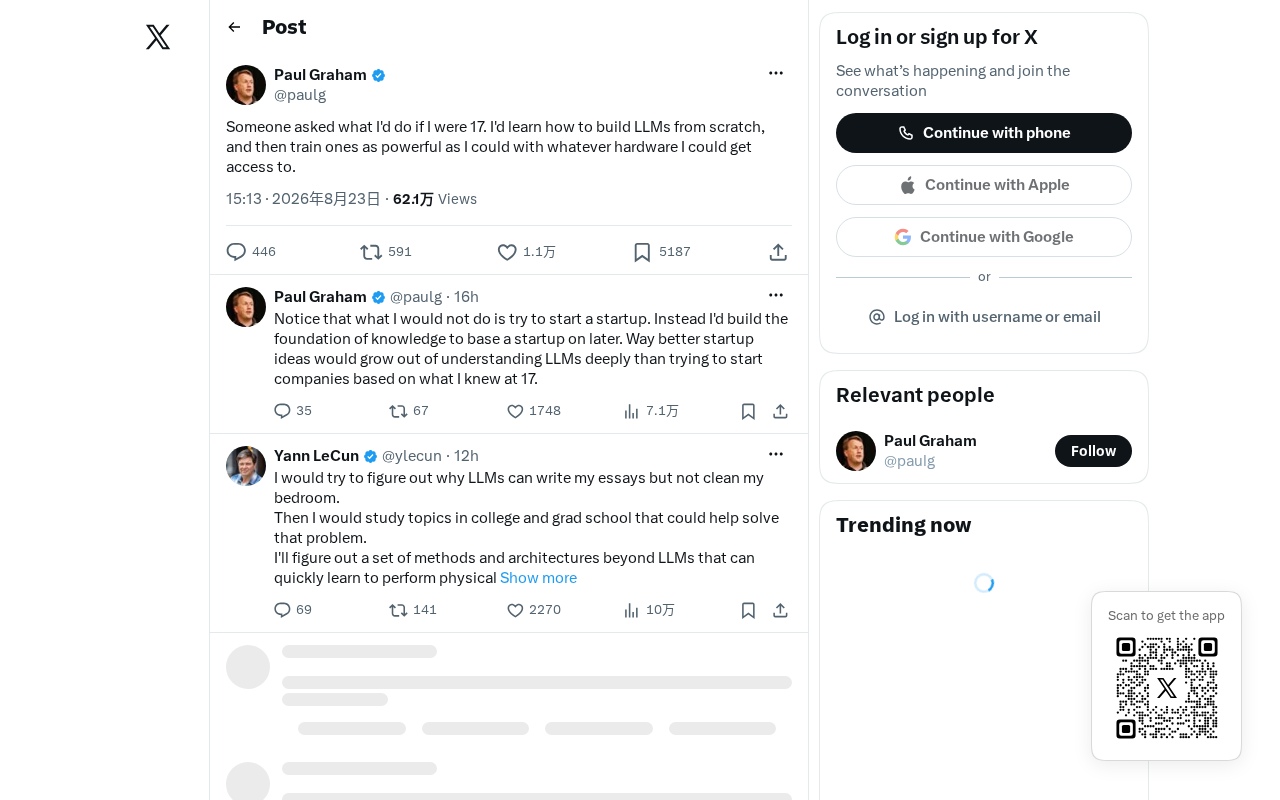
The author frames the argument through the lens of "going back to 17," taking a clear stance — if starting over, building a large language model (LLM) from scratch would be the top learning priority. While seemingly simple, this viewpoint touches on deeper issues spanning technical education, career planning, and talent development in the AI era. The active engagement in the comments — 23 upvotes and 34 comments — underscores the topic's controversial yet magnetic appeal.
Why "Build an LLM from Scratch"?
The Long-Term Value of Understanding Fundamentals
The phrase "from scratch" is the crux of the entire argument. Today, calling APIs from OpenAI, Anthropic, and other providers has become incredibly easy — a high school student can build a decent-looking chatbot in just a few hours. However, truly understanding the Transformer architecture, attention mechanisms, backpropagation, and how tokenizers work is an entirely different level from simply calling an API.
The Transformer architecture was first introduced by a Google team in their landmark 2017 paper Attention Is All You Need, fundamentally changing the paradigm of natural language processing. Before that, sequence modeling primarily relied on Recurrent Neural Networks (RNNs) and Long Short-Term Memory networks (LSTMs), which struggled with vanishing gradients and parallelization when processing long sequences. The Transformer's core innovation is Self-Attention, which allows the model to "attend to" all other positions in the input sequence simultaneously when processing each token, efficiently capturing long-range dependencies through Query, Key, and Value matrix operations. Every major large language model today — the GPT series, Claude, LLaMA, Gemini — is built on the Transformer architecture.
Building a small LLM from scratch means you need to write self-attention layers by hand, implement positional encoding, and figure out how gradient descent propagates through billions of parameters. Positional Encoding is an easily overlooked but critically important component — unlike RNNs, which naturally process sequences in order, the Transformer's self-attention mechanism is inherently permutation-invariant. Without positional information, the model can't distinguish between "the cat ate the fish" and "the fish ate the cat." From the original sinusoidal fixed encodings to Rotary Position Embedding (RoPE), now widely adopted by mainstream models like LLaMA and Qwen, positional encoding design directly impacts the context window length a model can handle and remains a core research topic for long-context models.
Tokenizers serve as the "entry point" component of large models. Modern LLMs commonly use subword tokenization strategies like BPE (Byte Pair Encoding), which iteratively merges the most frequent character pairs to build a vocabulary, striking a balance between vocabulary size (typically 30,000 to 100,000 tokens) and expressive power. Tokenizer design directly affects model performance and multilingual processing efficiency — what seems like a simple preprocessing step involves rich engineering trade-offs under the hood.
Backpropagation and gradient descent present equally significant challenges at the scale of large models. When parameter counts reach billions or even trillions, storing gradients and optimizer states for all parameters demands massive amounts of GPU memory, numerical stability issues in deep networks require techniques like layer normalization and gradient clipping, and distributed parallel training strategies (data parallelism, tensor parallelism, pipeline parallelism) are core knowledge in large model engineering.
This deep understanding paradoxically becomes the most durable skill in a rapidly evolving AI landscape — tools change, but the underlying math and engineering principles remain relatively stable.
Seizing the Window of Generational Opportunity
The author's choice of "17 years old" as the age is also quite deliberate. For young people at the peak of their knowledge absorption capacity, this is the historic window when LLM technology transitions from the lab to industry. Just as the previous generation of programmers seized the opportunities of the internet and mobile revolutions, young people who deeply understand generative AI's underlying technology will likely hold a first-mover advantage over the next decade.
The Community Divide: Fundamentals vs. Applied Skills?
This kind of argument tends to spark two distinctly opposing camps in tech communities.
Supporters argue that going deep into the fundamentals builds core competencies that are hard to replace. In an era of proliferating AI applications, mastering the underlying principles of LLMs is what truly sets you apart.
Skeptics counter that for the vast majority of use cases, understanding how to use LLMs may be more practically valuable than knowing how to build them. After all, the organizations capable of training competitive large models from scratch can be counted on one hand — most developers need applied skills like prompt engineering, RAG (Retrieval-Augmented Generation), and model fine-tuning.
It's worth explaining here that RAG (Retrieval-Augmented Generation) has become one of the most important technical paradigms in enterprise AI applications today. Its core idea is to retrieve relevant document fragments from an external knowledge base before the LLM generates a response, then inject the retrieved results as context into the prompt so the model generates answers based on reference materials. This approach was first systematically proposed by Meta AI's research team in 2020 and effectively addresses three major pain points of large language models: knowledge cutoff dates, hallucinations, and insufficient domain knowledge. A typical RAG system encompasses document chunking, vector embeddings, vector database indexing, semantic retrieval, and answer generation. Compared to fine-tuning the entire model, RAG is lower cost, more interpretable, and allows real-time knowledge updates, making it the preferred approach for most enterprises deploying LLM applications.
Others argue that at 17, you should prioritize building a strong foundation in math and programming rather than diving prematurely into any specific technology.
This divide fundamentally reflects the classic trade-off in technical education between "depth" and "breadth," and between "theory" and "practice."
Practical Takeaways for Young Learners
Learning Paths for Building an LLM from Scratch
The good news is that the barrier to learning how to build LLMs from scratch has dropped significantly. The following resources provide a clear roadmap for beginners:
- Andrej Karpathy's "nanoGPT" and "Let's build GPT" tutorial series: A hands-on, step-by-step guide to implementing a minimal GPT model. Karpathy, former Tesla AI Director and OpenAI co-founder, open-sourced the nanoGPT project which implements a trainable GPT model in roughly 600 lines of Python, distilling what would normally require thousands of lines of code into something a beginner can understand line by line. His YouTube tutorial "Let's build GPT: from scratch, in code, spelled out" has accumulated over ten million views and is widely regarded as one of the best introductory resources for understanding Transformers.
- Sebastian Raschka's Build a Large Language Model (From Scratch): A systematic walkthrough of the complete process of building an LLM from the ground up. Raschka, a machine learning researcher at the University of Wisconsin, covers everything from data preprocessing and model architecture implementation to pre-training and instruction fine-tuning, providing a complete hands-on learning path.
- Google Colab free GPU resources: Even without a high-end computer, you can train a small language model capable of generating coherent text. While Colab's free T4 GPU has limited compute power, it's more than sufficient for training character-level or small-scale language models.
The availability of these resources has dramatically democratized AI education — just five years ago, implementing a language model from scratch required deep academic expertise and substantial computing resources, but today an ordinary laptop is enough to begin the journey.
A More Balanced Learning Strategy
Synthesizing the community discussion, a more sensible recommendation might be: don't treat "building from scratch" as the only goal, but rather as an effective means of deeply understanding AI. By implementing a minGPT yourself, you'll truly grasp the engineering details behind the "magic" of large models. That said, you shouldn't neglect applied skills like prompt engineering and RAG, nor a solid foundation in math and programming.
Conclusion
The reason this Hacker News post resonated so widely is that it touches on a question every tech practitioner is grappling with: in an era of seismic technological change, what knowledge is most worth investing your time in?
The idea of "building an LLM from scratch" may not be right for everyone, but its core message — pursuing deep understanding of underlying principles rather than staying at the surface level of tool usage — holds value for learners of any age. Whether you're 17 or 37, maintaining curiosity and a drive to explore the essence of technology is always the best strategy for navigating an uncertain future.
Key Takeaways
Related articles

Bilibili's Hit Dify Tutorial: A Practical Guide to Building 20+ AI Apps from Scratch
A distilled guide to Bilibili's top-rated Dify tutorial: Windows + Docker deployment, MySQL connection, five app types, model integration strategy, and publishing.

Agent Skills Beginner's Guide: From Concepts to Multi-Agent Collaboration in Practice
A comprehensive guide to Agent Skills: core concepts, components, the importance of Description, standardization, beginner learning paths, and multi-agent collaboration.

One Neuron Detects Both Cats and Cars? We Reproduced It and Found a New Explanation
The cat-car neuron reinterpreted: researcher Cammarata argues it distinguishes pointy from round, not cats from cars. We reproduced the experiment and found the new explanation holds on most inputs—but cars are the exception. The interpretability debate continues on language models.