Tellie Prompter 1.5 Review: An AI Teleprompter That Follows Your Rhythm

Tellie Prompter 1.5 is a lightweight local AI teleprompter that follows your speech rhythm instead of making you follow it.
Tellie Prompter 1.5 is a 3MB Mac-native AI teleprompter that uses real-time speech recognition to follow your pace rather than forcing you to keep up with scrolling text. Version 1.5 adds key point tracking, smart duration alerts, and post-recording debrief analysis. Running entirely offline with no account or telemetry required, it's priced at a one-time $10 purchase—offering privacy-first, lightweight AI prompting for creators, educators, and presenters.
When a Teleprompter Starts to "Understand" You
The logic behind traditional teleprompters is simple: text scrolls at a fixed pace, and you must keep up. The moment you improvise, pause unexpectedly, or skip a section, you easily lose your place and end up in an awkward scramble. This is why many video creators and speakers have a love-hate relationship with teleprompters—they provide a safety net but constrain natural expression.
Tellie Prompter breaks this deadlock with an inverse approach. As its tagline says, "Most teleprompters make you follow them. Tellie follows you." It uses speech recognition to listen to what you're actually saying in real time and determines where you are in the script accordingly. This means you can freely pause, skip ahead, add impromptu remarks, or briefly go off-script without worrying about losing your place—the software automatically keeps up with your pace.
From a technical standpoint, the voice-tracking technology Tellie employs is a real-time application variant of "Forced Alignment" technology. Traditional forced alignment is primarily used in phonetics research, matching known text to audio signals along a timeline. Tellie applies this principle to a real-time scenario: the system continuously compares the microphone's incoming speech stream against the pre-loaded script through the coordinated work of acoustic and language models to determine where the speaker currently is in the text. The Speech Recognition framework built into macOS since Ventura can already perform high-quality speech recognition locally, providing the underlying technical foundation for Tellie's purely local implementation.
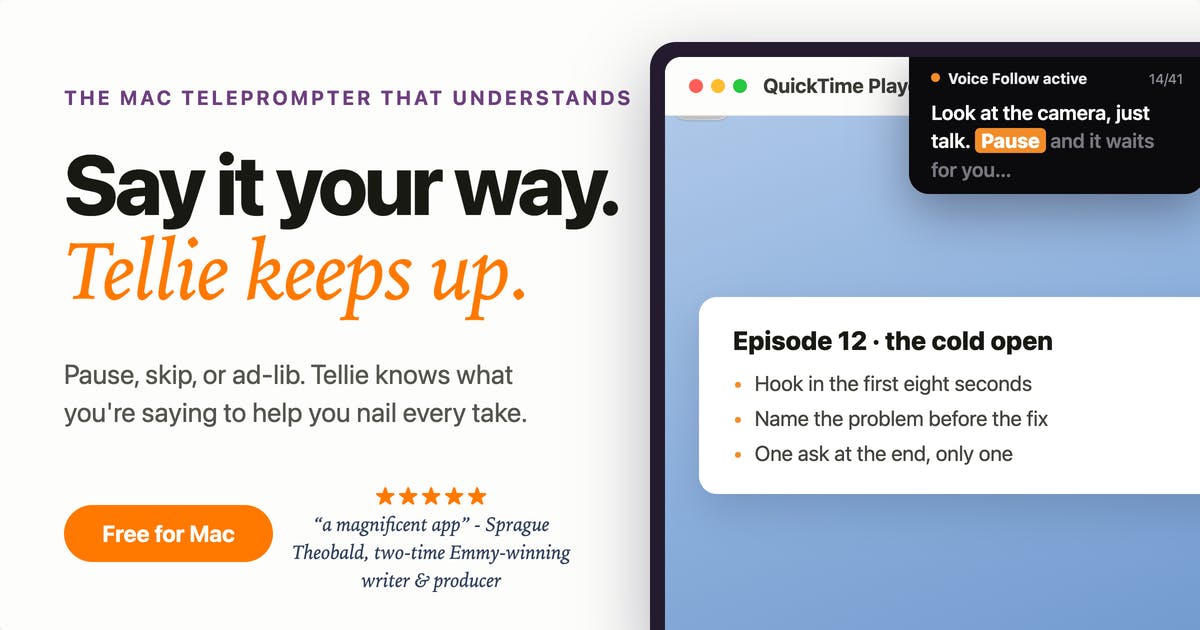
Tellie Prompter 1.5 Core Upgrades: Anticipating What You Haven't Said Yet
The latest 1.5 version pushes the smart prompting capabilities to new heights. Its newest tagline is quite telling: "Knows the things you haven't said yet." This isn't just marketing speak—it's backed by several substantial new features:
Key Point Tracking
Tellie 1.5 can identify and track important arguments in your script, ensuring you don't miss critical information when improvising or skipping sections. This feature is especially valuable for educational videos, product demos, or business pitches that rely on structured delivery—it acts like an invisible assistant, helping you maintain your content's backbone.
Behind this feature lies information extraction and semantic understanding technology from Natural Language Processing (NLP). The system needs to perform semantic analysis on the user's script to identify core arguments, key data, and essential logical nodes—similar to the "extractive summarization" method in automatic summarization, which uses sentence importance scoring to determine which content is structural and cannot be omitted. In the real-time scenario, the system also needs to cross-reference what the user actually says against these key points, determining which have been covered and which have been missed, and then providing visual cues at the appropriate moment.
Smart Duration Alerts
The new version alerts you when you're "talking too long." Controlling duration is a perennial challenge in content creation—whether it's the golden first few seconds of a short video or the strict time limits of a pitch presentation, going over time can lead to real losses. Tellie's real-time reminders give creators clearer control over their pacing.
Post-Recording Debrief Analysis
After recording, Tellie performs a "debrief" analysis of your session. This feature extends the teleprompter from a simple assistance tool into an expression training partner that covers the entire pre-recording, recording, and post-recording workflow.
Extreme Lightweight Design and Privacy-First Philosophy
Beyond its features, what's perhaps most impressive about Tellie Prompter is its technical philosophy. The entire application is only 3 MB—remarkably compact for a native Mac application. In today's software ecosystem where apps routinely weigh hundreds of megabytes, this extreme minimalism is a statement in itself.
A fully-featured intelligent app occupying only 3MB technically means Tellie heavily relies on macOS's built-in frameworks rather than bundling third-party libraries. The macOS platform provides rich native capabilities: the Speech framework handles speech recognition, the NaturalLanguage framework provides text analysis, and AVFoundation processes audio input. By fully leveraging these system-level APIs, developers don't need to package massive machine learning models or runtime environments into the app. For comparison, the Electron framework used by many cross-platform apps requires over 100MB for the runtime alone. Tellie's strategy of native Swift development not only brings size advantages but also ensures lower memory usage and better system integration.
More critically, there's its privacy commitment: completely local operation, no account required, no telemetry data. This means your voice and script content are never uploaded to any cloud server—all processing happens on your own device. For professionals handling confidential business presentations, unreleased product information, or sensitive content, this "data never leaves the device" design provides genuine peace of mind.
At a time when AI applications overwhelmingly depend on cloud-based large models and routinely require logins and data collection, Tellie has chosen a restrained path—implementing intelligent features through local, tracking-free means. This aligns perfectly with the Local-First software philosophy that has gained momentum in recent years. "Local-First" is a software design philosophy systematically articulated by Ink & Switch lab in their paper of the same name. Its core argument is that sovereignty over user data should belong to the user, and software should prioritize computation and storage on local devices rather than relying on cloud services. The rise of this philosophy relates to multiple factors: the risk of cloud service providers shutting down, increasingly strict data privacy regulations (such as GDPR), and growing user awareness of data sovereignty. As Apple Silicon's Neural Engine and Core ML framework mature, an increasing number of AI inference tasks can be efficiently completed on consumer devices, making local-first AI applications not just idealistic but technically viable choices.
Tellie Prompter Pricing and Market Performance
Tellie Prompter 1.5 received solid attention on Product Hunt, earning 99 upvotes and ranking 7th on the daily leaderboard. It was categorized under Productivity, Video Streaming, and Artificial Intelligence. The product was built by Steve Chazin.
In terms of pricing, Tellie takes a straightforward approach: 10-day free trial, with a full price of $10 (one-time purchase), plus a PRODHUNT10 promo code for Product Hunt users providing an additional $10 discount. This one-time purchase, low-price model better meets the expectations of independent creators and light users compared to subscription-based competitors.
From a competitive landscape perspective, the current teleprompter software market roughly divides into three tiers: the first tier consists of professional hardware+software solutions (such as Autocue, Datavideo), priced in the thousands of dollars and targeting the broadcast television industry; the second tier comprises subscription-based SaaS tools (such as PromptSmart, BigVu), typically $10-30/month, offering cloud collaboration and template features; the third tier is lightweight independent apps. Tellie clearly positions itself in the third tier but achieves a functional leap toward the second tier through its AI voice-following capability. Notably, PromptSmart was one of the earliest products to introduce voice following to teleprompters, but it uses a subscription model and requires cloud processing. Tellie creates clear differentiation through its privacy approach and pricing model.
Who Needs This AI Smart Teleprompter Most?
Tellie's positioning is crystal clear—it serves creators who need prompting assistance but don't want to be held hostage by their scripts. This includes:
- YouTubers and short-form video creators: Need to maintain natural delivery while not missing key points;
- Online educators: Often need to expand impromptu during lectures while managing time;
- Product demo presenters and pitch speakers: Need to fully convey key information within limited time;
- Privacy-conscious professionals: Don't want sensitive scripts passing through third-party servers.
Conclusion: A New Benchmark for Lightweight Local AI Teleprompters
Tellie Prompter 1.5 represents an AI application philosophy worth paying attention to: rather than pursuing comprehensive cloud capabilities, it solves a specific pain point through a lightweight, local, focused approach. It transforms the teleprompter from "you accommodating the tool" to "the tool accommodating you," then layers on key point tracking, duration alerts, and post-recording debrief features, bringing teleprompting back to its essence of "helping people express themselves better."
For content creators on the Mac platform, a 3 MB, account-free, telemetry-free, one-time purchase smart teleprompter is undoubtedly a choice worth trying.
Related articles

Gaussian Process Bandit Optimization: Exploration Strategies and Inference Regret Guarantees
Cumulative regret guarantees in Bayesian optimization fail to reflect final recommendation quality. This article examines a new study that provides inference regret guarantees for Gaussian process bandit optimization through exploration query strategies and fill distance analysis, validated on hyperparameter optimization and control tasks.
The Most Detailed Codex Guide on Bilibili: From Installation to Real-World Practice
The most detailed Codex guide on Bilibili: from app store installation to daily work mode configuration, with a real coffee shop project demonstrating file organization, data extraction, dashboard creation, and other practical tasks. Learn to use Plan Mode and desktop pets to leverage Codex efficiently.

Appearance Compensation in Volume Rendering: Why RGB Accuracy Cannot Guarantee Density Correctness
Volume rendering research reveals that volumetric data perfectly reproducing external RGB views may still contain density errors: appearance compensation can double central density and keep external rays unchanged even when L2 error exceeds 14.52%. Density recovery depends on appearance capacity, spatial resolution, and measurement design.