Talyn: Run Claude Code and Codex in Parallel in Cloud Sandboxes
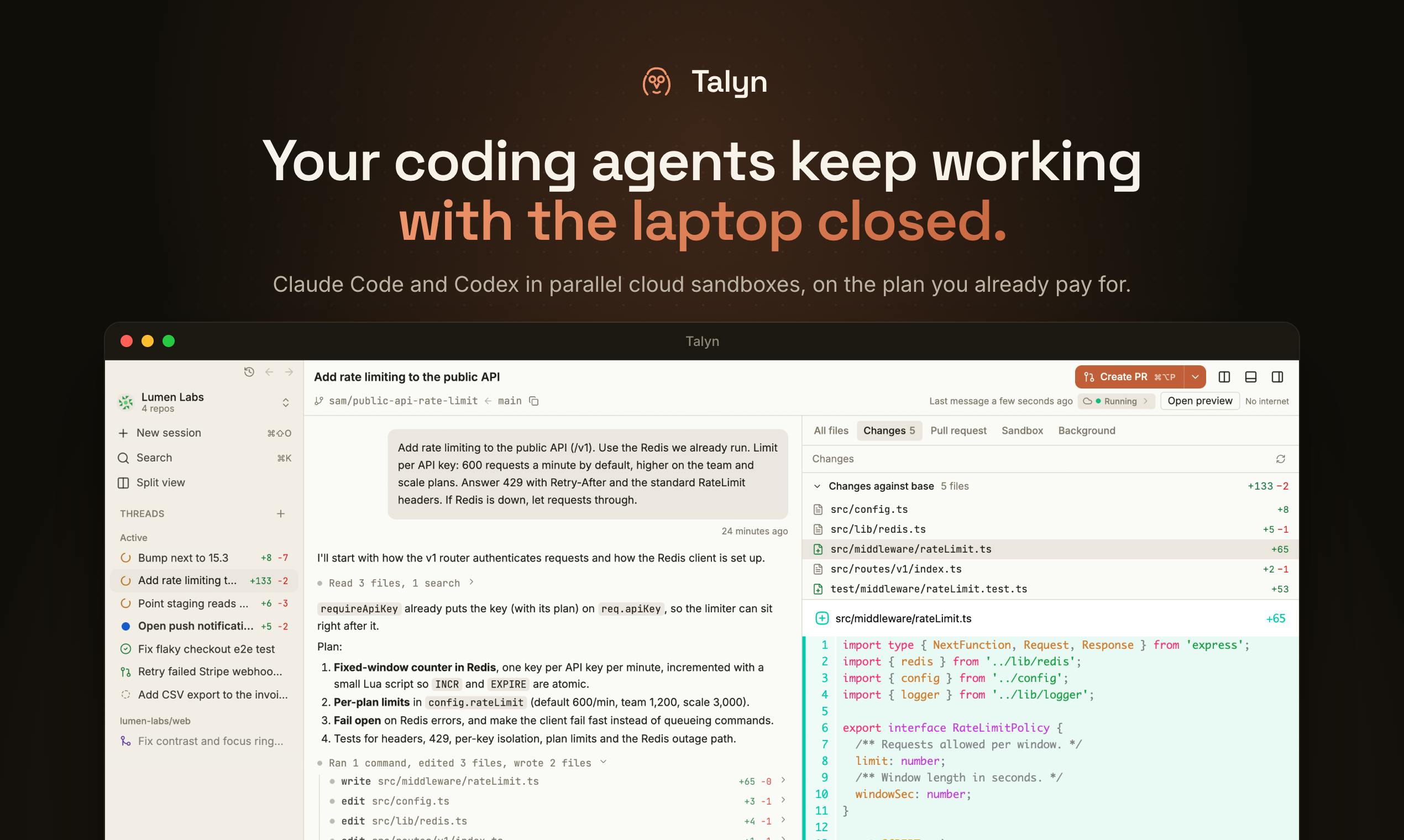
Talyn moves Claude Code and Codex into parallel cloud sandboxes, reusing existing subscriptions and delivering PRs asynchronously.
Talyn is a developer tool ranked fourth on Product Hunt. Its core idea is to move AI coding agents like Claude Code and Codex from the local terminal to parallel cloud sandboxes for execution. Each sandbox carries an independent task without blocking others, letting users push multiple coding jobs forward at once; tasks run asynchronously, so users can close their laptop and come back to a diff or a pull request that has already passed CI checks. It reuses users' existing paid model plans without reselling credits, offers 10 box-hours per month for free, and supports GitHub as well as macOS, Windows, Linux, and the browser. The article notes that Talyn doesn't change model capabilities; it optimizes where tasks execute and their concurrency, and its long-term value depends on details not yet public, such as sandbox consistency, security boundaries, and cost structure.
From Local Terminal to Cloud Sandbox: A Parallelization Attempt for AI Coding Assistants
AI coding assistants are moving from "assisted input" toward "agentic execution," but most developers are still constrained by their local environment: close the laptop and the task is interrupted; queue up multiple tasks and you can only wait serially. Talyn, a new product ranking fourth on Product Hunt, tries to solve this problem—it lets Claude Code and Codex run in parallel inside cloud sandboxes, so users can close their computer and come back to a diff or an already-green pull request.

Talyn's core proposition is straightforward: use the plan you already pay for (on the plan you already pay for) to move AI coding tasks into parallel cloud boxes for execution. It offers 10 box-hours per month for free, supports GitHub, and works on macOS, Windows, Linux, or a browser. The product is built by Tom Owers and is categorized under open source, software engineering, and developer tools.
How Does Talyn Actually Work?
Parallel Sandboxes: Running Multiple Coding Tasks Simultaneously
In traditional usage, a developer interacts with Claude Code or Codex in a single terminal—tasks are serial and depend on the local machine. Talyn puts these sessions into independent cloud sandboxes (boxes), each handling one task and not blocking one another. This means you can have Claude Code fix one bug while Codex writes tests for another module, and they won't compete for your local CPU or terminal windows.
The original text emphasizes "parallel cloud sandboxes" and "on the plan you already pay for," indicating that Talyn does not resell model credits but rather reuses the user's existing subscription. This lowers the barrier to trying it out and avoids double billing.
What Are Claude Code and Codex
Claude Code is a command-line AI coding agent from Anthropic that runs in the terminal, capable of reading project files, executing commands, modifying code, and iterating on its own—essentially packaging a large model into an agent that can autonomously complete multi-step coding tasks. Codex is OpenAI's code model and agent system (originally the Codex model, later evolving into a toolchain supporting agentic coding), which likewise can understand repository context and generate/modify code. What they share: both work as "agents" rather than "autocomplete," and can execute multiple steps in sequence. This also explains why they can be moved into sandboxes—the tasks themselves are self-contained and can run asynchronously to completion, without depending on the developer confirming line by line.
Close the Laptop, Come Back to a PR
The most compelling scenario in the product description is: "Close the laptop and come back to a diff, or to a pull request that is already green." Behind this is a shift toward asynchronous workflows—coding tasks no longer require the developer to watch the whole time; instead they run in the background like a CI pipeline and deliver reviewable code changes when done. For developers who need to switch context frequently, this "submit task—leave—come back to verify" pattern fits the real rhythm of work better.
diff and "already green" PRs
A diff is a difference view in version control, showing which lines were added, deleted, or modified relative to a baseline in a given change—the smallest unit of code review. A pull request (PR) is a merge request on GitHub: after a developer submits branch changes, they request merging into the mainline, which triggers the CI (continuous integration) pipeline to run tests and checks. The phrase "already green" means all status checks on the PR page have passed and are displayed in green, meaning this batch of AI-agent-generated code is not only written but has also passed automated tests. For asynchronous workflows, this is a key signal—when the developer returns, they face not a half-finished product but a candidate change that can be reviewed directly, or even merged.
Cross-Platform and GitHub Integration
Talyn supports macOS, Windows, Linux, and the browser, and builds its workflow around GitHub. Although the source material doesn't elaborate on integration specifics (such as PR creation or how status checks are triggered), the phrase "already green" suggests that it interacts with GitHub's CI status, and that a task's results are presented as a PR or diff when complete.
What box-hours mean for billing
box-hours refer to the hours a cloud sandbox (box) runs, and are Talyn's unit for measuring resource consumption: a sandbox running continuously for one hour counts as 1 box-hour, and multiple parallel sandboxes accumulate according to their respective runtimes. The free allowance is 10 box-hours per month, which means you can run one sandbox for ten hours, or ten sandboxes for one hour each. This metering method turns "concurrency" directly into cost—the more parallel and the longer you run, the faster you consume. Understanding this helps assess the actual cost of use: short fix tasks consume very little, while letting an agent autonomously iterate on a large refactor over a long time may quickly exhaust the allowance.
Who Should Use Talyn?
Judging by its positioning, Talyn targets developers who already use Claude Code or Codex—especially those with many tasks, a need to push multiple things forward in parallel, and no desire to be tied to their local machine. The free allowance of 10 box-hours per month is enough for users to validate on small tasks whether the workflow suits them; for teams, parallel sandboxes may also reduce the queueing overhead of "waiting for one task to finish before starting the next."
However, cloud sandboxes also introduce new considerations: the security boundary of running code in a third-party environment, consistency between the sandbox and the local development environment, and cost control for long-running tasks. The source material doesn't provide these details, so you'll need to evaluate them yourself before actually adopting it.
Differences from Existing Workflows
Talyn doesn't invent new model capabilities; what it optimizes is "where tasks execute and how concurrent they are." Moving AI coding agents from the local terminal to cloud sandboxes is similar in spirit to moving local scripts to CI—sacrificing some immediate interactivity in exchange for parallelism, persistence, and traceability. Its 89 votes and fourth-place ranking on Product Hunt show that this pain point resonates, but the 5 comments also indicate that discussion is still early.
For developers accustomed to local interaction, the latency and debugging experience of cloud sandboxes are potential friction points; for teams with dense tasks and a focus on throughput, the gains from parallelism and asynchrony may outweigh these costs. Talyn's value ultimately depends on whether the sandbox environment can reliably reproduce local development conditions and whether the GitHub workflow connection is smooth.
Conclusion
With its combination of "parallel cloud sandboxes + reuse of existing subscriptions + GitHub delivery," Talyn taps into a real gap in how AI coding assistants are used. It doesn't change the model; it changes how tasks run. The free allowance keeps the cost of experimentation manageable, and cross-platform support lowers the barrier to entry. Whether it's worth using long-term depends on details not yet covered in public information—such as sandbox consistency, security boundaries, and cost structure.
One-line Summary
Talyn moves Claude Code and Codex into parallel cloud sandboxes, reuses existing subscriptions, and delivers PRs asynchronously.
Paragraph Summary
Talyn is a developer tool ranked fourth on Product Hunt. Its core idea is to move AI coding agents like Claude Code and Codex from the local terminal to parallel cloud sandboxes for execution. Each sandbox carries an independent task without blocking the others, so users can push multiple coding jobs forward at once; tasks run asynchronously, and when users close their laptop and come back, they get a diff or a pull request that has already passed CI checks. It reuses the model plan users already pay for without reselling credits, offers 10 box-hours per month for free, and supports GitHub as well as macOS, Windows, Linux, and the browser. The article notes that Talyn doesn't change model capabilities; it optimizes where tasks execute and how concurrent they are, and its long-term value depends on details not yet made public, such as sandbox consistency, security boundaries, and cost structure.
Related articles

Multi-Agent Collaborative Development: Task Card-Driven Practices for Medium-to-Large AI Projects
A Bilibili creator shares a task card-driven, PM-orchestrated multi-Agent collaboration model with local-first repository state, so any Agent tool can take over a project anytime.
Cursor vs Copilot vs Claude Code: How Laravel Developers Should Choose
Compare Cursor, GitHub Copilot, and Claude Code for Laravel development: an AI-first editor, a plugin for existing editors, and a terminal agent for multi-file tasks and testing — plus workflow-based recommendations.
AgentScope Java Edition: A Practical Guide to Enterprise-Level Agent Frameworks
An in-depth analysis of Alibaba's AgentScope Java enterprise agent framework: contrasting client-side AI and server-side AI, explaining Java's natural advantages in high concurrency and distributed state management, and outlining a complete learning path from core principles to multi-agent collaboration.