TapTo.Top: Turning Product Rankings and Exposure into a Clicking Game
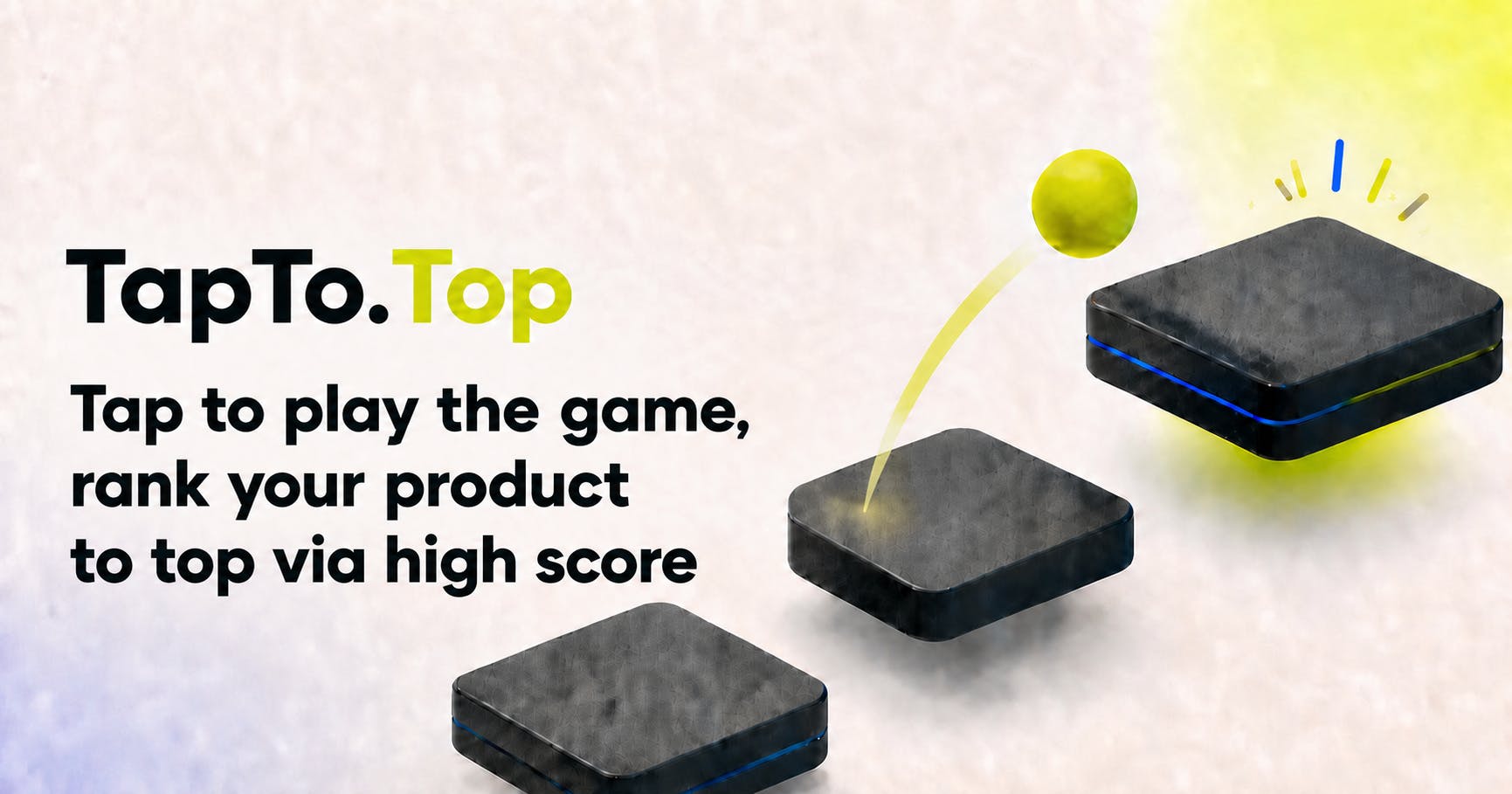
TapTo.Top gamifies product exposure by turning clicks into leaderboard rankings for free.
TapTo.Top is a free tool launched on Product Hunt that transforms product exposure into a clicking game. Users earn scores through clicks, and higher scores push products up the leaderboard for more visibility. Targeting indie developers and early-stage startups, it leverages gamification psychology to create a low-cost growth loop. However, its long-term success hinges on balancing fun with anti-cheating measures to maintain leaderboard credibility.
A Free Tool That Turns Marketing into a Game
In an era of severe product homogeneity and skyrocketing customer acquisition costs, how to make your product stand out has always been a headache for entrepreneurs and indie developers. Customer Acquisition Cost (CAC) measures the average cost a business spends to acquire a new customer, and in recent years, as competition in digital advertising has intensified, CAC on major platforms has continued to climb. According to research data from ProfitWell, the CAC in the SaaS industry has risen by approximately 60% over the past five years, and the cost per install for mobile apps has exceeded several or even tens of dollars in some categories. This trend has forced entrepreneurs to constantly seek more creative, low-cost growth strategies.
TapTo.Top, recently launched on Product Hunt, offers a rather playful solution: turning product exposure into a clicking game. Product Hunt is one of the world's most influential platforms for discovering new products, founded by Ryan Hoover in 2013 and later acquired by AngelList. The platform uses a daily ranking system where entrepreneurs and developers can launch their products, and community members determine daily rankings through Upvotes and comments. Top-ranked products receive massive exposure, and many well-known products like Notion and Loom gained early attention and seed users through their Product Hunt launch days — so much so that "Product Hunt Launch Day" strategy planning has become a discipline in its own right.
According to its Product Hunt page, TapTo.Top's core mechanic can be summed up in one sentence — "Tap to play, rank your product To Top." Users earn high scores through a clicking game; the higher the score, the higher the product's position on the leaderboard, thereby reaching more potential users. The product was created by Maker "Ahab," is currently completely free, and has garnered 19 upvotes and 2 comments since launch, sitting at #20 in the daily rankings.
TapTo.Top's Gamified Growth Logic
Turning User Attention into Ranking Currency
At its core, TapTo.Top's design philosophy converts "attention" into a competitive currency. Traditional product leaderboards typically rely on votes, likes, or paid promotion, but TapTo.Top introduces a gamified ranking mechanism: whoever invests more time clicking and scores higher gets a more prominent display position.
This gamified marketing design cleverly leverages people's competitive psychology and instant feedback mechanisms. The concept of Gamification was first coined by British programmer Nick Pelling in 2002, but it didn't gain widespread commercial adoption until around 2010. Its core idea is to apply game design elements — such as points, leaderboards, achievement systems, progress bars, and instant feedback — to non-game contexts to boost user engagement and behavioral conversion rates. Academic research suggests that gamification works primarily because of three core psychological needs identified in Self-Determination Theory: autonomy, competence, and relatedness. When users feel a sense of control and achievement through clicking and ranking, the release of dopamine drives them to participate repeatedly.
Returning to TapTo.Top, the clicking game itself has an extremely low barrier to entry — virtually anyone can participate — while the leaderboard's existence continuously incentivizes users to keep playing, creating a growth loop of "play → grind for points → climb the leaderboard → play again." For product makers, this means gaining sustained exposure at near-zero cost.
Free Pricing Lowers the Barrier to Try
A noteworthy detail: TapTo.Top currently leads with a "Free" label. In an environment where marketing tools generally charge fees, a free strategy can quickly attract early users to try it out, especially indie developers and small startup teams with limited budgets.
This is also a common cold start tactic used by many new products on Product Hunt. Cold Start is one of the most challenging phases in a product's lifecycle, referring to how a product acquires its first batch of users when it has no user base or accumulated data. This problem is particularly acute for platform and community-based products, as they often face the classic "chicken-and-egg" network effects dilemma. The underlying logic of a free strategy is to first use zero barriers to acquire user scale and usage data, then monetize through value-added services, premium features, or advertising. Classic examples include Slack's early free team plan, Dropbox's free storage tier, and Zoom's 40-minute free meetings. However, free strategies also carry risks: if a product fails to demonstrate core value during the free phase, subsequent paid conversion will be extremely difficult, potentially leading to a "lots of users but no monetization" trap. TapTo.Top is trading free access for user volume and word-of-mouth — how it designs its future monetization path is worth watching.
TapTo.Top's Positioning and Use Cases
On Product Hunt, TapTo.Top is categorized under Marketing, Tech, and Games — a cross-category positioning that speaks to its product nature: it's both a marketing tool and one wrapped in a game's skin.
In terms of applicable scenarios, TapTo.Top is likely best suited for the following types of users:
- Indie developers: Limited budgets, needing low-cost product exposure channels;
- Early-stage startup teams: Looking to gain community attention through fun, engaging methods;
- Marketing professionals: Seeking creative growth tactics that differ from traditional ad spending.
However, gamified ranking mechanisms also come with inherent concerns: when rankings are primarily determined by "click volume," it may incentivize score manipulation, diminishing the leaderboard's actual reference value. In any system that uses quantity-based metrics (clicks, votes, view counts, etc.) as ranking criteria, gaming the system is an almost inevitable challenge. From keyword stuffing in the early search engine era, to fake followers and astroturfing in the social media age, to fraudulent ratings in app stores, manipulation has always shadowed ranking systems. On the technical level, common anti-cheating measures include IP rate limiting, device fingerprinting, behavioral pattern analysis (such as detecting non-human regular clicking patterns), CAPTCHA mechanisms, and machine learning-based anomaly detection algorithms. For a platform like TapTo.Top whose core ranking mechanism is based on click volume, how effectively it designs anti-cheating strategies will directly determine its leaderboard's credibility and long-term viability. Once users discover that the leaderboard can be easily manipulated, the platform's trust foundation will quickly erode. Whether TapTo.Top can strike a balance between "fun" and "fairness" will be the key to its long-term survival.
Observations and Reflections on the Gamified Marketing Trend
From a broader perspective, TapTo.Top reflects a clear trend in today's product marketing landscape — Gamification is permeating an increasing number of non-game contexts. Whether it's streak-based check-ins in learning apps (such as Duolingo's consecutive learning days and leaderboard system, widely regarded as one of the most successful gamification applications), achievement badges in fitness apps, or TapTo.Top's click-based rankings, they all essentially use game mechanics to boost user engagement and retention. Gartner once predicted that over 70% of Global 2000 companies would adopt at least one gamified application, and this trend has indeed continued to accelerate — from Starbucks' membership star system to Nike Run Club's running challenges, gamification has become a standard item in the product design toolkit.
Of course, as a newly launched product with a modest number of upvotes, TapTo.Top currently looks more like an interesting experiment than a mature marketing solution. Its actual effectiveness — how much real, valuable exposure it can deliver for products, rather than mere click numbers — still awaits market validation.
For growth practitioners keeping an eye on new tactics, TapTo.Top is worth watching as a case study: it reminds us that in an era of diminishing traffic dividends, creativity and fun may be emerging as new variables for products to break through. But it's equally important to stay clear-headed — any "ranking game" disconnected from real value will ultimately struggle to deliver sustainable growth.
Key Takeaways
Related articles

WorkBuddy Full Tutorial: Build an AI Office Automation Agent from Scratch
A complete WorkBuddy tutorial: installation, three working modes, multimodal picture book video practice, expert team agent building, and workflow configuration for low-cost AI office automation.

WorkBuddy Agent Complete Guide: From Beginner to Automation in 7 Days
Based on Bilibili's 256-episode WorkBuddy masterclass, this systematically breaks down Tencent's AI office workbench core capabilities: Agent principles, Skill encapsulation, cross-platform connectors, scheduled automation, knowledge bases, and zero-code development, with learning path recommendations.

8 AI Accounts, 7 Failed: An Honest Review of Using AI to Get Work Done
Only 1 of 8 AI-run Bilibili accounts succeeded. We break down the real difference between "performing AI" and "using AI to get work done."