Tasklets: A Unit-Test Benchmark for Language Model Architectures

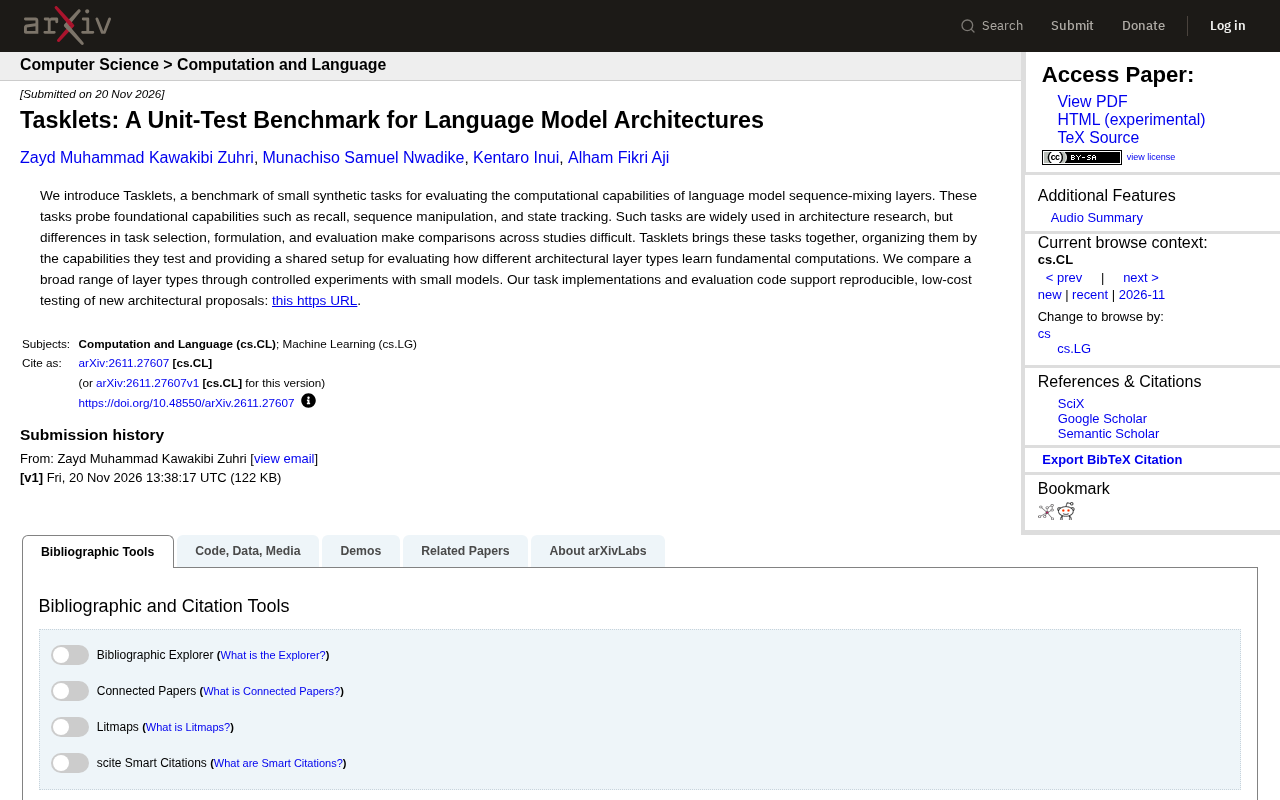
Tasklets provides a standardized unit-test benchmark for sequence-mixing layers using small synthetic tasks.
Tasklets is a standardized synthetic task benchmark for sequence-mixing layers in language models, addressing fragmented experimental setups and incomparable results in architecture research. It organizes scattered tasks into three basic computational capabilities—recall, sequence manipulation, and state tracking—and provides unified evaluation code for low-cost, reproducible controlled experiments on small models. Researchers can replace only the sequence-mixing layer while keeping other conditions constant, enabling clean attribution of performance differences. Positioned as a "unit test" rather than final evaluation, Tasklets helps quickly screen architectural ideas early on, with open-source code for easy integration of new proposals.
Architecture research often runs into an awkward problem: every paper claims its layer design is superior, but experimental setups vary wildly, making results hard to compare across studies. Tasklets aims to provide a standardized "unit test" platform for sequence-mixing layers, using a set of carefully designed small synthetic tasks.
Why do we need a unit-test-style benchmark?
Innovations in language model architecture tend to concentrate on sequence-mixing layers—attention, state space models, convolutions, recurrent networks, and so on. Researchers want to verify whether a new layer handles recall, sequence manipulation, or state tracking better, but current practice is for each to pick their own tasks, define their own input/output formats, and design their own evaluation pipelines. This fragmentation leads to two problems: first, results from different papers cannot be directly compared; second, testing new architectures is costly and hard to iterate on quickly.
Tasklets starts from a straightforward premise: bring scattered tasks together, categorize them by the capability being tested, and provide a unified evaluation setup. It does not aim for large-scale pretraining or downstream task performance; instead, it focuses on controlled experiments of basic computational capabilities.
Sequence-mixing layer is a core component in Transformers and subsequent architectures, responsible for letting tokens at different positions exchange information. In a standard Transformer, this role is played by self-attention; but attention has quadratic complexity, so researchers have proposed various alternatives, including state space models (such as Mamba, S4), long convolutions (such as Hyena), linear attention, and gated recurrent units. These layers differ greatly in computation, parameter efficiency, and long-sequence behavior, but their common goal is to "mix" the input sequence along the time dimension. Tasklets focuses on this layer because the main room for architectural innovation often lies here, while changes to other components (such as feedforward networks and normalization) are relatively mature.
What does Tasklets include?
According to the original description, Tasklets is a set of small synthetic tasks designed to probe the computational capabilities of sequence-mixing layers in language models. Specifically, it covers three types of basic capabilities:
- Recall: whether the model can extract and reproduce information from context;
- Sequence manipulation: transformations of sequence structure such as sorting, reversing, and copying;
- State tracking: maintaining and updating internal state as the sequence progresses.
These tasks are widely used in architecture research, but previously lacked a unified implementation. Tasklets organizes them into capability-based collections and provides evaluation code, supporting low-cost, reproducible comparison experiments on small models.
State tracking is a class of tasks that require the model to maintain an internal state while reading a sequence and update that state with new input. Typical examples include: tracking the value of a variable after multiple assignments, simulating a finite state automaton, or updating a counter according to instructions. These tasks test whether a layer can retain historical information at constant or controllable cost—this is exactly the strength of recurrent networks and state space models, and where pure attention layers tend to struggle on long sequences. Tasklets lists this as a separate category, meaning evaluation looks not only at the final output but also at the model's state consistency throughout the sequence, thereby more finely distinguishing the differences in "memory maintenance" capabilities across layer types.
How to use Tasklets to compare different layer types?
One of Tasklets' design goals is to support "controlled experiments." Researchers can replace the sequence-mixing layer in a model, keep other parts unchanged, and then observe performance differences on the same task set. This controlled-variable approach enables cleaner attribution—performance changes indeed come from the layer design itself, not from differences in training tricks or data recipes.
The original text mentions that the authors used Tasklets to compare multiple layer types, but did not disclose specific results in the abstract. However, the value of a benchmark lies not in the outcome of a single comparison, but in establishing a reusable testing pipeline. The accompanying GitHub repository (https://github.com/zaydzuhri/flame/tree/tasklets) provides task implementations and evaluation code, allowing new architecture proposals to quickly plug into testing.
Controlled experiment in architecture research refers to an experimental design where only one variable is changed and all other conditions are strictly aligned. In the context of Tasklets, this means: using the same small model backbone, the same training hyperparameters, the same data generation seeds and evaluation metrics, with the only replacement being the implementation of the sequence-mixing layer. This approach can exclude confounding factors from training tricks, data recipes, and model scale, making performance differences more likely attributable to the layer's own computational inductive bias. It should be noted that conclusions from controlled experiments usually hold only within the tested tasks and scale range, so Tasklets emphasizes its "unit test" positioning rather than claiming that a certain layer is necessarily better in real language modeling.
Practical significance for architecture research
Tasklets fills a gap: between "toy tasks" and "full language model evaluation," there is a missing layer of standardized basic capability testing. It allows architecture researchers to quickly screen ideas at an early stage without having to run expensive pretraining every time. At the same time, unified task definitions and evaluation protocols make results across papers more comparable.
Of course, there is still a gap between performance on synthetic tasks and real language capabilities. Tasklets is positioned as a "unit test" rather than a "final exam"—it tells you whether a layer has learned basic computations, but does not guarantee effectiveness on complex language tasks. This positioning is clear-eyed, and it is precisely where its value as a benchmark lies.
As architectural innovation accelerates, similar standardized test sets may become part of community infrastructure. Tasklets is a step in that direction.
Related articles

ChatGPT Plus Subscription Pitfall Guide: Go/Plus/Pro Tier Comparison and Quick Activation
A complete ChatGPT Plus subscription guide based on a Bilibili tutorial: from registering an account, comparing Go/Plus/Pro tiers, to the practical steps for quickly completing your subscription.

GPT-6.2 Sol/Astra Released! A Step-by-Step ChatGPT Plus Subscription Guide and Tier Comparison
GPT-6.2 Sol/Astra is out—here's a ChatGPT Plus subscription guide: register an account, compare Go/Plus/Pro tiers, and subscribe in a minute.

Comparing Three Channels for Subscribing to GPT Plus in China: Is Website Top-Up the Easiest?
How to subscribe to GPT Plus in China? This article compares website top-up, credit card, and mobile top-up channels—process, cost, and risk—with steps and tips to help you choose wisely.