TaskPeace: An AI Coding Agent Task Queue System Built on the MCP Protocol
TaskPeace: An AI Coding Agent Task Que…
TaskPeace is an MCP-powered task queue that lets AI coding agents autonomously pull and execute development tasks.
TaskPeace is an open-source task queue system designed for AI coding agents like Claude and Cursor. By leveraging the MCP (Model Context Protocol), agents can proactively pull tasks from a shared queue rather than waiting to be prompted. This pull-based model enables natural load balancing, decoupled task production and consumption, and reliable multi-agent coordination — pointing toward a future where AI agents work as autonomous members of a development team.
The Era of Multi-Task AI Collaboration in Software Development
As AI coding assistants like Claude, Cursor, and GitHub Copilot continue to grow more capable, the way developers work is fundamentally shifting. In the past, AI simply responded to one-off prompts. Today, developers increasingly want AI to behave like a team member — autonomously claiming tasks from a backlog and seeing them through to completion.
TaskPeace, an open-source project that recently appeared on Hacker News, is built precisely for this need. It's a task queue system designed for AI coding agents, allowing agents to proactively pull pending tasks via the MCP (Model Context Protocol).
While the project is still in its early stages, the technical direction it represents deserves serious attention: When AI agents gain autonomous task scheduling capabilities, how will the collaborative paradigm of software development evolve?
What Is TaskPeace
Core Positioning
TaskPeace has a clear purpose: it's a task queue where AI coding agents act as the "consumers." Developers add work items to the queue, and AI agents continuously pull tasks through a standardized interface and execute them.
This pull model is fundamentally different from the traditional push model. In a push model, humans hand tasks to AI one by one. In a pull model, AI agents fetch the next pending item at their own pace, enabling something much closer to autonomous work.
The Engineering Principles Behind Task Queues Task queues are a classic pattern in distributed systems. Their core idea is to decouple producers and consumers via an intermediate layer. In traditional software engineering, tools like Celery, RabbitMQ, and Redis Queue are widely used for async task processing. Task queues typically offer an atomic claim mechanism — when a consumer pulls a task, its status is immediately locked to prevent other consumers from claiming it. This is the key mechanism for avoiding conflicts in multi-agent scenarios. Mature task queues also support priority ordering, dead letter queues, retry strategies, and more — engineering capabilities that provide a solid foundation for reliable AI agent execution.
The Key Technology: MCP Protocol
The most notable technical choice in TaskPeace is its use of MCP (Model Context Protocol) as the communication bridge between agents and the task queue. MCP is an open protocol introduced by Anthropic that has been gradually adopted as an industry standard for establishing standardized connections between large language models and external tools and data sources.
Technical Background on MCP MCP is a communication protocol that Anthropic open-sourced in November 2024. It was designed to solve the "fragmentation" problem in connecting LLMs to the outside world — before MCP, every AI tool required custom integration code for each data source and service, creating an N×M compatibility matrix. MCP reduces this to N+M by defining a unified client-server architecture: any MCP Client only needs to implement the protocol once to connect to all MCP Servers. The protocol is built on JSON-RPC 2.0 and supports three core primitives: Tools, Resources, and Prompts — covering the essential interaction scenarios between AI agents and external systems. Since its release, MCP has gained support from major development tools including Cursor, Zed, and Replit, and is becoming the connectivity standard for the AI tooling ecosystem.
By wrapping the task queue as an MCP Server, any MCP-compatible AI client (such as Claude Desktop or Cursor) can connect to TaskPeace seamlessly — no custom adapter needed for each agent, dramatically reducing integration overhead.
Technical Architecture Deep Dive
Three Key Advantages of the Pull-Based Workflow
Why have AI agents "actively pull" tasks instead of passively receiving them? There are several key engineering considerations:
Natural load balancing. When multiple AI agents work in parallel, the pull model lets each agent claim tasks according to its own processing capacity — faster agents handle more, slower ones handle less — automatically achieving dynamic workload distribution.
Decoupling task production and consumption. Humans (or other systems) add tasks to the queue; AI agents consume them. Neither side blocks the other. Developers can batch-input requirements at any time and let agents process them continuously in the background.
Recoverability and persistence. The queue as an intermediate layer naturally provides task persistence. Even if an agent crashes or disconnects mid-task, unfinished items remain in the queue and can be re-claimed, effectively preventing work loss.
Ecosystem Compatibility via MCP Integration
Thanks to the MCP protocol, TaskPeace can theoretically connect with any MCP-compatible AI toolchain. Developers can call TaskPeace's tool functions — such as "get next task," "mark task complete," or "add subtask" — directly within their preferred development environment, seamlessly integrating task management into their AI coding workflow without extra adapters.
Use Cases and Practical Value
The Autonomy Spectrum of AI Agents
Before diving into specific scenarios, it's worth understanding the evolution of AI agent autonomy. Agent autonomy is typically divided into multiple levels: from basic single-turn Q&A (Level 1), to tool-augmented multi-step task execution (Level 2), to planning subtasks, self-correcting, and sustaining long-horizon work (Level 3). Most mainstream AI coding tools today are transitioning from Level 2 toward Level 3. Research from OpenAI, Anthropic, and others shows that providing agents with structured task management frameworks — rather than relying on the model's internal memory and planning — significantly improves execution reliability. This is the fundamental reason external task queue systems like TaskPeace have value: they externalize uncertain "in-model planning" into observable, intervenable "system-level state management."
Long-Horizon Autonomous Development
TaskPeace is best suited for decomposable, long-running development work. For example, a developer can break a large refactor into dozens of small items, add them to the queue, and let AI agents process them one by one — with humans only stepping in at key review checkpoints. This "humans plan, AI executes" division of labor is a proven high-efficiency collaboration model in current AI programming practice.
Multi-Agent Coordination
As it becomes increasingly feasible for a single developer to run multiple AI agents simultaneously, coordinating those agents to avoid duplicate work or task conflicts is a new engineering challenge. A task queue serves as a shared "single source of truth" — using atomic claim mechanisms to ensure each task is handled by exactly one agent, providing reliable infrastructure for multi-agent coordination.
From Conversational to Task-Centric Interaction
TaskPeace represents an important shift in AI programming interaction paradigms — from chat-centric to task-centric. Instead of going back and forth with AI in conversation, developers maintain a structured task list and let AI continuously deliver against it. This model more closely mirrors how real software teams actually operate.
Implementation Challenges and Considerations
Despite its forward-thinking design, this type of tool still faces real-world challenges:
Task granularity. Tasks that are too coarse are hard for AI to complete independently; tasks that are too fine drive up planning overhead for humans. Finding the right granularity still requires extensive trial and error.
Quality assurance. Once AI autonomously completes tasks, how do you ensure output quality? Introducing automated testing and code review as "acceptance gates" is an unavoidable challenge for maturing these systems.
Context consistency. Tasks often have dependencies. Whether an AI agent processing a single task can access sufficient project context — avoiding a "can't see the forest for the trees" problem — is a significant challenge.
Context Windows and the Multi-Task Challenge LLMs face a structural limitation when handling independent tasks: the finite context window. While leading models now support context windows extending to hundreds of thousands or even millions of tokens, cross-task dependency information, global project state, and outputs from previously completed tasks are often impossible to fully fit into a single inference context. Solutions being explored in the industry include: RAG-based long-term memory via vector databases, structured task summaries auto-generated upon task completion, and knowledge graph-based project state tracking. For TaskPeace to truly solve the "context consistency" challenge, incorporating these mechanisms will be an unavoidable direction for future development.
Conclusion
TaskPeace is still in early exploration, but it touches on a rapidly heating core question: How do we evolve AI coding agents from "assistive tools" to "autonomous workers"? By combining the proven concept of task queues with the emerging MCP protocol, it offers a clean and practical infrastructure approach for multi-agent coordination and long-horizon autonomous development.
For developers at the frontier of AI-assisted programming, tools like this are worth following closely. They may not be perfect yet, but they are sketching out one possible shape of future software development — where humans focus on planning and decision-making, while AI agents work through a structured task queue, steadily turning ideas into reality.
Related articles
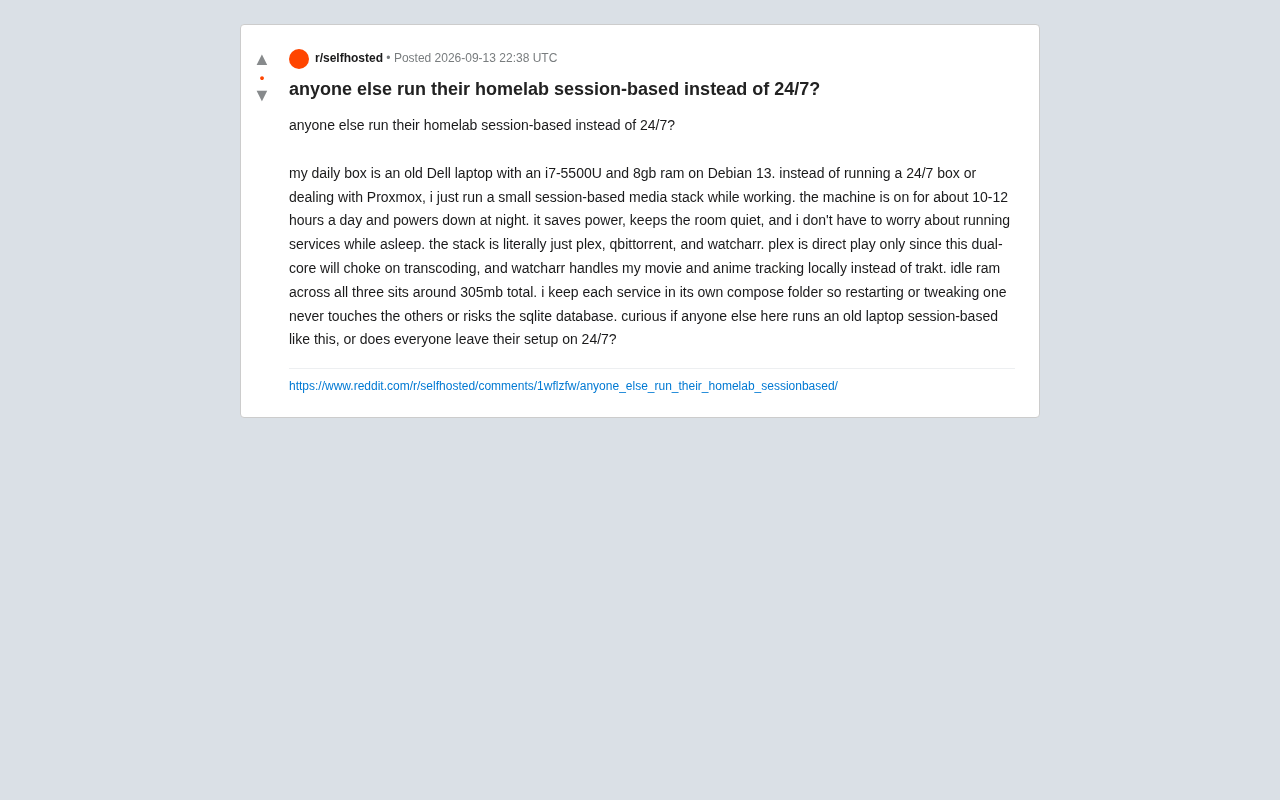
Session-Based Home Server: Running a Low-Power Homelab on an Old Laptop
A Reddit user runs Plex, qBittorrent, and Watcharr on a 10-year-old laptop for just 10–12 hrs/day, using only 305MB RAM idle. Exploring session-based vs. 24/7 Homelab trade-offs.

OpenAI Launches ChatGPT for Financial Services: Built-in Financial Data + GPT-6 Reasoning
OpenAI launches ChatGPT for Financial Services, combining built-in financial data with GPT-6 Astra reasoning to support research, financial modeling, and client materials for financial institutions.

When AI Controls Your Credit Card: The Hidden Risks of Autonomous Payments
When AI agents gain credit card access, hidden dangers emerge: vague authorization, prompt injection attacks, and unclear liability. Learn the real risks and how to stay protected.