Tech Companies Should Know Me Better: A User's Reverse Privacy Manifesto

Tech companies have plenty of data but shallow understanding—they capture behavior, not intent.
The article discusses a popular Hacker News blog post arguing that tech companies collect massive user data yet never truly understand users. The core point: they gather behavioral data, not intent data, so shallow signals like clicks and dwell time get misread as preferences, leading to poor recommendations. It explores the privacy paradox—users don't reject data sharing, but the exchange is unequal. The author advocates shifting from passive tracking to active intent modeling, with users participating through explicit settings and feedback. It also notes that ad-driven business models create incentive misalignment, leaving "understanding users better" without commercial priority.
Tech giants collect massive amounts of user data, yet they never seem to truly understand us. Recently, an article titled "I wish tech companies knew more about me" sparked heated discussion on Hacker News, earning 277 points and 247 comments. The author puts forward a counterintuitive view: the problem isn't that tech companies know too much, but that they don't know deeply or accurately enough.
Data-Rich, Understanding-Poor
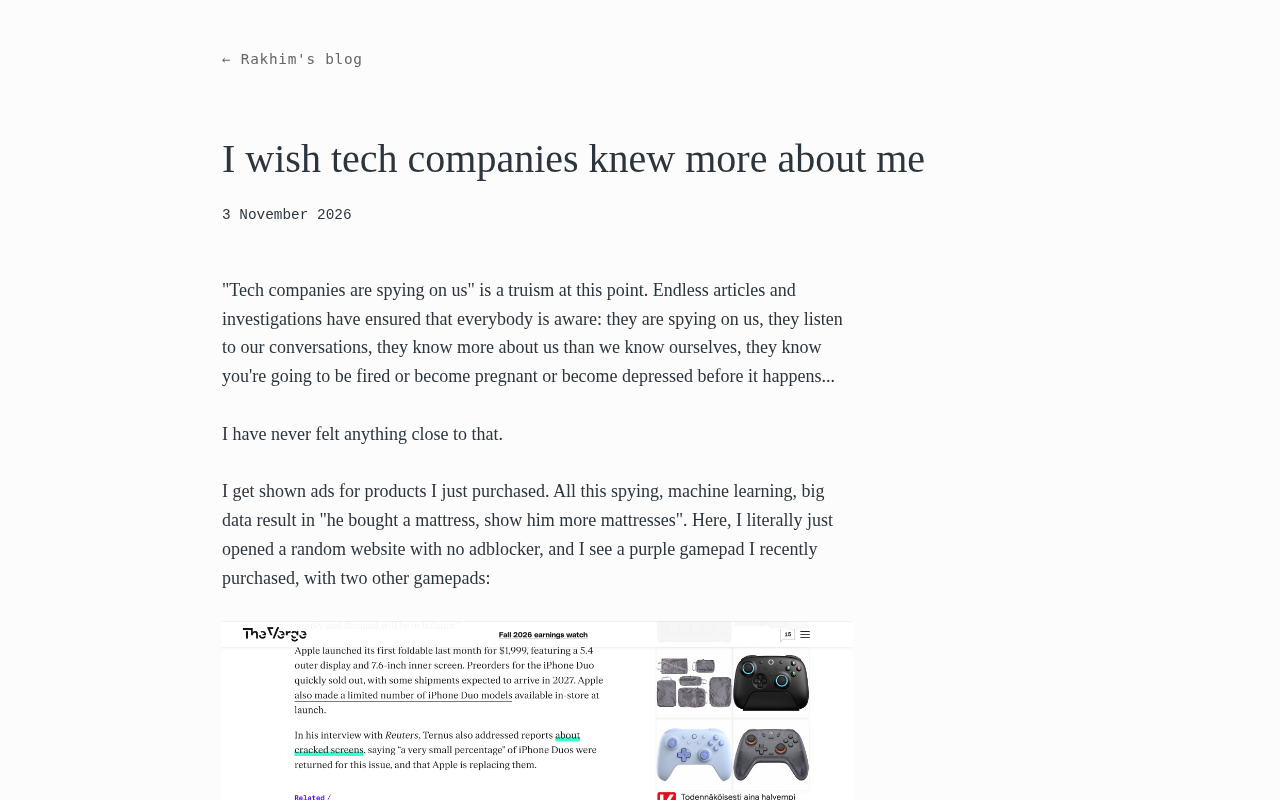
We live in an era wrapped in data. Every click, every pause, every swipe is recorded. Logically, tech companies should understand our preferences, habits, and needs better than anyone. But in reality, recommendation algorithms frequently miss the mark, ad targeting is intrusive, and personalized experiences often devolve into low-level errors like "recommending the product you just bought again."
The author's core insight is this: tech companies collect behavioral data, not intent data. They know what you clicked, but not why you clicked it; they record how long you looked, but don't understand what you actually want. This accumulation of "shallow data" cannot translate into "deep understanding."
The Limits of Behavioral Tracking
The limitation of behavioral tracking is that it can only capture surface phenomena. When a user clicks on a news article, it might be out of genuine interest, an accidental tap, or simply to close a pop-up. Algorithms treat all these behaviors indiscriminately as "preference signals," which naturally introduces bias. The author argues that if tech companies truly want to understand users, they need to ask more proactively and model user intent more carefully, rather than relying solely on passively collected behavioral logs.
The Distinction Between Behavioral Data and Intent Data
Behavioral data refers to the observable traces users leave when interacting with a system—clicks, scrolls, dwell time, purchase records—passively collected "surface signals." Intent data, by contrast, describes why users take those actions—their goals, motivations, constraints, and expected outcomes—which typically requires active solicitation or inferential modeling. The key difference lies in causality: behavioral data can only reveal correlation, not whether a click stems from interest, an accidental tap, or habit. This is also why recommendation systems easily fall into the "collaborative filtering trap"—they maximize behavioral similarity rather than intent matching. Recent directions in both academia and industry, such as "intent understanding" and "conversational recommendation," are attempts to bridge this gap.
The Privacy Paradox: What Users Really Want
This view touches on a long-standing privacy paradox. In traditional discussions, users are portrayed as defenders of privacy, wary of data collection. But the author points out that many users don't mind sharing information—provided that sharing delivers real value. If tech companies can use data to provide precise, useful services, users are willing to trade some privacy.
The problem is that the current data exchange is unequal. Users pay with their data but receive crude, even off-putting experiences in return. The author calls on tech companies to rethink the purpose of data collection: not to pile up user profiles, but to build genuine understanding.
From "Knowing More" to "Understanding Deeper"
This leads to a key shift: from pursuing data volume—"knowing more"—to pursuing data quality—"understanding deeper." The author suggests that tech companies should let users actively participate in the personalization process, for example through explicit preference settings, feedback mechanisms, and conversational interaction, letting users tell the system what they actually want. This "user-driven expression" model builds more accurate user models than passive behavioral tracking.
The Privacy Paradox
The privacy paradox refers to the fact that users verbally place high importance on privacy yet often voluntarily give up personal information in practice—casually granting app permissions, accepting cookie tracking, or disclosing large amounts of private details on social platforms. The concept was first systematically discussed in research on e-commerce and online behavior, and later used to explain the gap between "privacy attitudes and privacy behaviors." Common explanations include: privacy costs being masked by immediate convenience, users' lack of visibility into data flows, and a sense of helplessness—"it's already been collected anyway." For this case, the significance is that the privacy paradox shows users don't uniformly reject data sharing; they are evaluating whether the exchange is worthwhile. When companies use data to improve usability, the paradox can be mitigated; when data serves only ad monetization, the paradox turns into distrust.
Implications for Product Design
For product designers, this article raises a thought-provoking proposition: personalization should not be just a black-box algorithmic operation, but a transparent process that users can perceive, control, and participate in. When users can understand why a system makes a particular recommendation and can easily correct deviations, data collection and privacy trade-offs gain legitimacy.
The discussion on Hacker News reflects this consensus: many commenters agree that tech companies' current "understanding of users" is largely marketing rhetoric, and the actual product experience falls far short of true personalization. Some comments note that tech companies are better at using data to optimize ad monetization than to optimize user experience—and that may be the root of the problem.
A Skewed Incentive Structure
This skewed incentive structure makes "understanding users better" a low commercial priority. The ad-driven business model demands higher click-through rates and dwell time, not more precise intent matching. The author's view is essentially a call for a paradigm shift: treating user understanding itself as the product goal, rather than a byproduct of monetization.
Ad-Driven Business Models and Incentive Misalignment
Most consumer tech companies derive revenue from advertising, typically priced on impressions, click-through rates, and conversion rates. This determines that the objective function of product optimization is "extending usage time, increasing ad inventory, and raising click propensity," rather than "accurately satisfying user intent." When user intent aligns with commercial goals, personalization looks great; once the two conflict, the system tends to push content that generates clicks rather than the results users actually want. This incentive misalignment explains why "understanding users better" ranks low on roadmaps—precise understanding doesn't directly translate into ad revenue. Changing this requires adjusting evaluation metrics (e.g., replacing click-through rate with task completion rate and user retention quality) or introducing monetization models that don't depend on ads, such as subscriptions.
Editor's Commentary
What makes this article resonate is that it punctures a repeatedly advertised illusion: more data does not equal deeper understanding. Tech companies possess unprecedented data collection capabilities but have made slow progress in understanding user intent. True personalization requires shifting from passive tracking to active dialogue, from behavioral records to intent modeling. For AI products, this lesson is especially important—in the era of large models, the ability to understand user intent may define product value more than data scale.
Original link: https://rakhim.exotext.com/i-wish-tech-companies-knew-more-about-me
Discussion link: https://news.ycombinator.com/item?id=50378942
One-line Summary
Tech companies have plenty of data but shallow understanding—the problem is they capture behavior, not intent.
Paragraph Summary
The article centers on a widely discussed blog post on Hacker News, pointing out that although tech companies collect massive user data, they never truly understand users. The core argument: they collect behavioral data rather than intent data, so shallow signals like clicks and dwell time are misread as preferences, leading to inaccurate recommendations and personalization that devolves into low-level errors. The article further discusses the privacy paradox—users don't reject data sharing, but the current exchange is unequal, with crude experiences in return for data. The author advocates shifting from passive behavioral tracking to active intent modeling, letting users participate in personalization through explicit settings, feedback mechanisms, and conversational interaction. Finally, it notes that ad-driven business models create incentive misalignment, leaving "understanding users better" without commercial priority, and proposes treating user understanding itself as a product goal rather than a monetization byproduct.
Related articles
 Tech Frontiers
Google Omni 1.2 Flash: 15-Second AI Video at Just $0.07 per Second
Google DeepMind releases Gemini Omni 1.2 Flash: 15-second video, 720p at $0.07/sec (30% cheaper), multi-turn editing without regeneration, draft upscaling to 4K.
 Tech Frontiers
No AI Ghostwriting: Writer's Quarter Reinvents Novel Writing with a Visual Workbench
The Writer's Quarter is an AI-free novel writing and planning tool that unifies character building, story planning, and manuscript writing in one visual workbench. This article analyzes its positioning, target users, and differentiated value amid the rise of AI writing tools.
 Tech Frontiers
Fleeep: A Unified Inspiration Collection Notes App for Creatives
Fleeep is a notes app for creatives that unifies screenshots, bookmarks, saved posts, and inspiration into one calm, cross-device, offline-capable space. This article analyzes its positioning, differentiation, and target users.