TechCrunch 2026 Startup Battlefield Top 20 Revealed: From Organs to Orbit

TechCrunch unveils its 2026 Startup Battlefield Top 20, spanning from organ medicine to orbital aerospace.
TechCrunch Disrupt's Startup Battlefield has announced its 2026 Top 20, with twenty founders advancing to the main stage to compete for a $100,000 prize and the Disrupt Cup. This year's picks span an unusually wide range, described officially as "from organs to orbit" — covering organ-level biomedical tech, orbital-scale aerospace applications, and a broad middle ground of hard-tech innovation. The article argues this reflects early-stage investment attention shifting toward fields with greater technical depth. Startup Battlefield has historically produced companies like Dropbox, Cloudflare, and Mint.
From Organs to Orbit: A Full Breakdown of TechCrunch's 2026 Startup Battlefield Top 20
TechCrunch Disrupt's Startup Battlefield has long been one of the most closely watched stages for early-stage startups worldwide. According to TechCrunch's official RSS feed, the Top 20 list for 2026 has now been officially announced — twenty founders have stood out from a large pool of applicants and will compete on the main stage at TechCrunch Disrupt for a $100,000 prize and the iconic Disrupt Cup.
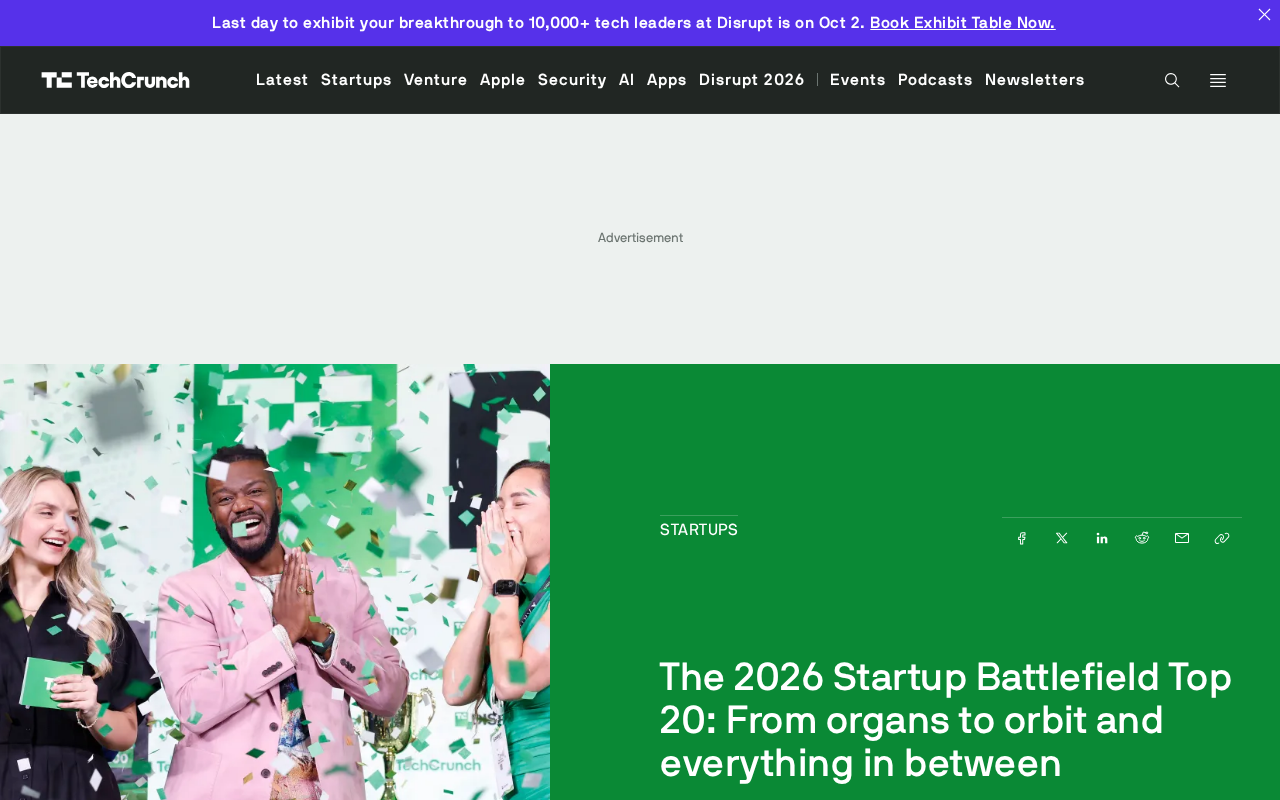
A Startup Spectrum Spanning Extreme Scales
What stands out most about this year's selections is the sheer breadth of fields they cover. The official description uses a rather evocative phrase: "From organs to orbit" — and this is no rhetorical flourish, but an accurate reflection of today's startup ecosystem.
On the biomedical side, some teams are working directly at the organ level; on the aerospace and space side, other projects are targeting orbital-scale applications. In between, there's a large spread of innovation in the middle ground — while the specifics of these directions aren't detailed one by one in the official announcement, the very framework sketched out by the keywords "organs" and "orbit" suggests that this 2026 cohort is tackling some of the most fundamental and difficult problems in the physical world and life sciences.
This span itself sends a signal: attention in early-stage investment and entrepreneurship is tilting toward fields with greater technical depth.
Startup Battlefield: Why It Still Matters
Startup Battlefield's historical track record is a major reason it continues to attract top-tier early-stage projects. Companies like Dropbox, Cloudflare, and Mint all appeared on this stage and went on to become leaders in their respective fields. For startups still in their early stages, this competition offers more than just prize money.
Making the Top 20 means gaining exposure on TechCrunch's main stage, pitch experience in front of top investor judges, and intensive media and industry attention throughout the Disrupt conference. The $100,000 prize is certainly a tangible resource, but what's truly scarce is the signaling value this stage provides — it amounts to a forced, high-intensity validation, compressing a technical narrative into a few minutes and making it clear to the most demanding audience.
TechCrunch Disrupt is a major annual tech industry conference hosted by TechCrunch, typically featuring keynote speeches, product showcases, startup exhibition areas, and multiple panel sessions. Startup Battlefield is its core competition segment, in which TechCrunch's editorial team selects a small number of early-stage startups from global applicants, letting founders pitch on the main stage to investors, media, and audiences within a time limit, and take questions from judges.
Unlike other startup competitions, Startup Battlefield emphasizes "first public debut" and "high-intensity validation": many teams have not had large-scale exposure before competing, and the judges are mostly frontline venture capitalists and veteran entrepreneurs, so performance can directly affect the pace of subsequent fundraising. Its judging criteria typically cover multiple dimensions including technological innovation, market opportunity, team execution, and presentation performance.
The Next Step for Twenty Founders
According to the official announcement, these twenty founders will now enter the formal competition phase on the Disrupt main stage, with the ultimate goal of taking home the $100,000 prize and the Disrupt Cup. The specific competition schedule, judging lineup, and pitch details have not yet been fully released, but it's safe to expect that these twenty teams will go through multiple rounds of refinement and preparation before taking the stage.
What's worth watching is which of these teams can offer truly engineering-feasible and commercially viable answers between the two extreme directions of "organs" and "orbit." The TechCrunch Disrupt stage has never lacked grand narratives, but those that ultimately endure are often the teams that break big problems down into executable steps.
For readers following early-stage tech startups, this Top 20 list is itself a sample worth studying — it reflects the current distribution of hot spots in hard-tech entrepreneurship and foreshadows the track differentiation that may emerge in the coming years.
One-line Summary
TechCrunch announces its 2026 Startup Battlefield Top 20, spanning from organ medicine to orbital aerospace.
Paragraph Summary
TechCrunch Disrupt's Startup Battlefield has announced its 2026 Top 20 list, with twenty founders advancing from a large applicant pool to the main stage, where they'll compete for a $100,000 prize and the Disrupt Cup. The most striking feature of this year's selections is their enormous breadth, summarized officially as "from organs to orbit," covering organ-level biomedical technology, orbital-scale aerospace and space applications, and a large middle ground of hard-tech innovation. The article argues this span reflects a shift in early-stage investment attention toward fields with greater technical depth. Startup Battlefield has historically produced companies like Dropbox, Cloudflare, and Mint, and its value lies not only in prize money but in the signaling value of main-stage exposure, investor judging, and media attention.
Related articles

Amphibious Transforming Drone: Beyond 100x Power Savings, What Are the Real Needs?
Is the amphibious transforming drone just a gimmick? Starting from the 100x power difference of the M4 Morphobot, explore real application scenarios and thesis topic ideas, analyzing boundary conditions where pure drones and pure ground robots both fail.

Warhound Raises $200 Million: Genetically Engineered "War Dogs" Paired with Anduril Gear
Warhound raises $200M, backed by Ben Lamm and Palmer Luckey, to genetically engineer dogs for military and law enforcement use and equip them with Anduril gear. This article analyzes its technology direction, funding logic, and ethical controversy.

Claude API Comes to Google Cloud: IAM Integration and SDK Access Guide
Anthropic hosts the full Claude API on Google Cloud with IAM-controlled permissions and unified billing. This guide covers the Vertex AI and Anthropic-hosted entry points, IAM role configuration, and SDK access.