TechCrunch Disrupt 2026 Day 1 Highlights: A Must-Attend Tech Event for Founders
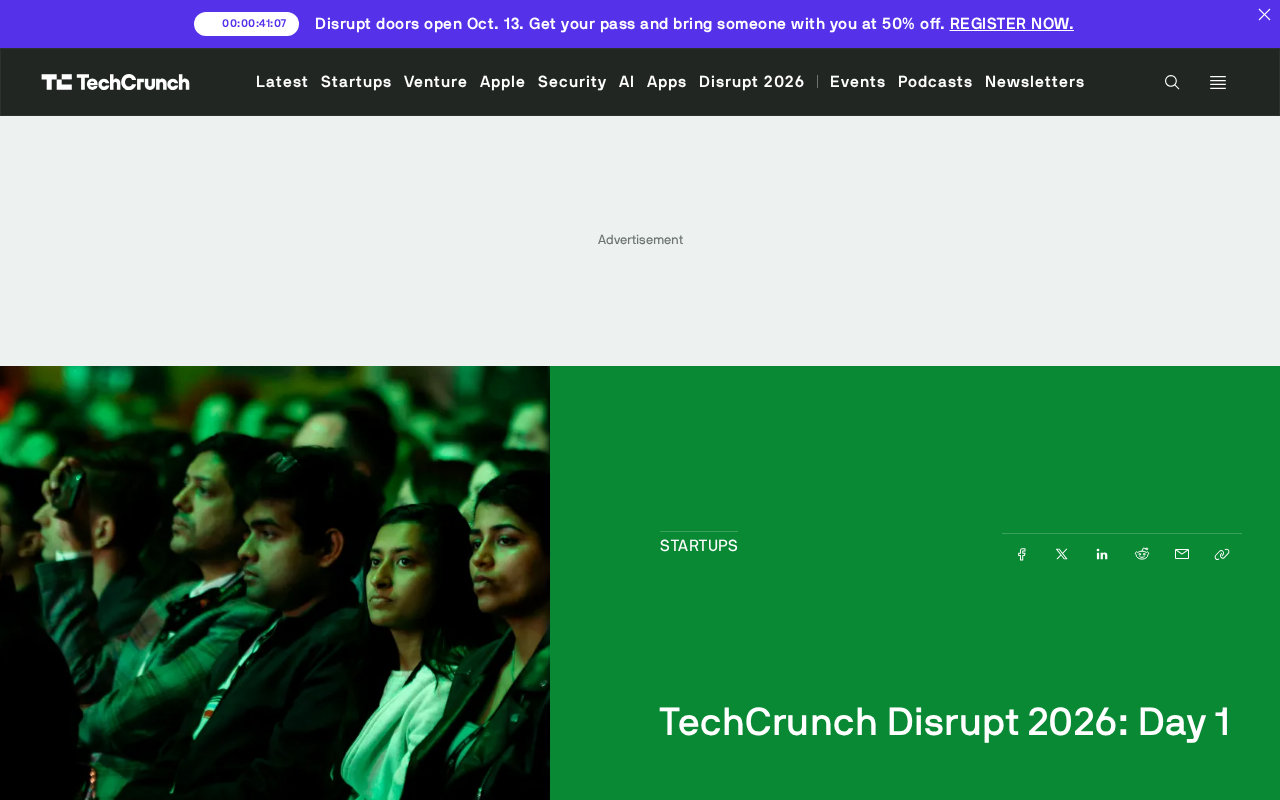
TechCrunch Disrupt 2026 opens Day 1 in San Francisco, spotlighting AI application-layer deployment and early-stage startup trends.
TechCrunch Disrupt 2026 opened on October 13 at Moscone West in San Francisco, drawing over 10,000 tech leaders, founders, and investors on Day 1. The event remains a key exposure and fundraising window for early-stage startups, with Startup Battlefield particularly critical—historically launching multiple unicorns and acquisition targets. Thematic focus has shifted from foundation model capabilities to three threads: application-layer commercial viability, integrating AI coding tools into engineering workflows, and how open-source vs. closed-source selection reshapes startup logic. For remote observers, the article recommends locking in 3–5 business-relevant sessions and treating the event as competitor and demand sampling rather than mere news.
TechCrunch Disrupt 2026 officially kicked off today at Moscone West in San Francisco. According to official information, the first day of the conference (October 13) is expected to draw over 10,000 tech leaders, founders, and investors, gathering for focused discussions on the startup ecosystem, AI deployment, and early-stage fundraising.
Why Disrupt Remains the "Bellwether" of the Startup World
Disrupt has long been regarded as a stage for early-stage startups, not just another industry expo. Its core value lies in bringing founders, investors, and tech buyers into the same space, dramatically compressing the "demo—feedback—funding" pipeline. This year's event at Moscone West—with its venue scale and attendance numbers—signals one thing: in a cycle of cautious capital, high-quality in-person connections are valued even more.
For practitioners focused on the AI application layer and AI coding tools, Disrupt's Startup Battlefield segment is especially worth tracking—historically, multiple projects that were later acquired by major tech companies or grew into unicorns made their public debut here.
Startup Battlefield is TechCrunch Disrupt's most iconic competition. Each year, organizers select dozens of early-stage startups from thousands of global applications, giving them the opportunity to pitch on the main stage to a panel of top-tier investors, competing for prize money and exposure. Its unique value lies in its "debut" nature: many companies first showcase their products to the public here, with Dropbox, Mint, Fitbit, and others having appeared and gained early attention at this event. Compared to typical expos, Battlefield's judging mechanism is closer to a real fundraising scenario—demos, business model scrutiny, and valuation negotiations happen almost simultaneously—making the participant list a frequently cited bellwether for predicting the next year's startup hotspots.
AI Remains the Main Thread, But the Focus Is Shifting
Judging from Disrupt's programming patterns in recent years, conference content typically follows the technology cycle. After discussions around foundation model capabilities have peaked in a phased manner, founders and investors are more concerned with three things:
- Whether the application layer can achieve a closed commercial loop: From tool-based products to vertical industry solutions, whoever finds a sustainable payment path first gains more pricing power.
- AI coding and development efficiency: Copilot-style tools have moved from "experimentation" to "team standard," and how to integrate AI coding assistants into existing engineering workflows is a high-frequency question in developer communities.
- The boundary between open source and closed source: The advantages of open-source tools in inference cost and deployment flexibility are reshaping startups' technology selection logic.
For content creators and independent developers, these three threads also correspond to actionable product opportunities, rather than remaining at the level of discussion topics.
Foundation models refer to AI large models pre-trained on massive data with general-purpose capabilities, such as GPT, Claude, Gemini, etc., which serve as the underlying support for the current AI application layer. Their capability ceiling determines the boundaries of what upper-layer products can achieve, but training and inference costs are extremely high, typically affordable only by major tech companies and a handful of leading startups. The so-called "foundation model capability peak" does not mean technology has stopped progressing, but rather that the perception of marginal improvement has weakened: as the gap between models on general benchmarks narrows, competitive advantage shifts from "how powerful the model is" to "how to use it, in which scenario, and whether it can sustainably charge"—this is precisely the underlying reason for the three threads mentioned in the article: application-layer commercial loops, AI coding, and open-source/closed-source selection.
A Few Directions Worth Watching on Day 1
Opening day is typically the day with the highest information density, with keynote speeches on the main stage and early-stage project demos in the exhibition area running in parallel. For readers who cannot attend in person, here's a suggested priority for filtering information:
- The Startup Battlefield participant list: This is a low-cost way to gauge next year's startup hotspots.
- Public statements from investor roundtables: Valuation expectations and term changes for early-stage fundraising are usually first released here.
- Recurring product forms in the exhibition area: When multiple teams independently build the same type of tool, it often means the demand has already been validated.
With 10,000+ attendees, the information volume is enormous—selective following is more effective than absorbing everything.
Early-stage fundraising valuation expectations and terms are a barometer for gauging whether the startup environment is tight or loose. Valuation expectations refer to the psychological price investors assign to a team, market size, and technical barriers, while terms include equity dilution ratios, liquidation preferences, anti-dilution protections, and other details. In a cycle of cautious capital, investors tend to压低 valuations and raise term protections, while founders care more about whether cash can sustain them to the next round. Investor roundtables are worth watching because these statements typically precede formal fundraising data disclosures, and can to some extent predict pricing trends for early-stage rounds in the coming quarters.
Follow-Up Advice for Remote Observers
If you're not in San Francisco on-site, there's no need to worry about missing out. TechCrunch typically provides continuous on-site reporting and video replays throughout the event, and attendees on social media often share key takeaways in real time.
A practical approach: first use the official schedule to lock in 3–5 sessions directly relevant to your business, then after the event, do a focused search for secondhand summaries of those sessions to avoid being overwhelmed by fragmented information. For teams working on AI applications and AI coding tools, treating Disrupt as a concentrated sampling of competitors and user needs will be more valuable than treating it as a news event.
One-line Summary
TechCrunch Disrupt 2026 opened its first day in San Francisco, focusing on AI application-layer deployment and early-stage startup hotspots.
Paragraph Summary
TechCrunch Disrupt 2026 opened on October 13 at Moscone West in San Francisco, with over 10,000 tech leaders, founders, and investors expected on the first day. The conference remains a key exposure and fundraising window for early-stage startups, with the Startup Battlefield segment particularly critical—historically, multiple unicorns and acquisition targets made their debut here. The thematic focus has shifted from foundation model capabilities to three main threads: whether the application layer can achieve a closed commercial loop, how AI coding tools integrate into engineering workflows, and how open-source vs. closed-source technology selection is reshaping startup logic. For remote observers, the article suggests locking in 3–5 sessions directly relevant to your business, avoiding being overwhelmed by massive fragmented information, and treating the conference as a sampling of competitors and demand rather than a mere news event.
Related articles

Anthropic IPO Countdown: The Compute Cost Ledger Behind a $2 Trillion Valuation
Anthropic's IPO targets up to $2 trillion — double its Series H valuation. We break down the timeline, compute cost logic, and the key question investor day must answer.

Anthropic IPO Prospectus Revealed: Behind 12x Revenue Growth, the Twin Tests of Compute Costs and Customer Concentration
Anthropic filed its IPO prospectus: 2025 revenue up 12x to $4.6B, net loss $42B including $34B non-cash. Breaking down compute costs, $2T valuation logic, customer concentration risks, and founder control.

Xteink X4 Pro Review: A Mini E-Reader That Fits in Your Pocket, Now More Affordable
Xteink X4 Pro is a 4.26-inch mini e-reader, smaller and thinner than a 6-inch Kindle, magnetically attachable to phones, and cheaper than ever. We analyze its screen, design, use cases, and value.