TechCrunch Founder Summit: Beyond the Agenda, a Boston Rendezvous

TechCrunch Founder Summit lands in Boston on Nov 4, focused on networking and practical insights; on-site prices will rise.
TechCrunch Founder Summit 2026 is set for November 4 at SoWa Power Station in Boston, designed to bring founders and investors into one physical space. Officials make clear the agenda is only one reason to attend — on-site networking and practical insights are equally essential. The article covers summit positioning, time and place, what founders gain, and attendance tips: for early-stage founders, face-to-face time with peers and investors is often more valuable than talks, and officials recommend registering early before on-site ticket prices increase.
TechCrunch Founder Summit 2026 will take place on November 4 at SoWa Power Station in Boston, bringing founders and investors together. The official messaging emphasizes that the summit's agenda is only part of the story — on-site networking and practical insights are equally essential.
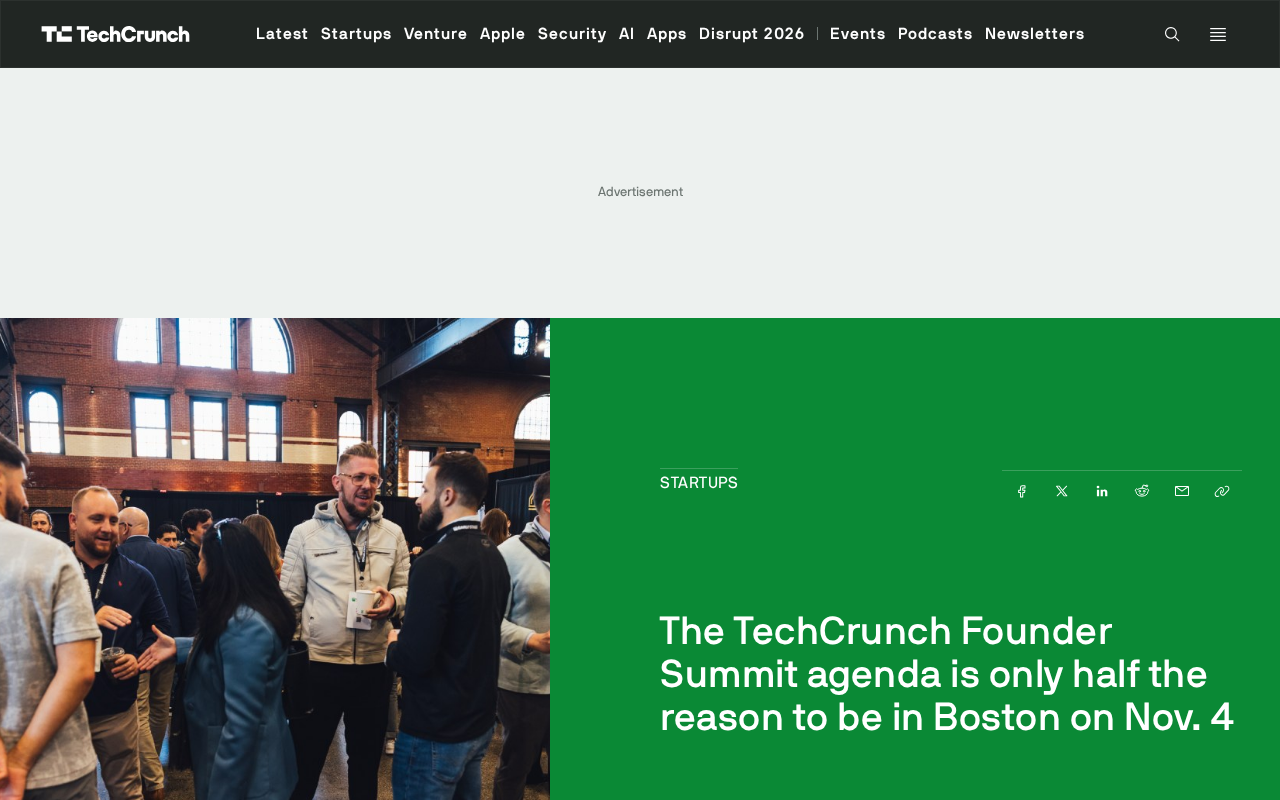
Summit Positioning: More Than an Agenda
In its event preview, TechCrunch states outright: the agenda is only one reason to go to Boston. That line reveals the core value of this kind of founder summit — stage talks matter, of course, but what's truly scarce is the chance to meet peers and investors face to face.
For early-stage founders, encountering potential investors and entrepreneurs who have been through similar stages in the same space is often more practically valuable than listening to a single talk. The choice of SoWa Power Station also continues TechCrunch's tradition of high-energy in-person events, emphasizing the live experience over online streaming.
Time and Place: November 4, SoWa Power Station, Boston
The event is scheduled for November 4 at SoWa Power Station in Boston. Officials note that on-site ticket prices will increase, and recommend registering before the price goes up.
This kind of pricing strategy is common at tech conferences: early-bird tickets create urgency and push attendees to decide early. For founders who are interested, registering early not only locks in a lower price but also makes it easier to plan travel and meetings.
SoWa Power Station is a historic building in Boston's South End SoWa Arts and Design District. Originally a Boston Edison power substation built in the late 19th century, it was later converted into a multi-purpose venue capable of hosting large events. Its high-ceilinged industrial halls, exposed steel frames, and industrial aesthetic have made it a popular choice for tech and creative events. For attendees, the SoWa area itself is also home to galleries, studios, and restaurants, making it convenient to arrange meetings before and after the event. Choosing a location outside the downtown core convention centers signals that TechCrunch values atmosphere and spatial flexibility over standardized conference facilities.
What Founders Get Out of It
Based on the official description, the summit's value centers on two things: practical insights and connections. The former corresponds to the on-stage content, the latter to on-site interaction.
Both matter especially to founders. Many decisions in building a startup have no standard answer, and talking with people who've been there or asking investors for advice often helps founders avoid detours. The summit provides exactly this kind of high-density exchange environment.
Early-stage founder typically refers to entrepreneurs between seed and Series A stage, whose product is not yet fully validated or just beginning to scale. Decisions at this stage rely heavily on external information: how to set the fundraising cadence, how to vet investors, how to build an early team — there's little internal experience to draw on. The value of events like founder summits for early-stage teams lies in low-cost access to a large number of peers at similar stages and active investors, creating an information-density advantage in a short time. By contrast, growth-stage founders tend to focus on deeper industry topics, and their motivations and takeaways differ accordingly.
Attendance Tips
If you're considering whether to go to Boston, base your decision on your goals: are you looking to gain practical experience in a specific area, or to meet a batch of investors and peers in one concentrated stretch? Either way, planning your meeting list in advance and reviewing the agenda will make your time on-site more efficient.
Officials have already sent a clear signal: on-site ticket prices will increase. For founders who are sure they'll attend, registering early is the more cost-effective choice.
Early-bird pricing is a common tiered pricing mechanism at tech conferences: a limited number of tickets are sold at a lower price months before the event, then raised in stages up to the full on-site price. Its purpose is not only to bring in cash early and reduce event uncertainty, but also to use price signals to screen for more committed attendees. For attendees, the gap between early-bird and on-site prices can often reach tens of percentage points, but buying early also means bearing the risk of itinerary changes. The key to deciding whether an early-bird ticket is worth locking in is confirming that your goals for attending are clear — if you already have a preliminary meeting list or specific agenda items in mind, registering early offers better value.
One-line Summary
TechCrunch Founder Summit lands in Boston on November 4, emphasizing networking and practical insights, with on-site ticket prices set to rise.
Paragraph Summary
TechCrunch Founder Summit 2026 is set for November 4 at SoWa Power Station in Boston, positioned to bring founders and investors together in one physical space. Officials make clear that the agenda is only one reason to attend — on-site networking and practical insights are equally essential. The article covers four angles: summit positioning, time and place, what founders gain, and attendance tips. For early-stage founders, face-to-face interaction with peers and investors is often more practically valuable than listening to talks; officials warn that on-site ticket prices will increase and recommend registering early to lock in a lower price and make it easier to plan travel and meetings.
Related articles

Qwen 3.8 Beats Opus at Coding—But Can Your Mac Run It?
Open-source Qwen 3.8 beats Opus 4.6 at coding at just 18GB, but how much Mac memory do you need? 24GB crashes; 32GB is the sweet spot. Full config guide inside.

Claude Code + Agent: Building a Fully Automated AI Testing Loop
Bilibili course breakdown: how test developers can use Claude Code terminal-based Agents to build a fully automated AI testing loop. Compares permission boundaries of terminal vs. device Agents, explains why enterprise projects choose Claude Code over Open Claude-type tools, and outlines the Node.js environment setup and DeepSeek model integration path.

Working with AI Agents Requires Nerves of Steel
The more autonomous AI agents become, the heavier the user's psychological burden. Drawing from a Hacker News discussion, this article analyzes black-box anxiety, behavior drift, and monitoring fatigue in agent collaboration, and offers practical approaches like sandbox isolation, permission control, and task granularity management to reduce cognitive load.