TechCrunch Founder Summit Opens in Boston Soon: Founders Don't Need a Silicon Valley Address

TechCrunch Founder Summit opens in Boston in two days, emphasizing that founders don't need a Silicon Valley address to build something big.
TechCrunch Founder Summit will be held in Boston on November 4, with only two days left until opening. The summit designs its agenda around founders, emphasizing high-value connections rather than large-scale exhibitions, and lowers the barrier to entry through early registration discounts and group passes. The choice of Boston is symbolic: it challenges the long-standing inertia of Silicon Valley as the default coordinate for startups and acknowledges a multi-centered entrepreneurial reality supported by university resources, biotech, and early-stage investment ecosystems. The article argues that for teams in product validation or early fundraising, one effective conversation may be worth more than ten rounds of general networking, and the value of such events lies in bringing resources and networks to the local area, enabling founders to build meaningful connections with specific questions in hand.
TechCrunch Founder Summit is about to take place in Boston, with only two days left until the event opens. This founder-centric summit sends a clear signal: building a great company doesn't necessarily require a Silicon Valley address.
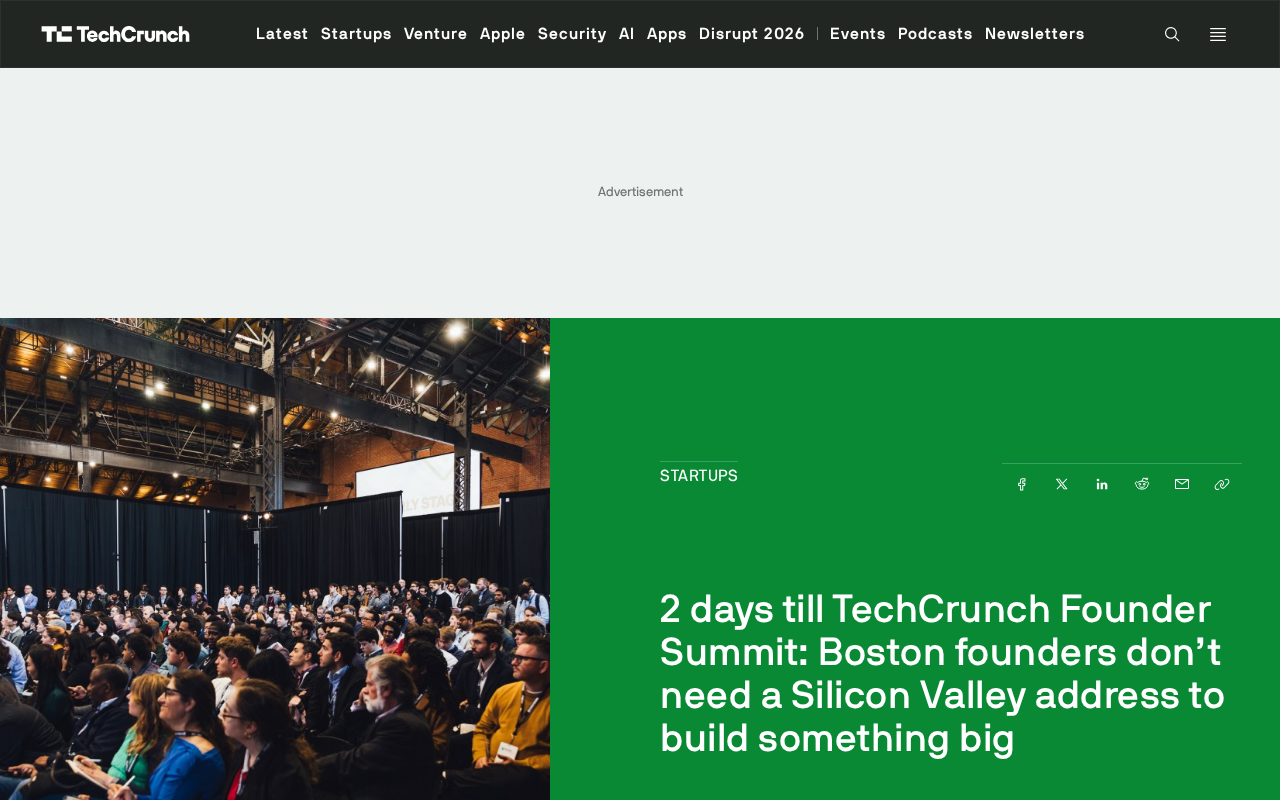
A Gathering Tailor-Made for Founders
According to official TechCrunch information, the Founder Summit agenda is designed entirely around the founder community, emphasizing a "founder-focused agenda" and "impactful connections." The choice of Boston rather than the traditional heart of Silicon Valley is itself symbolic.
For early-stage entrepreneurs, time and budget are extremely precious. The summit offers flexible ways to participate: early registration saves up to $100, and group passes come with additional discounts. This pricing strategy clearly aims to lower the barrier to entry for founders, making it affordable for more early-stage teams.
Boston's Entrepreneurial Confidence
The original headline directly states the core argument—Boston founders don't need a Silicon Valley address to build something big. This isn't an empty slogan but an observation of the current geography of entrepreneurship.
For a long time, Silicon Valley has been seen as the default coordinate for tech startups, with funding, talent, and media exposure all seemingly centered on that Bay Area. But Boston has dense university resources, medical and biotech industry clusters, and an increasingly active early-stage investment ecosystem. The Founder Summit landing here means TechCrunch is actively acknowledging this multi-centered entrepreneurial reality.
For founders outside Silicon Valley, the value of such events is that they bring resources and networks to the local area rather than requiring founders to move to California first.
How Silicon Valley Became the Default Coordinate for Startups
Silicon Valley's long-standing status as the "default address" for tech startups is closely tied to its historical path: the university-industry collaboration promoted by Stanford University in the mid-20th century, the Shockley Semiconductor Laboratory, and the subsequent "traitorous eight" who founded Fairchild Semiconductor gradually spawned three waves—semiconductors, personal computers, and the internet. As venture capital firms (such as Kleiner Perkins and Sequoia) gathered on Sand Hill Road, a highly concentrated positive feedback loop of capital, talent, media, and success stories formed. This clustering effect lowered transaction costs for early-stage companies—fundraising, hiring, and finding customers often happened within a few kilometers—and also shaped the external path dependency that "startups must go to the Bay Area." Understanding this background is essential to understanding why "not needing a Silicon Valley address" is seen as an argument worth emphasizing: it challenges a long-standing geographic inertia, not merely local promotion.
The Rise of Multi-Centered Startup Ecosystems
So-called multi-centered entrepreneurship means innovation activity is no longer concentrated in a single geographic hub but forms distinctive ecosystems in multiple cities. Boston is a typical example of this trend: leveraging universities like Harvard and MIT, it has accumulated deep strengths in biotech, healthcare, robotics, and deep tech, with the Kendall Square area hosting numerous laboratories, startups, and pharmaceutical R&D centers. Meanwhile, remote collaboration tools, distributed funding channels, and cross-regional talent mobility have reduced the rigid constraints of location, enabling early-stage teams to complete product validation and fundraising outside traditional tech centers. This change does not mean Silicon Valley is declining but that founders have more paths to choose from—the resource density and fit of a local ecosystem often affect early success more than "whether you're in the Bay Area."
What the Two-Day Countdown Means
With only two days left until the November 4 event, this timing is a signal for founders to act. The summit's core selling point isn't large-scale booths or lengthy keynotes but founder-focused agenda design and high-quality connection opportunities.
In the early stages of a startup, one effective conversation can be more valuable than ten rounds of general networking. Founder Summit limits attendees to founders and related roles, objectively increasing the density and relevance of interactions. The availability of group passes also encourages founding teams to participate together, bringing insights directly back to the company.
The Connection Value of Founder-Only Events
The value logic of events aimed exclusively or primarily at founders differs from general tech conferences. The high homogeneity of attendee identities means conversations can more easily dive directly into specific issues like product, fundraising, hiring, and customer acquisition, reducing ineffective networking. Event scale is usually deliberately controlled to increase interaction density and the probability of two-way matching. In the early stages of a startup, a high-quality conversation—whether with a potential investor, an early customer, or a peer who has faced similar pitfalls—can directly influence the company's next decision. Therefore, the core metric for such events isn't the number of booths or star speakers but whether attendees can generate actionable, follow-up connections.
Participation Logic Worth Noting
Judging from the event's positioning, TechCrunch hasn't packaged Founder Summit as just another general tech conference. It emphasizes connections among founders and an agenda oriented toward practical problems. This positioning is particularly suited for teams in the product validation or early fundraising stage.
Boston's entrepreneurial ecosystem is proving that geography is no longer the sole variable determining success or failure. What really matters is whether you can access the right resources and the right people, and whether there's a platform willing to focus its attention on founders. The message Founder Summit is sending two days before opening is clear: bring your questions and come build meaningful connections on site.
For founders still hesitating, the window is narrowing. The early registration price advantage and group discounts are the most immediate reasons to participate.
One-line Summary
TechCrunch Founder Summit opens in Boston in two days, emphasizing that founders don't need a Silicon Valley address to build something big.
Paragraph Summary
TechCrunch Founder Summit will be held in Boston on November 4, with only two days left until opening. The summit designs its agenda around founders, emphasizing high-value connections rather than large-scale exhibitions, and lowers the barrier to entry through early registration discounts and group passes. The choice of Boston is itself symbolic: it challenges the long-standing inertia of Silicon Valley as the default coordinate for startups and acknowledges a multi-centered entrepreneurial reality supported by university resources, biotech, and early-stage investment ecosystems. The article argues that for teams in product validation or early fundraising, one effective conversation may be worth more than ten rounds of general networking, and the value of such events lies in bringing resources and networks to the local area, enabling founders to build meaningful connections with specific questions in hand.
Related articles

Deleted Reddit Post Sparks Debate Over AI Content Moderation
A Reddit post removed with only a 'Removed by Reddit' notice highlights AI content moderation's transparency gaps, misjudgment risks, and appeal challenges for platforms and creators.

DSH + Ollama Local LLM Deployment in Practice: Free Chat with Da Fei Yu
Bilibili creator tests DSH + Ollama local LLM deployment end to end: Ollama install, Xunlei-accelerated downloads, ModelScope GGUF model import, DSH custom API address setup, and a comparison of Qwen 3.5 4B, 8B, Gemma, and other models on 8GB VRAM, with advice on choosing local deployment vs. API calls.

Tested: A $899 Mac Mini vs. a $200/Month AI Subscription
Real-world test of whether an M4 Mac mini can replace a $200 AI subscription: 16GB can't fit large models, and both speed and quality fall short—but privacy, no caps, and near-zero running costs make it an ideal host for an always-on agent. Includes buying advice per configuration and money-saving strategies.