Tecla: A Productivity Tool That Turns Your TODO List into an AI Agent Interface

Tecla is a proactive AI work assistant with a TODO list as its core interface, automatically identifying tasks from Slack, email, and meetings and executing them with one click.
Tecla is a proactive AI work assistant that appeared on Product Hunt. It breaks the passive "you ask, I answer" mode of traditional AI assistants by using a TODO list as its core interface, proactively scanning user activity across Slack, email, and meetings, identifying tasks and organizing them into a to-do list that users can execute with a click—no prompt writing required. The product received 74 upvotes and 2 comments on Product Hunt, ranking 20th, and is in an early exposure stage. Its core capability is cross-platform context integration, but this also brings challenges such as accuracy, privacy and security, and execution reliability. Tecla represents the trend of AI assistants evolving from passive response to proactive service, and whether it can deliver on its promises in real scenarios will determine the prospects of this type of product.
In an era where AI assistants are proliferating, most products remain stuck in a passive "you ask, I answer" mode. A new product on Product Hunt called Tecla aims to break this inertia—it uses the TODO list as its core interface, letting AI proactively surface tasks from your workflow and execute them with a single click. The product received 74 upvotes and 2 comments on Product Hunt, ranking 20th for the day and drawing considerable attention.
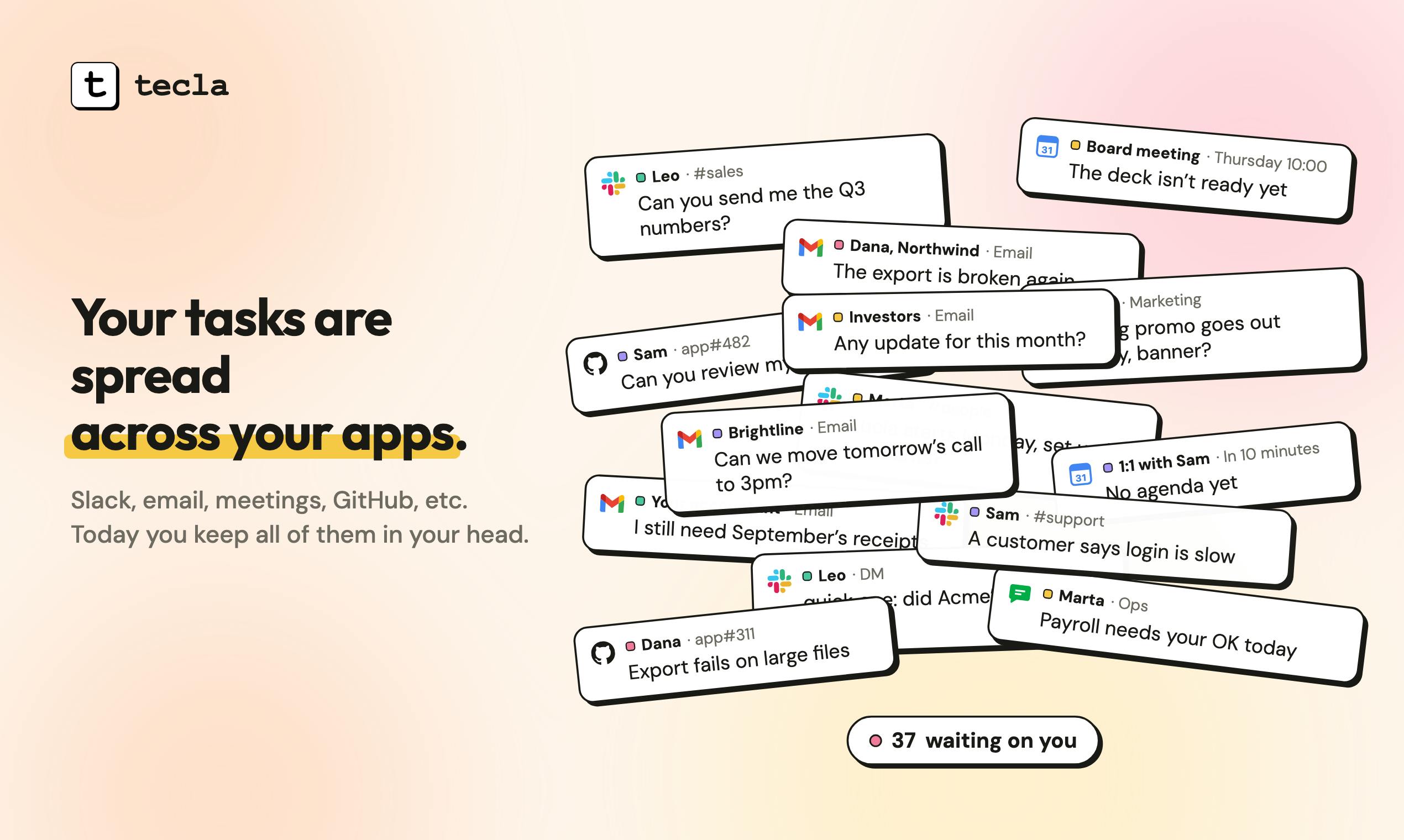
From Passive Response to Proactive Action: Tecla's Product Logic
Tecla positions itself as a "proactive AI work assistant." Its core logic isn't to wait for user commands, but to proactively scan user activity across Slack, email, and meetings, identify work items that need to be completed, and organize them into a curated TODO list. Users simply click any item, and Tecla executes it on their behalf—no prompt writing required, and no switching back and forth between multiple text threads.
This design approach directly addresses a pain point of current AI assistants: the barrier of prompt engineering. Most AI tools require users to clearly articulate their needs, but in real work scenarios, people often only know that "there's something to do" without being able to immediately break it down into machine-executable instructions. Tecla attempts to automate this step, letting AI take on the responsibility of "understanding what needs to be done."
Prompt Engineering refers to the process by which users must carefully design input instructions (prompts) to obtain desired outputs from large language models. This typically involves techniques such as clarifying task objectives, providing context, and specifying output formats. For non-technical users, prompt engineering constitutes a practical barrier to using AI tools—they may not know how to translate vague intentions into clear, executable instructions. Tecla attempts to bypass this step by proactively identifying tasks and automatically generating execution plans, allowing users to enjoy AI capabilities without learning prompting techniques. This represents an attempt to evolve AI tools toward "zero-prompt" interaction.
The Interface Is the TODO: A Shift in Interaction Paradigm
Tecla's most striking design decision is using the TODO list itself as the user interface. This isn't simply feature stacking, but a shift in interaction paradigm. Traditional AI assistants typically use chat windows as their medium, requiring users to initiate conversations; Tecla pushes to-do items to the forefront, so users see "what needs to be handled right now" as soon as they open the product, and can trigger execution with a click.
This design lowers the barrier to use and also changes the rhythm of human-AI collaboration. AI is no longer a tool that needs to be summoned, but a work companion that continuously observes, organizes, and reminds in the background. The official description mentions that users will "never miss anything again," which underscores the emphasis on workflow continuity—AI's memory and perception cover multiple scenarios including chat, email, and meetings, forming an unbroken thread of tasks.
Proactive AI Agent refers to an AI system capable of continuously observing its environment, autonomously judging when to take action, and proactively initiating tasks—in contrast to traditional passive responsive assistants (such as chatbots). Proactive agents typically need capabilities including environmental perception, task mining, prioritization, and autonomous execution. Tecla's approach of monitoring Slack, email, and meetings to identify to-do items is a manifestation of this concept. The challenge for such agents lies in balancing proactivity with a sense of user control—excessive proactivity may cause interference, while insufficient proactivity degrades into an ordinary tool. Currently, proactive AI agents are seen as an important direction for AI assistant evolution, but how to reliably implement them in real workflows remains a focus of industry exploration.
The Potential and Challenges of Multi-Scenario Context Integration
Tecla claims it can understand "what needs to be done" from Slack conversations, email exchanges, and meetings, and carry all the context needed for execution. This means it needs cross-platform access to user work data, performing semantic understanding and task extraction on information. From the product demo, this process is simplified to "click to complete," but in actual implementation, the accuracy of cross-platform data integration, privacy and security, and the reliability of task execution are all unavoidable challenges.
Currently, Tecla's discussion volume on Product Hunt is not particularly high—2 comments and 74 upvotes indicate it is still in an early exposure stage. However, the "proactive AI agent" direction is receiving increasing attention, and Tecla, with its TODO list entry point, provides a product sample worth observing. Whether it can deliver on its "no prompts needed" promise in real work scenarios will determine whether this type of proactive assistant can become the mainstream form of the next wave of productivity tools.
Cross-platform context integration involves extracting, aligning, and fusing information from multiple heterogeneous data sources (such as Slack, email, and meeting records) to build a unified understanding of the user's work state. This requires solving technical challenges such as data format differences, entity resolution (identifying information from different platforms that refers to the same task), and temporal alignment. Additionally, privacy and security are core concerns: cross-platform access means AI needs to access sensitive work communication content, and ensuring data encryption, access control, and compliant use (such as GDPR) are necessary conditions for product implementation. Tecla's claimed ability to "carry all the context needed for execution" depends on the maturity of these underlying capabilities, and its actual effectiveness will depend on the accuracy of integration and the establishment of user trust.
Key Takeaways
- Tecla is a proactive AI work assistant that uses a TODO list as its core interface rather than a traditional chat window.
- It automatically identifies tasks from Slack, email, and meetings, and users can execute them with a single click without writing prompts.
- The product received 74 upvotes and 2 comments on Product Hunt, ranking 20th, and is in an early exposure stage.
- Cross-platform context integration is Tecla's core capability and also the main challenge it faces in implementation.
- Proactive AI agents represent the trend of AI assistants evolving from passive response to proactive service.
One-line Summary
Tecla is a proactive AI work assistant with a TODO list as its core interface, automatically identifying tasks from Slack, email, and meetings and executing them with one click.
Paragraph Summary
Tecla is a proactive AI work assistant that appeared on Product Hunt. It breaks the passive "you ask, I answer" mode of traditional AI assistants by using a TODO list as its core interface, proactively scanning user activity across Slack, email, and meetings, identifying tasks and organizing them into a to-do list that users can execute with a click—no prompt writing required. The product received 74 upvotes and 2 comments on Product Hunt, ranking 20th, and is in an early exposure stage. Its core capability is cross-platform context integration, but this also brings challenges such as accuracy, privacy and security, and execution reliability. Tecla represents the trend of AI assistants evolving from passive response to proactive service, and whether it can deliver on its promises in real scenarios will determine the prospects of this type of product.
Related articles
Google Stitch Skills: Connecting Coding Agents to the Design Workflow
Google Stitch Skills is an Agent Skills library following the open standard, adding a design-to-code workflow to the Stitch MCP Server. This article breaks down its three skill groups, SKILL.md directory structure, installation paths, and dependency pitfalls.

40.5-Inch Color E-Paper Art Frame: An Art Display You Charge Once a Year
The Ink Poster Tella 40.5-inch color e-paper art frame uses the E Ink Spectra 6 full-color solution: A1 format, no backlight, no noise, about one charge a year, 2,000+ licensed artworks built in, and automatic adaptation of phone photos.

Jingle Jam Memories: RT's Awkward First Encounter with Lewis
RT shares his awkward first Jingle Jam experience: unexpectedly pushed into the studio, meeting Lewis and Yogg's cast, and Toddy appearing in armor.