Telo MT1 Micro Electric Pickup: Can a Small Body Hold Big Ambitions?

The Telo MT1 crams full-size pickup specs into a micro body — a bold idea facing massive production hurdles.
The Telo MT1 is a micro electric pickup designed by former Tesla engineers, aiming to deliver an 8-foot bed, 8,000-lb towing, 350-mile range, and sub-4-second 0-60 in a compact body starting at $41,520 — with around 14,000 reservations already placed. Its concept directly targets the pain points of America's ever-growing full-size trucks. However, its safety architecture currently relies on AI virtual simulation without real-world crash test validation, and its planned 2027 delivery faces the triple challenge of production ramp-up, supply chain management, and sustained financing. Reserving a Telo MT1 is ultimately a trust bet on an unproven startup's ability to deliver.
A Small Truck Designed to Solve the "Big Pickup Problem"
Pickup trucks in the American market keep getting bigger — harder to park, thirstier on fuel, and awkward for daily urban commuting. These pain points gave rise to what seems like a contradictory new breed of vehicle: the Telo MT1. Designed by former Tesla engineers, this micro electric pickup attempts to pack full-size truck utility into an impressively compact body.
On paper, the MT1 looks almost too good to be true: with the mid-gate folded down, it offers an 8-foot bed, 8,000 lbs of towing capacity, 0–60 mph in under 4 seconds, up to 350 miles of range, and even a hidden "frunk tunnel" beneath the bed for extra storage. Fitting all of that into such a small footprint is an engineering challenge in its own right.

AI-Driven Virtual Testing Backs the Safety Claims
The biggest concern with a compact body is crash safety. The shorter the vehicle, the less front-end crumple zone available to absorb impact energy — which directly affects the ability to pass mandatory crash tests.
Telo's response: they completely redesigned the frontal crash architecture using AI-powered virtual simulations to ensure the vehicle can legally hit the road. This approach is increasingly common in modern automotive development — simulation can dramatically shorten development cycles and reduce costs. The catch, however, is that virtual test results and passing real-world regulatory crash tests are two entirely different things. Simulation can optimize a design, but it cannot replace physical crash validation with an actual vehicle. For a startup, clearing that hurdle is often the true make-or-break moment.

Automotive crash safety simulation typically relies on Finite Element Analysis (FEA), building digital models of body structures to simulate force transfer, material deformation, and occupant protection during a collision. In recent years, the integration of AI and machine learning has allowed engineers to complete parameter optimization iterations in hours that previously took weeks. However, U.S. federal regulations (FMVSS) and rating programs from NHTSA and IIHS require physical crash tests with real vehicles — simulation results cannot substitute for regulatory certification. For startup automakers, completing a full battery of crash certification tests typically costs tens of millions of dollars, and any deviation between real-world results and simulation predictions can mean structural redesigns from the ground up — one of the key reasons many startup brands stumble before reaching production.
$40K Starting Price, 14,000 Reservations, and the Demand Behind Them
Telo's founders firmly believe there's genuine market demand for an "urban utility vehicle" — people who want a capable work truck without the footprint of a full-size land yacht.
The data backs them up. The Telo MT1 starts at $41,520 and has already accumulated approximately 14,000 reservations. Those numbers suggest a meaningful segment of consumers genuinely embraces the "small but capable" philosophy and is willing to pay for an electric pickup better suited to urban environments. Compared to mainstream electric pickups that routinely approach or exceed 80 inches in width, the MT1's differentiated positioning targets a long-neglected niche.

The Real Test: Getting to Mass Production
No matter how impressive the specs or how enthusiastic the reservations, for an EV startup, it's only the beginning. Telo has targeted 2027 for deliveries, but as the video bluntly acknowledges: in an industry weighed down by massive debt loads, actually delivering on that promise is extraordinarily difficult.
The pattern has played out repeatedly in the EV startup world — writing a shiny spec sheet for a compact vehicle is the easy part. The hard part is scaling that product into mass production and putting real trucks in customers' driveways. From Rivian to Lucid to the many startups that have already collapsed, production ramp-up, supply chain management, and sustained financing are the variables that determine survival. For an unknown new brand, that road is inevitably steep.
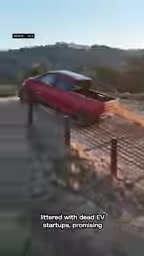
The mass production struggles facing EV startups are structural. Unlike legacy automakers, startup brands typically lack their own stamping and body assembly lines, forcing them to rely on contract manufacturers or build their own facilities — while negotiating long-term procurement agreements for core supply chain components like batteries and motors carries extremely high barriers to entry. Rivian suffered severe losses in its early production phase due to parts shortages and factory ramp-up issues, with actual per-vehicle production costs at one point far exceeding the sale price. Fisker filed for bankruptcy protection in 2024 after failing to establish a stable manufacturing system. For a brand like Telo — which has yet to disclose details about a manufacturing partner — whether the 2027 delivery target holds will depend largely on whether the company can simultaneously lock in a factory, secure its supply chain, and close continued financing rounds within the next two years.
Would You Bet on It?
The Telo MT1 represents a product philosophy worth taking seriously: using technology to redefine the balance between pickup truck size and practicality. Its concept is fresh, its positioning is clear, and its pricing is genuinely compelling.
But between concept and reality stand three formidable hurdles: crash testing, production ramp-up, and funding. For consumers, this is ultimately a bet on trust — believing that an unknown startup team can turn a paper promise into a real truck parked in your driveway. Are you willing to take that bet?
Related articles

Amphibious Transforming Drone: Beyond 100x Power Savings, What Are the Real Needs?
Is the amphibious transforming drone just a gimmick? Starting from the 100x power difference of the M4 Morphobot, explore real application scenarios and thesis topic ideas, analyzing boundary conditions where pure drones and pure ground robots both fail.

Warhound Raises $200 Million: Genetically Engineered "War Dogs" Paired with Anduril Gear
Warhound raises $200M, backed by Ben Lamm and Palmer Luckey, to genetically engineer dogs for military and law enforcement use and equip them with Anduril gear. This article analyzes its technology direction, funding logic, and ethical controversy.

Claude API Comes to Google Cloud: IAM Integration and SDK Access Guide
Anthropic hosts the full Claude API on Google Cloud with IAM-controlled permissions and unified billing. This guide covers the Vertex AI and Anthropic-hosted entry points, IAM role configuration, and SDK access.