Temp Mail Major Update: Disposable Inbox + Private Forwarding Aliases to Protect Your Real Email Address

Temp Mail adds forwarding aliases and more, upgrading disposable email into a long-term privacy identity tool.
Temp Mail is a privacy tool that generates a temporary inbox in one click with no sign-up required. Its latest Product Hunt update introduces Forwarding Aliases on Android — share a private address, receive mail instantly in your real inbox, and keep your actual address hidden from senders, similar to Apple's Hide My Email and SimpleLogin. The update also adds one-tap verification code copying, custom usernames and domains, reusable inboxes, 29-language support, and an ad-free website. It bridges "quick throwaway" and "long-term identity isolation" in a single tool for privacy-conscious users who want simplicity. Not suitable for sensitive accounts, as mail passes through third-party servers.
Privacy leaks often start with a single email address. Signing up for trials, downloading resources, subscribing to newsletters — every time you hand over your real email, you're opening a door to spam and data tracking. Temp Mail, which recently launched on Product Hunt and climbed to #15 on the day's leaderboard, is back with a major update. Its combination of disposable inboxes and private forwarding aliases aims to build a firewall around your real inbox.
A Familiar Need, a Sharper Solution
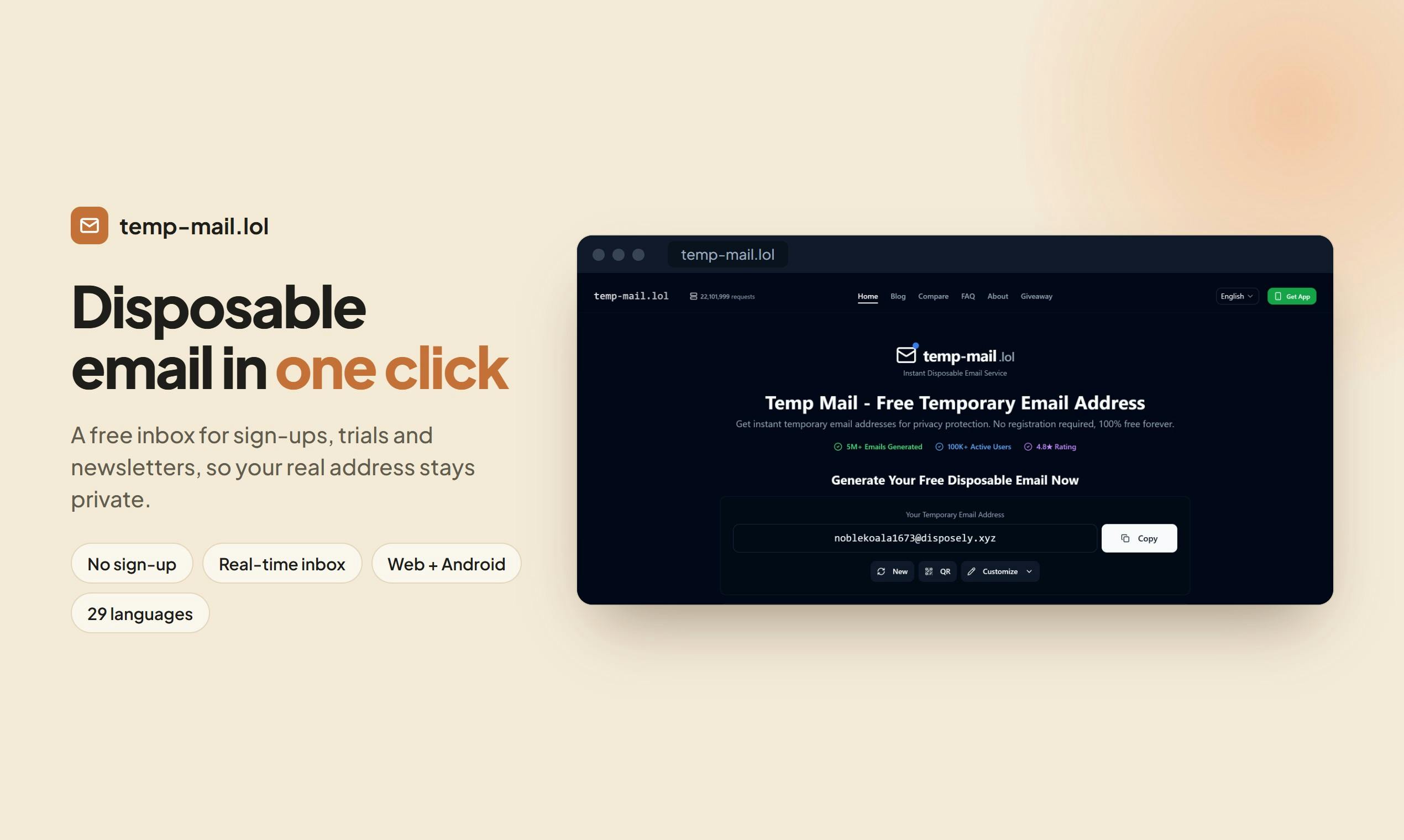
Temp Mail's core proposition is straightforward: one click, and you get a free disposable email address — no registration required. For situations where you just want to grab a free trial, download something, or subscribe to a newsletter, this "use and discard" model is practically essential. You no longer have to expose your primary inbox to questionable websites.
Tools like this aren't new — the temporary email space has plenty of players. What sets Temp Mail apart is a more polished experience and a deeper focus on privacy. The three keywords driving this update are: zero friction, control, and longevity.
What's New in This Update
What makes this update worth paying attention to are several improvements that address real pain points.
Forwarding Aliases: Keep Your Real Inbox Hidden
The most notable new feature is Forwarding Aliases on Android. You share a private alias address with others, and emails arrive in your real inbox within seconds — while senders never see your actual email address.
This is fundamentally different from a disposable inbox: disposable addresses are temporary, while forwarding aliases are long-term but identity-isolated. The concept is closer to Apple's Hide My Email or services like SimpleLogin — you can keep receiving mail indefinitely, and if an alias gets abused, you simply discard it without affecting your main inbox.
SimpleLogin is currently the most prominent open-source email alias service; it was acquired by Proton (the parent company of ProtonMail) in 2022. Its core idea is to generate a unique alias for every site you register with, routing all mail through an alias server before it reaches your real inbox. Apple's "Hide My Email" is a native system-level implementation on iOS/macOS that automatically generates a random address when you sign up for sites via Safari, backed by Apple's infrastructure. Both share a "single-point isolation" advantage: if one alias is flooded with spam or caught in a data breach, you simply disable that alias and your primary inbox is completely unaffected. Temp Mail's forwarding alias follows the same technical approach, with the difference being that it also offers disposable inboxes as a lightweight entry point — lowering the barrier for users who don't want to create a separate account just for an alias service.
One-Tap Verification Code Copy
One of the most tedious parts of using a temporary inbox is manually digging a verification code out of an email. Temp Mail now lets you copy verification codes with a single tap, eliminating the need to select and paste text repeatedly. It's a small detail, but it makes a meaningful difference in high-frequency use.
Custom Usernames and Domains, Reusable Inboxes
Users can now choose a custom username and domain, then reuse the same inbox going forward. This means a temporary email address no longer has to be a one-time-use throwaway — it can become a dedicated inbox for a specific purpose, like receiving a particular category of subscriptions.
29 Languages and an Ad-Free Website
On the internationalization front, Temp Mail supports 29 languages, including right-to-left scripts like Arabic and Urdu, reaching user groups in the Middle East and South Asia that are often overlooked. The team also emphasizes that its website is ad-free — a genuine differentiator in a space where most free tools rely on advertising revenue.
Who Is This For?
Temp Mail's category tags clearly point to its audience: Android, Email, Privacy. It targets everyday users who have a basic awareness of privacy but don't want to invest time in complex configurations.
For users who constantly sign up for new services, disposable inboxes block a large volume of marketing noise. For those who want to manage their identity boundaries over the long haul, forwarding aliases offer "single-point isolation" when any one address is compromised. Together, they cover the full spectrum from "quick fix" to "long-term identity management."
A Moment of Sober Reflection
The tool is genuinely useful, but it's worth thinking clearly about its limits. Disposable email services inherently involve a trust question — your emails pass through a third-party server, which makes them unsuitable for anything sensitive (banking, important accounts). The same applies to forwarding aliases: the privacy guarantees ultimately depend on how the service provider actually handles your data.
From Product Hunt's metrics, 74 upvotes and 3 comments put it at a moderate level of attention — the product got noticed but hasn't sparked a broader conversation. It feels more like a mature, steadily-iterated utility that nails the user experience than a disruptive innovation. For users with the relevant needs, it's worth trying. But before integrating it into your privacy workflow, it's just as important to think clearly about which emails should go through it — and which shouldn't.
The core privacy risk with email alias and disposable inbox services is intermediary visibility: all emails routed through their servers are theoretically readable by the service provider during transit, unless end-to-end encryption is used throughout (which most ordinary emails are not). When evaluating whether a service is trustworthy, several dimensions are worth checking: whether the service is open-source or has undergone independent audits; the log retention policy stated in the privacy documentation; the data protection legal environment of the company's jurisdiction (e.g., whether it falls under GDPR); and whether any public data breaches have been recorded. For highly sensitive email communications, a safer alternative is to use an end-to-end encrypted email service like ProtonMail or Tutanota, rather than relying on a forwarding intermediary.
Related articles

5 Practical Ways Real Estate Agents Can Use AI to Boost Efficiency (2026 Edition)
How can real estate agents use AI to boost efficiency? Based on a YouTube walkthrough, this breaks down five methods — ChatGPT for listing descriptions, Canva for marketing materials, forms for open house leads, Zapier for automated follow-up, and seller meeting prep — and flags risk boundaries like fair housing laws, photo authenticity, and price verification.

Grok Bot vs ChatGPT Agent: Which AI Agent Is More Powerful?
How does Grok Bot differ from ChatGPT Agent? This comparison examines how they work: Grok Bot has a cloud computer and runs persistently inside tools to execute multi-step tasks automatically; ChatGPT Agent operates web pages in a browser and is more mature at general tasks. Includes selection advice.

Walmart Agent Gateway: AI Shops for You Automatically—Why Is Amazon Going the Opposite Way?
Walmart's Agent Gateway lets ChatGPT, Gemini and other AI assistants access its product catalog to search, compare and add to cart, with spending limits and per-purchase approval. Amazon blocks external AI agents—two retail giants, opposite paths. Currently US-only, India may follow.