Temporal Leakage Distorts TGB Node Affinity Leaderboard: A Point-in-Time Audit

Audit finds temporal leakage in TGB node affinity evaluation; leaderboard shifts significantly under leakage-free protocol.
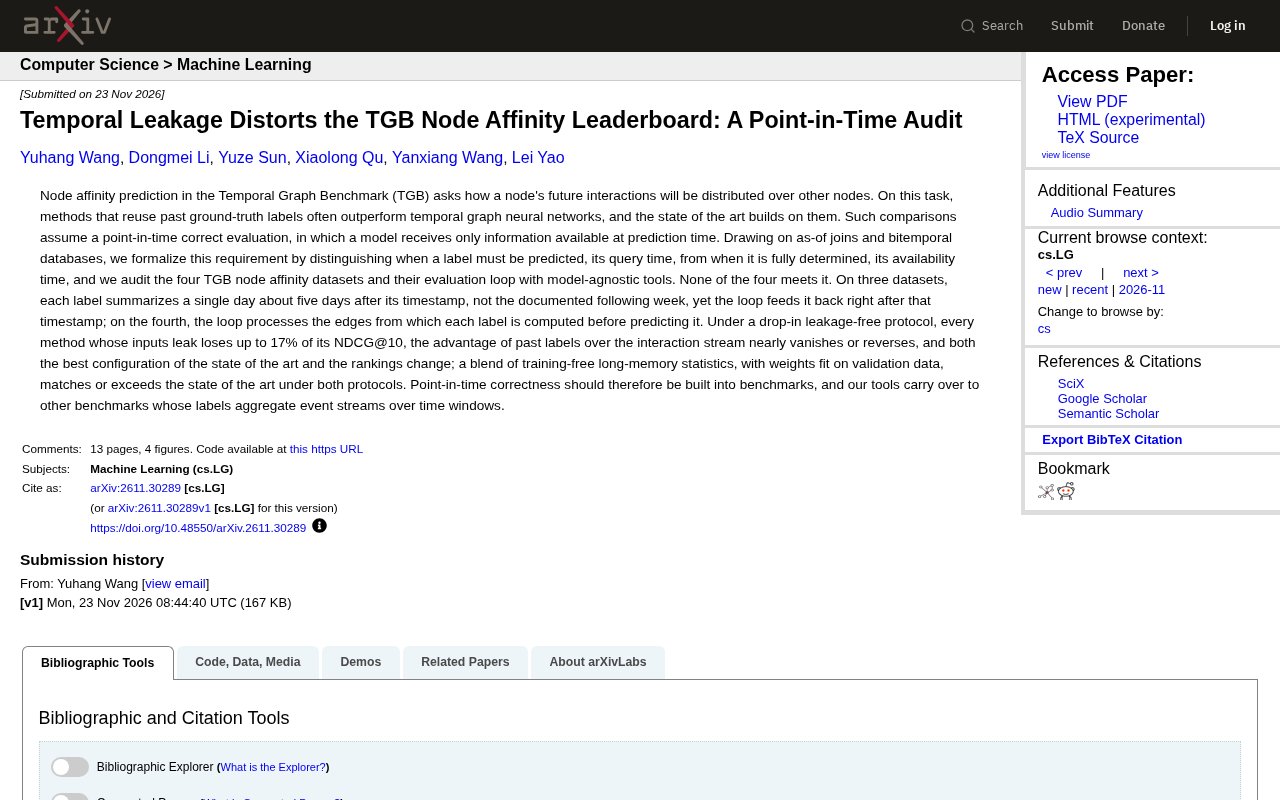
A recent audit reveals that Temporal Graph Benchmark (TGB)'s node affinity task systematically suffers from temporal leakage in dataset construction and evaluation loops, with models accessing future information at prediction time. Using bitemporal database concepts to distinguish label query time from availability time, the study examines four datasets and finds none satisfies point-in-time correctness. Under a leakage-free protocol, all leaking input methods drop by up to 17% in NDCG@10, the advantage of past labels vanishes or reverses, and rankings change. A training-free long-memory statistics method matches or exceeds state-of-the-art methods under both protocols. The study calls for embedding point-in-time correctness into benchmarks and recalibrating the leaderboard.
Introduction
In the field of dynamic graph learning, the node affinity prediction task requires models to predict the future interaction distribution of nodes with other nodes. Temporal Graph Benchmark (TGB), as an important benchmark in this field, has its leaderboard long regarded as an authoritative reference for method performance. However, a recent audit study reveals a critical issue: temporal leakage may severely distort the fairness of the leaderboard.
According to the study, on TGB's node affinity tasks, methods that reuse past ground-truth labels often outperform temporal graph neural networks (TGNNs), and current state-of-the-art methods are built precisely on top of these methods. Such comparisons presuppose that evaluation must be point-in-time correct, i.e., models can only access information available at prediction time. But the audit finds that four TGB node affinity datasets and their evaluation loops all fail to meet this requirement.
Temporal Leakage: Definition and Formalization
Drawing on the concepts of as-of joins and bitemporal databases, the study distinguishes a label's "query time" (the moment at which the label must be predicted) from its "availability time" (the moment at which the label is fully determined). This formalization clearly defines the requirement of point-in-time correctness: at prediction time, the model may only use information available before the query time.
However, in TGB's evaluation loop, the boundary between a label's availability time and query time is blurred. The audit uses model-agnostic tools to examine the four datasets and finds that none satisfies point-in-time correctness.
Bitemporal Database is a model that records both "valid time" (the time period during which a fact is true in the real world) and "transaction time" (the time at which the fact is entered into the database). In temporal graph learning evaluation, this concept helps distinguish a label's query time from its availability time: query time is the moment at which the model must make a prediction, and availability time is the moment at which the information the label depends on is fully determined and can be safely used. If the evaluation loop exposes the label to the model before its availability time, temporal leakage occurs. An as-of join is a database technique that joins data tables according to the semantics of "as known as of a certain point in time," commonly used to construct point-in-time-correct training/evaluation samples.
Audit Findings: Problems with Datasets and Evaluation Loops
The audit reveals specific data leakage mechanisms. In three datasets, each label actually summarizes single-day interactions within roughly five days after its timestamp, rather than the "following week" claimed in the documentation. Yet the evaluation loop feeds the label back to the model immediately after the timestamp, causing the model to use future information at prediction time. In the fourth dataset, the evaluation loop processes the edges used to compute the label before predicting the label, likewise causing leakage.
These findings indicate that temporal leakage is not accidental but systematically present in dataset construction and evaluation pipelines.
NDCG@10 (Normalized Discounted Cumulative Gain at 10) is a commonly used evaluation metric in ranking and recommendation tasks, measuring the quality of the relevance ranking of the top 10 predictions. It first discounts relevance scores by position (lower weight for lower ranks), then normalizes by dividing by the total discounted gain under the ideal ranking, yielding a value between 0 and 1. In node affinity prediction, a higher NDCG@10 indicates that the model's predicted future interaction distribution is closer to the true distribution. This metric is particularly sensitive to top-ranked results, making it suitable for measuring whether the model ranks the most likely interacting nodes first.
Impact of Leakage on the Leaderboard
To quantify the impact of leakage, the study designs a drop-in leakage-free protocol. Under this protocol, the NDCG@10 of all methods with leaking inputs drops by up to 17%. More strikingly, the advantage of past labels over interaction streams nearly vanishes or even reverses, and both the best configurations and leaderboard rankings of state-of-the-art methods change.
This result directly challenges conclusions previously drawn from leaky evaluations. For example, some methods may lead the leaderboard partly because they exploit leaked information more effectively, rather than because of genuine predictive capability.
New Findings Under the Leakage-Free Protocol
Under the leakage-free protocol, a method that mixes training-free long-memory statistics, with weights fitted on validation data, matches or exceeds the performance of state-of-the-art methods under both protocols. This suggests that when evaluation becomes fair, simple and robust methods may be more competitive.
This finding also suggests that the community needs to re-examine the validity of methods that rely on historical labels and to develop stronger baselines that do not depend on leakage.
Training-free Long-memory Statistics refers to methods that construct prediction scores directly from nodes' historical interaction frequencies or co-occurrence statistics over longer time windows, rather than through gradient training. Long memory means the model retains and aggregates interaction information from far earlier than the current moment to capture stable affinity relationships between nodes. Such methods have few parameters and require no training, making them insensitive to changes in evaluation protocols; however, their effectiveness depends heavily on whether historical statistics can be legitimately obtained, and if temporal leakage exists in evaluation, their advantages may be exaggerated or obscured.
Conclusions and Implications
The study calls for building point-in-time correctness into benchmarks and provides tools that can be generalized to other benchmarks, especially those whose labels aggregate event streams within time windows. For the TGB community, this means the leaderboard may need to be recalibrated to ensure fair comparisons.
Temporal leakage affects not only the node affinity task but may also exist in other temporal graph learning tasks. In the future, benchmark design should pay greater attention to rigor in the temporal dimension to avoid misleading research directions due to imperfect evaluation protocols.
One-line Summary
An audit finds temporal leakage in TGB node affinity evaluation, with leaderboard rankings changing significantly under a leakage-free protocol.
Paragraph Summary
A recent audit study reveals that Temporal Graph Benchmark (TGB)'s node affinity task systematically suffers from temporal leakage in dataset construction and evaluation loops, with models accessing future information at prediction time. Drawing on bitemporal database concepts to distinguish a label's query time from its availability time, the study examines four datasets and finds that none satisfies point-in-time correctness. Under a leakage-free alternative protocol, all input methods with leakage drop by up to 17% in NDCG@10, the advantage of past labels over interaction streams nearly vanishes or even reverses, and leaderboard rankings change. A training-free long-memory statistics method matches or exceeds state-of-the-art methods under both protocols. The study calls for building point-in-time correctness into benchmarks and recalibrating the leaderboard.
Related articles

Trained Entirely on Ascend NPU! Phai-A1-35B Code Model Hands-On Test
Phai-A1-35B-1M is a 35B expert model based on Qwen 3.6, targeting code and Agents, with its entire fine-tuning and reinforcement learning training done on Huawei Ascend NPUs. This article covers its MoE architecture, 1M context, official benchmark scores, and deployment, plus license caveats for the base model.

RK3588S Benchmarks Local LLMs: 35B MoE vs. NPU Acceleration — Which Is Faster?
RK3588S benchmarked with local LLMs: 4B dense, 35B MoE, and NPU-accelerated models compared. Pure CPU hits 5.8 tokens/s generation; NPU reaches 26 tokens/s prefill — revealing edge device selection strategies.

GLM 5.4 Recurrent Transformer Explained: How 750B Parameters Surpasses DeepSeek?
Zhipu AI releases GLM 5.4, the first recurrent Transformer flagship with 750B parameters claiming 2-3T-model intelligence. Analysis of its tech, DeepSeek comparison, and lack of third-party tests.