Ten Years Later, 'Pokémon Go to the Polls' Still Echoes Across the Internet

A political gaffe slogan became an ironic rallying cry for young voters a decade later.
The article traces how Hillary Clinton's 2016 'Pokémon Go to the polls' slogan evolved from mockery into a lasting internet meme. Over ten years, it's been remixed and recreated as an ironic rallying cry for young voters. The piece analyzes how irony lowers barriers to political expression and reveals the uncontrollable afterlife of slogans in participatory culture.
Ten years ago, when Hillary Clinton said "Pokémon Go to the polls" on the campaign trail, she probably never imagined the phrase would become an enduring internet meme. Today, it's no longer just shorthand for a political misstep—it has become an irony-shrouded rallying cry, especially for young voters who are weary of politics yet still hold onto hope.
The Accidental Life of a Slogan
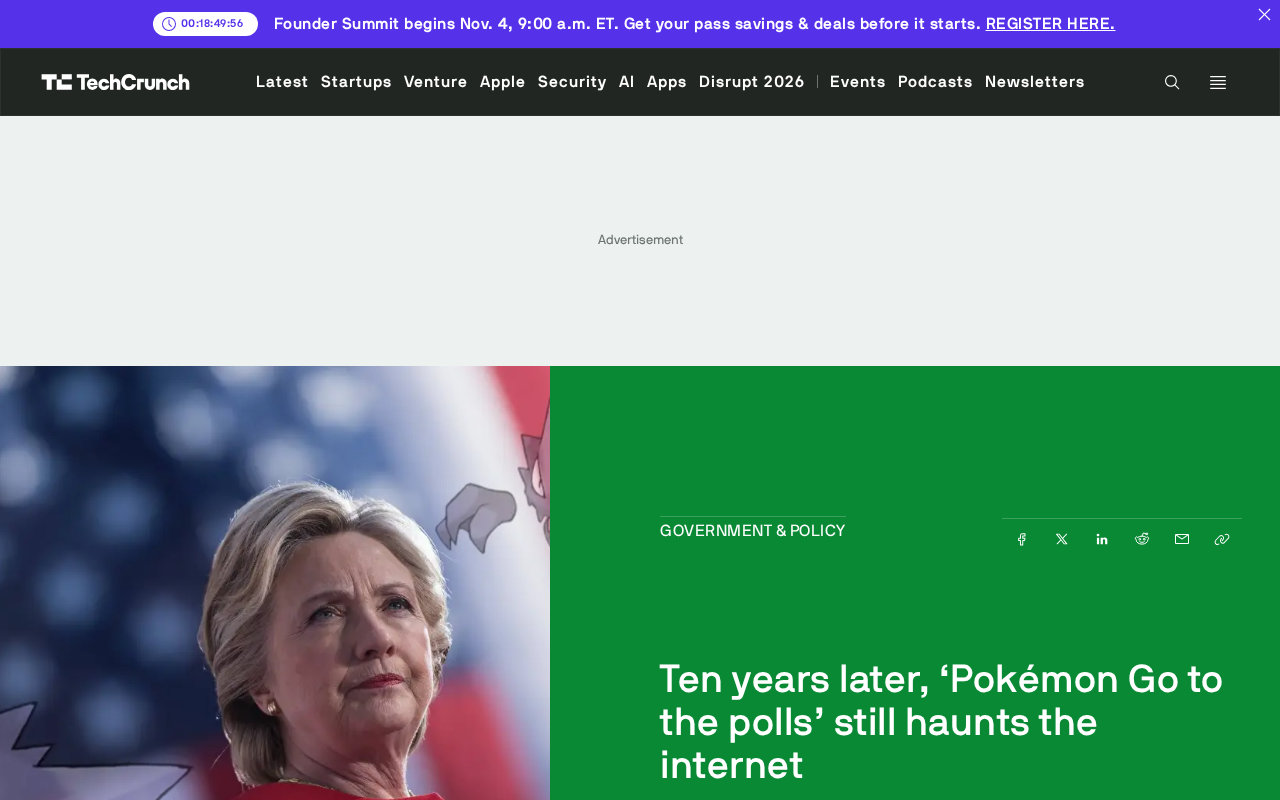
In 2016, Hillary Clinton tried to ride the hype of Pokémon Go during a campaign speech, urging voters to cast their ballots. The line spread widely and quickly became a laughingstock: when politicians awkwardly co-opt pop culture, the results tend to backfire. Yet a decade later, the phrase hasn't disappeared. It's been endlessly clipped, remixed, turned into reaction images, and appears on forums, social media, and offline signs. According to the original report, it has become an "irony-shrouded rallying cry" used by young voters who "still dare to hope for change."
This transformation is worth examining. The same sentence has shifted from an object of mockery to an identity marker—a reflection of how the younger generation has recoded political expression. They no longer chant slogans earnestly; instead, they use self-deprecation and parody to convey their demands. Irony becomes both camouflage and a signal that connects them to one another.
Meme is a key concept for understanding how this phrase evolved. The term was coined by Richard Dawkins in 1976, originally referring to units of ideas that self-replicate like genes in cultural transmission. In the internet context, memes typically manifest as images, videos, or phrases that are widely imitated, adapted, and recreated, with their spread depending on participatory creation by users rather than one-way broadcasting. Whether a piece of content can become a meme often depends on its "malleability"—whether it can be easily applied to different contexts. "Pokémon Go to the polls" became excellent meme material precisely because of its forced juxtaposition and inherent absurdity, allowing it to be constantly remixed and recontextualized over the past decade.
Why Do Young People Still Use It?
For many young voters, directly expressing political enthusiasm can seem naive—even mockable. Borrowing a "failed" slogan lowers the barrier to expression while dispelling the awkwardness of being scrutinized. The original report noted that the phrase's enduring vitality comes precisely from its "irony-shrouded" quality—it allows users to maintain both distance and participation simultaneously.
This phenomenon is not isolated. In internet culture, much political expression wears the guise of meme-play. From reaction images to short videos, young people use entertainment to lower the threshold for engaging with serious issues, yet the core remains a desire for change. Hillary's slogan happened to become a ready-made container for this contradictory mindset.
Irony here is not merely a rhetorical device but a political communication strategy. When a speaker uses irony, there is tension between the literal meaning and the intended meaning, and listeners must share background knowledge to decode it. This "insider" mechanism naturally creates group boundaries: those who use the same meme confirm each other's identity, while outsiders may only see the literal meaning. For young voters, irony offers "deniability"—if accused of being too political, they can claim they're "just memeing." This ambiguity lowers the social risk of political expression while preserving space for conveying genuine demands.
Long-Term Lessons for Political Communication
For political communicators, this case offers lessons on two levels. On the surface, forcibly grafting pop culture is highly risky and easily backfires. More deeply, a mocked slogan isn't necessarily dead—it may be reactivated in another context, only with a meaning completely divorced from its original intent.
The original report's use of "haunts the internet" to describe the phrase's state is apt. It reappears like a ghost, each appearance carrying new interpretations. Politicians cannot control a slogan's afterlife, and the internet excels at giving old material new meaning.
Participatory Culture, a concept introduced by scholar Henry Jenkins, refers to audiences no longer being passive recipients of information but active creators and disseminators. In the age of social media, the "afterlife" of political slogans is largely determined by participatory culture: users assign new meanings to original material through editing, captioning, and derivative works, and political camps have almost no control over this process. The case of "Pokémon Go to the polls" demonstrates that once official content enters the field of participatory culture, ownership of its meaning shifts—the final form may be completely opposite to the original intent, yet it continues to circulate.
After Irony, Hope Remains
Looking back at "Pokémon Go to the polls" ten years later, it has transcended partisan politics to become a cultural footnote about the political mindset of a generation. The original report's subtitle captures the key point: those who use this phrase are young voters who are "jaded" yet "still dare to hope for change." Irony is their language; hope is their underlying color.
Will the phrase continue to circulate? Most likely yes. As long as young people need a less formal, less naive way to express political expectations, this meme has room to exist. It reminds us that the internet's memory is not simply forgetting or remembering but a continuous process of appropriation and reinvention.
One-line Summary
A political misstep slogan became a meme through which young voters ironically express political hopes a decade later.
Paragraph Summary
The article reviews how Hillary Clinton's 2016 "Pokémon Go to the polls" slogan evolved from an object of mockery into an enduring internet meme. Over ten years, the phrase has been endlessly clipped, remixed, and recreated, becoming an "irony-shrouded rallying cry" for young voters to express political demands. The article analyzes how irony provides young people with camouflage that lowers the barrier to expression and dispels the awkwardness of being scrutinized, allowing them to maintain both distance and participation. This case reveals the risks of forcibly grafting pop culture in political communication and the uncontrollable nature of a slogan's "afterlife"—the internet excels at giving old material new meaning. Ultimately, the phrase became a cultural footnote about the political mindset of a generation that is "jaded yet still dares to hope."
Related articles

AI Can Read Neural Network Weights Directly: Do Models Already Exceed Expectations?
A Reddit developer experiment shows language models can directly read neural network weights and infer their function. Astra, Opus 5.5, and Muse Spark 1.3 all passed the test, sparking discussion on model generalization and training sources.

India's Microdrama Market Explodes: EloElo Secures $80M Investment from NBCUniversal
EloElo secures $80M from NBCUniversal to boost StoryTV, its microdrama platform with over 33M monthly active users, as India's microdrama market draws global capital.

Acoustic Detection of Multi-Rotor UAVs: Fusing Handcrafted Features with Pre-Trained Embeddings
Study reveals data leakage from random splits in UAV acoustic detection, proposes source-disjoint protocol with stacked ensemble of handcrafted features and YAMNet embeddings, achieving 95.29% accuracy for low-cost drone detection.