Tencent Hunyuan Hy4 Goes Open Source: 770B Parameters, 1M Context
Tencent open-sources its 770B Hunyuan flagship model, as dual Riemann Hypothesis proofs and DeepSeek's hundred-billion-yuan funding arrive in the same period
Tencent open-sourced its native multimodal flagship model Hunyuan Hy4, with 770B total parameters, 49B activated parameters, and 1M context, using a MoE architecture, with vLLM and Together AI supporting it on launch day. On the same day, two Riemann Hypothesis-related proofs appeared: an Anthropic mathematician claimed a Lean-formalized proof completed with Claude, and a Stanford postdoc published a purely human proof of the generalized Riemann Hypothesis, both awaiting independent verification. DeepSeek's operating entity completed a business registration change, raising hundred-billion-yuan-scale funding this round at a post-investment valuation of about 615.5 billion yuan, with Liang Wenfeng holding about 67.42% and retaining control. On the hardware side, Huawei launched the Blind OE Pro, Alibaba Cloud's Zhen 5V90 chip will enter mass production in Q1 next year, and Apple is hiring a senior engineering manager to build an AI agent capable of cross-app task execution. Signal restricts screenshots to prevent system-level agents from reading chat content. In addition, Gemini opened GIF generation, Thinking Machines open-sourced Inkling 2 Mini, and AutoClip gained 983 stars in a single day.
Tencent has taken a landmark step in the open-source large model race. Tencent's official membership account announced that the open-source weights for its native multimodal flagship model Hunyuan Hy4 (referred to in the original text as Hi-I4) have been officially released. The model has a total parameter count of 770 billion (770B), with 49 billion parameters activated per inference, and supports a context length of 1 million (1M) tokens. A system card was released alongside it, disclosing safety, security, and alignment evaluation results, with dedicated notes on cyber and biological risks. Both the vLLM inference framework and Together AI stated they would provide support on launch day, meaning developers can complete local or cloud deployment right away.
The Trade-offs Behind the Flagship Specs
The combination of 770B total parameters and 49B activated parameters indicates that Hunyuan Hy4 uses a Mixture-of-Experts (MoE) architecture, maintaining large-capacity knowledge storage while controlling per-inference cost. The 1M context directly targets the current top tier of long-text processing, suitable for code repository understanding, long document analysis, and complex multi-turn tasks. Choosing to open-source the flagship model rather than a lightweight version helps attract enterprise developers and research teams to build applications around its ecosystem.
Mixture-of-Experts (MoE) architecture is a sparsely activated neural network design: the model contains multiple parallel "expert" subnetworks and a gating network responsible for routing, and each token is dispatched to only a few experts for computation. As a result, the total parameter count can be far larger than the number of parameters actually activated per inference. Hunyuan Hy4's ratio of 770 billion total parameters to 49 billion activated parameters is about 16:1, meaning most parameters lie dormant during a single forward pass, allowing the model to store knowledge with larger capacity while keeping the per-token compute cost close to that of a dense model with tens of billions of parameters.
The key difficulty of MoE lies in load balancing: if the gating network always sends tokens to a few experts, the remaining experts receive no training and the capacity advantage cannot be realized. Common countermeasures include setting a capacity limit for each expert, adding a load-balancing penalty term to the loss function, and using expert parallelism at inference time to distribute different experts across different GPUs. This also explains why MoE models, despite having fewer activated parameters, often require more VRAM and more complex parallelism strategies during deployment—all expert weights must still reside in memory or be quickly schedulable.
A Double Shock in Mathematics: Two Proofs of the Riemann Hypothesis
According to The Verge, Anthropic mathematician Levent Alpoge claimed to have found a proof of the Riemann Hypothesis in collaboration with Claude, and wrote the argument as compilable Lean code. The proof has not yet been independently verified, Anthropic was not involved in this release, and it did not respond to requests for comment.
On the same day, according to TechStrange, a Stanford postdoc published a proof of the generalized Riemann Hypothesis completed entirely by humans. The mathematics community is still checking both materials section by section. Two proofs appearing on the same day—one with AI involvement and one purely human—is itself worth pondering: AI's role in formal mathematics is evolving from an auxiliary tool toward a collaborator, but the verification mechanism remains the core of the human academic community.
Lean is an interactive theorem prover and also a dependently typed formal language. Unlike programming languages such as Python, a "program" in Lean is the mathematical proof itself: propositions are written as types, proofs are terms of those types, and a proof is only accepted as correct once the type checker passes. This makes it naturally suited to carrying large-scale mathematical formalization projects; Mathlib is a community-built mathematics library that has accumulated hundreds of thousands of theorems.
Writing a proof of the Riemann Hypothesis as compilable Lean code matters because it turns "whether the proof is correct" into a question a machine can verify line by line, bypassing details easily missed in human peer review. But formalization itself cannot guarantee that the formalized proposition is the original proposition—translating a natural-language statement into a Lean definition is still done by humans, and definitional substitution or hidden assumptions may occur. Therefore community verification usually has two layers: first, whether the code compiles; second, whether the formalized statement matches the accepted mathematical formulation section by section.
DeepSeek Completes Business Registration Change, Valuation and Capital Layout Emerge
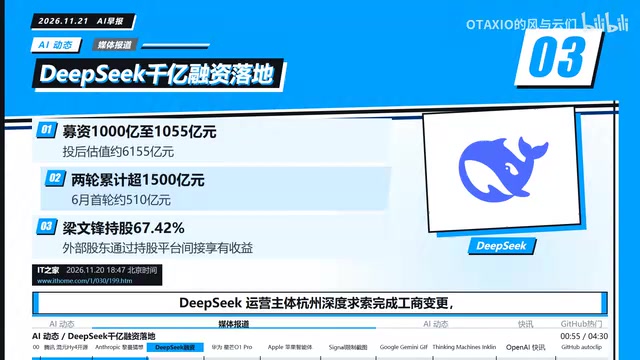
According to IT Home, DeepSeekAd's operating entity Hangzhou DeepSeek completed a business registration change, adding shareholder Hangzhou Chengyan and increasing registered capital by about 21.1%. Securities Times, citing informed sources, reported that this round raised 100 billion to 105.5 billion yuan, with a post-investment valuation of about 615.5 billion yuan; combined with the first round of 51 billion yuan in June, the two rounds total more than 150 billion yuan. Liang Wenfeng directly and indirectly holds about 67.42%, and control has not changed.
The scale of these figures is quite rare among AI startups. A high valuation coexisting with absolute founder control means DeepSeek has maintained strong independence in its fundraising pace, and also provides ample ammunition for subsequent R&D investment.
Hardware and Devices: Updates from Huawei, Alibaba Cloud, and Apple
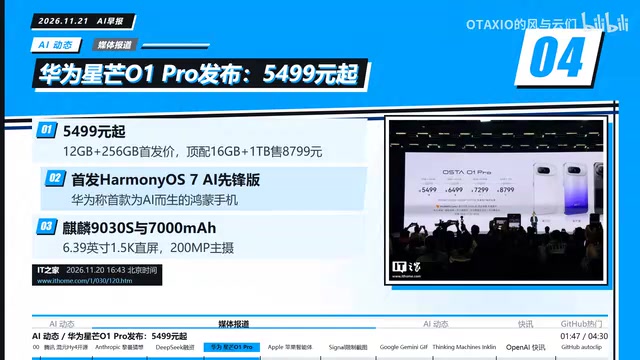
At a launch event, Huawei introduced the new Blind OE Pro, starting at 5,499 yuan, equipped with the Kirin 9030S processor and a 7,000 mAh battery, with a body 6.68 mm thick and weighing about 200 grams, featuring a 6.39-inch 1.5K flat display and a 200-megapixel main camera. The device debuts Harmony OS 7 AI Pioneer Edition, which Huawei calls the first Harmony phone born for AI, offering AI interaction available right from the lock screen and system-level proactive intelligence.
According to IT Home, Alibaba Cloud announced that the Zhen 5V90 chip will enter mass production in the first quarter of next year, with three times the compute of the Zhen 5M890. On Apple's side, according to TechCrunch, Apple is hiring a senior engineering manager to build an AI agent that can perform tasks on a computer on the user's behalf. The job description states the agent can browse the web, work across apps, run commands, write and debug code, and choose the right tool for each step. The report says Apple wants it to remain private and meet Apple's usual standards of polish, while also tightening control over third-party agents on Mac.
Privacy and the Battle for Platform Control
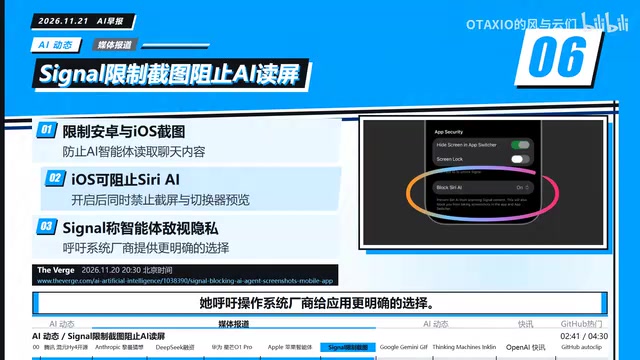
According to The Verge, Signal has begun restricting screenshots on Android and iOS to prevent AI agents in the system from reading chat content. iOS users can enable blocking Siri AI in settings, while also prohibiting screen capture and API calls. Signal President Meredith Whittaker said in a blog post that system-level agents analyze screen content, weakening Signal's ability to independently guarantee privacy, and she called on operating system vendors to give apps clearer choices.
This move echoes Apple's tightening control over third-party agents on Mac: as AI agents gain cross-app operational capabilities, the game between platforms and apps over data visibility will only intensify.
The key difference between system-level AI agents and ordinary apps lies in the permission level. Agents running at the operating system level typically understand the current interface through accessibility services, screen-reading APIs, or screenshot recognition, thereby clicking, typing, and moving information across apps on the user's behalf. This capability inherently bypasses the app's own sandbox boundary: an app cannot distinguish between "the user themselves looking at the screen" and "an agent running in the user's name reading the screen."
Signal's screenshot restriction targets exactly this chain—blocking screenshots cuts off the most direct means for agents to obtain chat content. But offense and defense are asymmetric: as long as the system still allows screen recording, accessibility tree reading, or accessibility APIs, the app side can only plug the gaps one by one. This is also why Whittaker calls on OS vendors to provide clear switches: by placing the choice at the platform layer, apps need not repeatedly make local compromises between features and privacy. The same tension appears when Apple tightens control over third-party agents on Mac, only in the opposite direction.
Model and Tool Updates at a Glance
Google Gemini's official account announced that the GIF generation feature is available to all Google AI subscribers, and free in the United States, Japan, South Korea, Australia, Canada, the United Kingdom, Germany, and France. Users can describe the GIF they want directly in the main conversation, or first select the image or video tool and then choose GIF as the format. The official account said the feature is powered by the latest video model Gemini Omni 1.2 Flash, emphasizing smooth motion and consistent image quality in every frame.
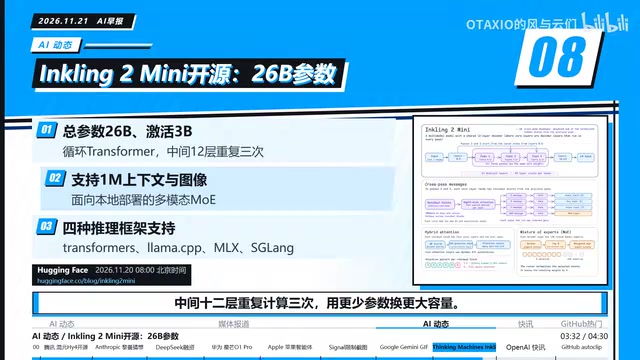
The Hugging Face blog introduced Thinking Machines' open-source model Inkling 2 Mini, aimed at local deployment. It is a recurrent Transformer multimodal mixture-of-experts model with about 26 billion total parameters, 3 billion activated per token, and support for 1M token context and image input. The model keeps only 24 physical layers, with the middle 12 layers computed three times, trading fewer parameters for greater capacity. It has already been adapted to multiple local inference frameworks, making it easy to run on personal computers.
Other briefs: ElevenLabs announced that Ad Engine adds video ad editing and localization capabilities, which can automatically dub, translate subtitles, and place ads on advertising platforms; OpenAI published a blog stating that protections against adversarial distillation have been applied to GPT 6.2 Astra, with the attack success rate in internal red-team testing dropping from 5% to 0.2%.
Recurrent Transformer refers to a structure that repeatedly reuses the same set of layers along the depth dimension. A conventional Transformer computes each layer's parameters only once, whereas a recurrent structure lets several middle layers iterate repeatedly over the same input, effectively trading fewer physical layers for a deeper effective computation graph. Inkling 2 Mini keeps only 24 physical layers, with the middle 12 layers computed three times—exactly this idea: the parameter count stays at the 26 billion level, but the effective depth and number of inference steps are stretched.
This kind of design is especially friendly for local deployment—VRAM usage is determined by the number of physical layers and total parameters, and repeated computation adds only time, not weight volume, so it can achieve results close to a larger dense model on consumer-grade GPUs. The cost is that inference latency rises linearly with the number of repetitions, and gradients during training must be propagated across iterations, placing additional demands on VRAM and stability. Combined with MoE, sparse activation keeps per-token compute low, while the recurrent structure deepens expressive capacity under limited parameters.
GitHub Trending: AutoClip Automatically Edits Long Videos
Today's top GitHub trending project is Zhou Xia Ouka's (as described in the original) AutoClip, with 983 new stars in a single day. It is an open-source AI video editing desktop tool that automatically cuts long videos such as podcasts, interviews, and courses into short videos, generating subtitles, covers, and publishing copy, adapted for Douyin, Xiaohongshu, TikTok, and Bilibili. The software is free, cloud models are billed by usage, and users can enter the editor when adjustments are needed. For content creators, such tools are driving the cost of distributing long videos down to near zero.
One-line Summary
Tencent open-sources its 770B Hunyuan flagship model, as dual Riemann Hypothesis proofs and DeepSeek's hundred-billion-yuan funding arrive in the same period
Paragraph Summary
Tencent open-sourced its native multimodal flagship model Hunyuan Hy4, with 770B total parameters, 49B activated parameters, and 1M context, using a MoE architecture, with vLLM and Together AI supporting it on launch day. On the same day, two Riemann Hypothesis-related proofs appeared in the mathematics world: an Anthropic mathematician claimed a Lean-formalized proof completed with Claude, and a Stanford postdoc published a purely human proof of the generalized Riemann Hypothesis, both awaiting independent verification. DeepSeek's operating entity completed a business registration change, raising hundred-billion-yuan-scale funding this round at a post-investment valuation of about 615.5 billion yuan, with Liang Wenfeng holding about 67.42% and retaining control. On the hardware side, Huawei launched the Blind OE Pro, Alibaba Cloud's Zhen 5V90 chip will enter mass production in Q1 next year, and Apple is hiring a senior engineering manager to build an AI agent capable of cross-app task execution. Signal restricts screenshots to prevent system-level agents from reading chat content. In addition, Gemini opened GIF generation, Thinking Machines open-sourced Inkling 2 Mini, and AutoClip gained 983 stars in a single day.
Related articles

Chess.com Crosses Over as a Gaming Giant: Classic Games Platform Goes Live
Chess.com launches Classic Games platform with 10 new classic games including Backgammon, Go, Mahjong, and Sudoku, expanding from a chess platform to a comprehensive gaming hub.
LLMs Can Read and Write Executable Files Byte by Byte: A New Take on Hex Dumps
LLMs can read and write executable files byte by byte from hex dumps. This Hacker News discussion reveals new ways models handle binary data, including technical principles, applications, and security risks.

Jingle Jam 2026 Registration Opens: Lewis Uses Old Footage to Rally Volunteers for Fundraising
Jingle Jam 2026 fundraising registration is open. Lewis uses old footage edited into a new video, calling on viewers to create fundraising pages at jingle jam.tiltify.com to support eight charities. The event takes place in the first two weeks of December.