LLMs Can Read and Write Executable Files Byte by Byte: A New Take on Hex Dumps
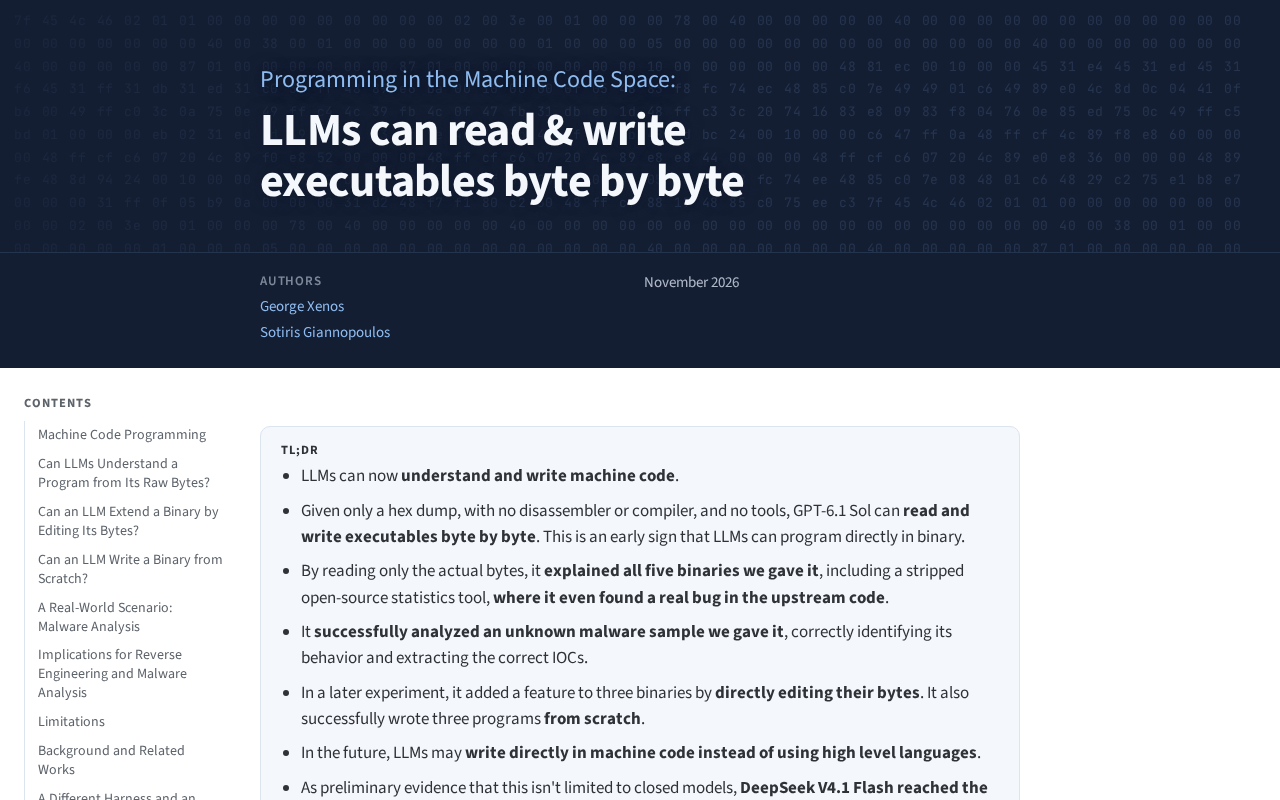
LLMs can read and write executable files byte by byte via hex dumps, but are limited by pattern recognition and context windows.
The article explores LLMs' ability to read and write executable files byte by byte from hex dumps. Hex dumps convert binary data into hexadecimal text, enabling LLMs to "read" and generate byte sequences like ordinary text. This capability is based on the model's recognition of common byte patterns such as PE headers and ELF headers, rather than true binary semantic understanding. Application scenarios include reverse engineering assistance, security analysis, and education, but there are risks of context window limitations, file corruption from generated erroneous bytes, and malicious exploitation. The Hacker News discussion considers this more of an interesting experiment suitable for small-scale modifications, requiring strict validation and sandbox environments; it remains a niche trick.
LLMs Can Read and Write Executable Files Byte by Byte: A New Take on Hex Dumps
Large language models (LLMs) are typically used for text generation, code completion, or conversational interaction, but a discussion from Hacker News reveals a more low-level possibility: LLMs can directly read and write executable files byte by byte from a hex dump. This sounds like giving the model a "binary eye," but is it a natural extension of model capabilities, or a clever use of existing toolchains?
From Text to Binary: LLMs' Cross-Domain Capability
Traditionally, LLMs process token sequences, while executable files are binary byte streams. A hex dump converts binary data into human-readable hexadecimal text, where each byte corresponds to two hex characters. This means LLMs can "read" the structure of an executable file just like ordinary text, and when needed, generate new hex strings that are then converted back to binary. According to the Hacker News discussion, this approach allows the model to directly manipulate the byte content of executable files without relying on specialized binary analysis tools.
This capability seems simple, yet it opens up new ways of interaction. For example, security researchers can have the model inspect hex dumps for suspicious patterns or generate patch bytes. But it must be clear that LLMs do not truly "understand" binary semantics; they merely predict based on patterns in training data.
Hex Dump is a textual representation method that converts a binary file into two hexadecimal characters per byte, typically showing 16 bytes per line with an ASCII sidebar for comparing printable characters. This representation allows any binary data—including executable files (such as Windows PE format or Linux ELF format)—to be converted into plain text, which can then be directly "read" by text processing tools and language models. In a hex dump, each byte consistently corresponds to two hexadecimal characters (0-9, A-F), so each character generated by the model precisely maps to one nibble of the file, providing the theoretical basis for byte-by-byte editing.
Technical Principles and Limitations
The core of LLM processing hex dumps lies in pattern recognition. The model has seen vast amounts of code and text during training, including hexadecimal representations, so it can learn common byte sequence patterns such as PE headers, ELF headers, or common instruction encodings. Given a hex dump, the model can predict the next byte or identify anomalies.
However, this capability has obvious limitations. First, LLMs have limited context windows; for large executable files, a hex dump quickly exhausts the token budget. Second, the model may generate plausible but incorrect byte sequences, leading to file corruption. The Hacker News discussion also points out that this method is more suitable for small-scale modifications or analysis rather than complete binary rewriting.
PE Header and ELF Header are metadata regions of executable file formats, containing critical information such as program entry points, section tables, and import/export tables. PE (Portable Executable) is the standard format for Windows systems, while ELF (Executable and Linkable Format) is widely used in Linux and Unix systems. These headers have fixed magic numbers (e.g., ELF's 0x7F 45 4C 46) and structured fields, appearing as characteristic byte sequences in hex dumps. LLMs may have seen textual representations of such patterns extensively during training, thus being able to recognize or generate these header structures. However, it should be noted that the model's understanding of header field semantics is still based on statistical associations, not true format specification reasoning.
Context Window is the maximum number of tokens an LLM can process in a single inference. For binary files, the text expansion rate of a hex dump is about 2 characters per byte (higher with spaces and newlines); a 1MB executable file converted to a hex dump may exceed 2MB of text, corresponding to hundreds of thousands of tokens. Current mainstream models typically have context windows ranging from tens of thousands to hundreds of thousands of tokens, so fully reading large executable files is nearly infeasible. In practice, only key regions of the file (such as headers or code sections) are typically extracted for analysis, or chunking strategies are used, but chunking loses cross-region correlation information.
Potential Applications and Risks
From an application perspective, LLMs' ability to read and write executable files can be used for rapid prototyping, reverse engineering assistance, or educational purposes. Security analysts might use the model to quickly locate anomalous bytes in hex dumps or generate simple shellcode snippets. But risks also exist: malicious attackers could use LLMs to generate byte sequences of malicious code, bypassing text-based detection.
In the Hacker News discussion, some argued that this capability is more of an "interesting experiment" than a production-grade tool. LLM outputs require strict validation and sandbox environments; otherwise, security vulnerabilities may be introduced.
Shellcode is a compact machine code used to exploit software vulnerabilities, typically distributed as hexadecimal byte sequences (e.g., \x31\xc0\x50\x68...). Since shellcode itself is a byte stream, hex dump is one of its natural representations. LLMs can generate or modify byte sequences based on common shellcode patterns in training data, but the generated code often contains invalid instructions or triggers security mechanisms (such as DEP, ASLR). The security community's concern about such capabilities is that models might be induced to generate variants that bypass detection, although actual weaponization still requires extensive manual debugging.
Future Outlook
As model context windows expand and binary understanding improves, LLMs' role in binary analysis may become more important. But currently, hex dump reading and writing remains a niche trick suitable for exploratory work. Developers should remain cautious and treat LLMs as辅助 tools rather than replacements.
This discussion also reminds us that the boundaries of LLM capabilities are constantly being redefined, and how to safely leverage these capabilities will be an ongoing topic.
One-line Summary
LLMs can read and write executable files byte by byte via hex dumps, but are limited by pattern recognition and context windows.
Paragraph Summary
The article explores LLMs' ability to read and write executable files byte by byte from hex dumps. Hex dumps convert binary data into hexadecimal text, enabling LLMs to "read" and generate byte sequences like ordinary text. This capability is based on the model's recognition of common byte patterns such as PE headers and ELF headers, rather than true binary semantic understanding. Application scenarios include reverse engineering assistance, security analysis, and education, but there are risks of context window limitations, file corruption from generated erroneous bytes, and malicious exploitation. The Hacker News discussion considers this more of an interesting experiment suitable for small-scale modifications, requiring strict validation and sandbox environments; it remains a niche trick.
Related articles

Gemini 4 Neon's Comeback: How Google's 'American Doubao' Shipped Five Models in Two Weeks
Google shipped five models in two weeks. Gemini 4 Neon ranks third globally and first on the coding agent leaderboard, at half the cost of Opus 5.5. A Bilibili creator breaks down the three-layer comeback story: regulatory relief, sparse MoE architecture, and in-house TPUs—plus Carbon promo savings tips and AntiGravity quota rules.

What Is Hermes Agent? An Always-On AI Agent That Grows With You
Hermes Agent is an always-on AI agent running on a VPS, reachable via WhatsApp, Telegram, and Discord. It manages lists, calendars, and scheduled tasks and grows with use.

Building AI Animated Videos with Claude Code: A Hands-On Local Toolchain Guide
A hands-on demo of using Claude Code with local open-source tools like Kokoro and Remotion to generate AI videos with narration, animation, and music in minutes. Workflow, efficiency gains, and limitations analyzed.