Chess.com Crosses Over as a Gaming Giant: Classic Games Platform Goes Live
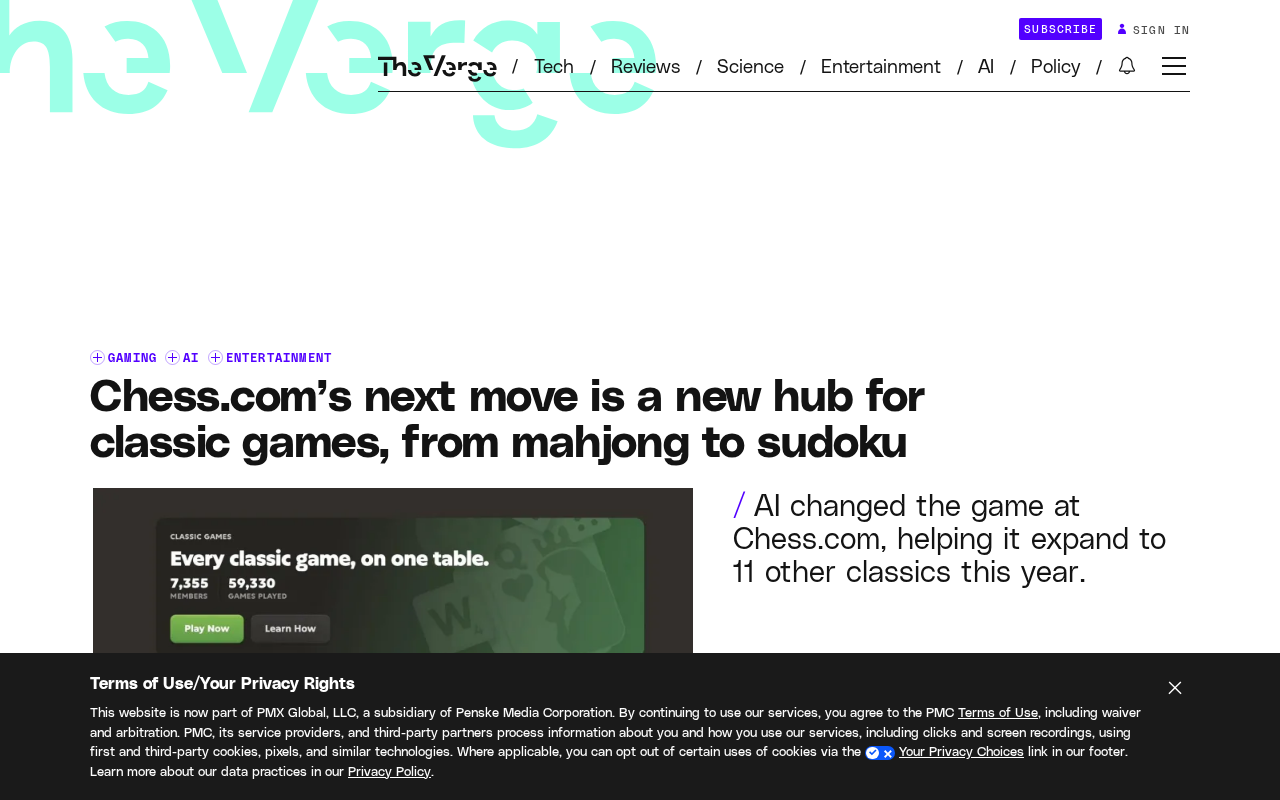
Chess.com launches Classic Games platform with 10 new classic games, expanding from chess to a comprehensive gaming hub.
After launching Gambit, a no-gambling poker site, Chess.com announces the addition of 10 classic games through its Classic Games platform, including Backgammon, Checkers, Go, Hearts, Mahjong, Shogi, Sudoku, Solitaire, Xiangqi, and the word game word. This expansion aims to leverage its massive user base and platform operation experience to cover a wide range of players from hardcore strategy to casual puzzle fans. The article analyzes the logic behind this diversification: board games overlap heavily with chess user demographics and can reuse Elo ratings and community features, while card and puzzle games are used to expand the user base. It also notes the challenge that mature competitors already exist in each vertical, and Chess.com needs to offer differentiated experiences in areas like rule unification and AI analysis.
Chess.com is transforming from a chess platform into a comprehensive classic games hub. After launching Gambit, a poker site without real-money gambling, the company has announced the addition of 10 new games: Backgammon, Checkers, Go, Hearts, Mahjong, Shogi, Sudoku, Solitaire, Xiangqi (Chinese Chess), and a word game alternative called word. All of these games are integrated into a new platform called Classic Games, marking a major expansion for Chess.com into diversified gaming territory.
From Chess to Diversified Gaming: The Logic Behind Chess.com's Expansion
Chess.com's expansion is not a whim. Earlier this year, the company launched Gambit—a poker site that does not involve real-money gambling—to test the waters beyond chess. Now, the Classic Games platform introduces 10 games at once, covering board games, card games, puzzles, and more, demonstrating the company's determination to build a comprehensive gaming platform.
The core of this strategy lies in leveraging Chess.com's existing massive user base and mature platform operation experience to bring classic games with equally deep historical roots and strategic depth into the ecosystem. Games like Backgammon, Go, and Xiangqi overlap heavily with the chess user demographic, while Sudoku and Solitaire can attract a broader casual audience.
The Preemptive Move with No-Gambling Poker
The launch of Gambit was an important step in Chess.com's diversification. It explicitly excludes real-money gambling, which aligns with Chess.com's consistent compliance stance and lowers the psychological barrier for new users. Poker and chess share similarities in strategy, and Gambit can be seen as Chess.com's exploration of the boundaries of "strategy games."
The Elo rating system is one of Chess.com's core technical assets, designed by physicist Arpad Elo and originally used for chess rating calculations. Its basic principle is to dynamically adjust scores based on the current ratings of both players and the outcome: beating a higher-rated opponent earns more points, while losing to a lower-rated opponent results in a bigger point deduction. The advantage of the Elo system lies in its mathematical simplicity and cross-game portability—any two-player zero-sum competitive game can adopt a similar mechanism. Go's dan system, Shogi's strength certification, and even Backgammon's matchmaking logic can all be adapted by drawing on Elo's underlying ideas. If Chess.com reuses this mature rating and matchmaking system for new games, it can significantly reduce development costs while ensuring fairness and consistency in player experience.
Detailed Look at the Ten Classic Games: Covering Board, Card, and Puzzle Games
The first batch of 10 games on the Classic Games platform includes:
- Backgammon: An ancient two-player dice board game balancing luck and strategy.
- Checkers: A simple strategic board game with broad appeal.
- Go: A deep strategy game originating from East Asia, gaining global popularity in recent years.
- Hearts: A classic trick-taking card game testing cooperation and calculation.
- Mahjong: A tile-based game originating from China, extremely popular in Asia and Chinese communities worldwide.
- Shogi: Japanese chess, similar to international chess but with unique rules.
- Sudoku: A numerical logic puzzle suitable for fragmented time play.
- Solitaire: A single-player card game, a classic memory from the Windows era.
- Xiangqi: Chinese chess, with a massive player base in East Asia.
- word: A Scrabble-like word game, though the name and specific rules have not been disclosed in detail.
These games cover a wide spectrum from hardcore strategy to casual puzzle, showing Chess.com's intention to attract players of different levels.
Synergy Between Board Games and Chess
Games like Go, Shogi, and Xiangqi overlap heavily with chess in player demographics—they all emphasize deep thinking, strategic planning, and long-term learning. Chess.com's existing Elo rating system, game analysis tools, and community features may be reused for these games to enhance user experience. For example, Go's dan system shares similar logic with chess ratings, and the platform can draw on existing experience to build quickly.
Casual Attempts with Card and Puzzle Games
Hearts, Mahjong, Sudoku, and Solitaire lean more toward casual scenarios. These games have lower barriers to entry and suit casual players. Chess.com may hope to expand its user base and increase time spent on the platform through them. Sudoku and Solitaire, in particular, have huge potential user groups on mobile.
Trick-taking card games is a general term for card games played in "tricks," where players each play a card per round, determine who wins the trick according to rules, and ultimately score by tricks won or specific card combinations. Hearts is a classic representative, with core mechanics including follow-suit rules, penalty cards (hearts and the Queen of Spades), and the "shoot the moon" reversal mechanism. These games share similar strategic structures with Mahjong and Bridge: incomplete information, card counting and probability estimation, and team cooperation or competitive博弈. By introducing Hearts and Mahjong, Chess.com is actually recognizing the deep strategy hidden beneath the casual exterior of these games, complementing the strategy-heavy preferences of chess users.
Platform Integration and Future Outlook
As an independent platform, Classic Games will complement the main Chess.com site. It is currently unclear whether these games will share a unified account system, social features, and payment system, but given Chess.com's operating style, integration is highly likely.
From an industry perspective, Chess.com's diversification reflects a trend among online gaming platforms: enhancing user lifetime value by expanding content categories. Chess is a relatively vertical field with an obvious growth ceiling. By introducing more classic games, Chess.com can attract users who have limited interest in chess but enjoy other strategy games.
However, challenges cannot be ignored. Each game has its mature competitor platforms—for example, Go has OGS, Mahjong has multiple online platforms, and Sudoku has countless mobile apps. Chess.com needs to offer differentiated experiences in these games to persuade users to migrate.
Digital Opportunities for Classic Games
One detail: many classic games still have room for improvement in digitalization. For example, Mahjong's online experience is often fragmented due to regional rule differences, and Go's AI analysis tools are not friendly enough for beginners. If Chess.com can address these pain points—such as offering unified rule options, smart hints, and review analysis—it has a chance to stand out.
Mahjong's rule fragmentation is a long-standing challenge for online Mahjong platforms. Mahjong has spawned dozens of regional variants across China, Japan, Southeast Asia, Europe, and America—such as Chinese Official Mahjong, Japanese Riichi Mahjong, Cantonese Mahjong, and Sichuan Bloody Battle—with huge differences in scoring, the number of fan types, and winning conditions. This fragmentation makes it difficult for players to match across regions and for platforms to unify competitive standards. If Chess.com can provide clear rule categorization, a standardized ranking system, and cross-rule game analysis tools for Mahjong, it will effectively address this industry pain point, similar to the network effects it built in chess through unified rules and rating systems.
Conclusion
Chess.com's Classic Games platform is a bold category expansion, extending from chess to 10 classic games in board, card, and puzzle categories. This move leverages its existing user base and technical capabilities while facing competition from mature competitors in each vertical. If Chess.com can replicate its experience in fair competition, community operations, and user experience from chess to new games, it may open up new territory in the digitalization of classic games.
Related articles

Gemini 4 Neon's Comeback: How Google's 'American Doubao' Shipped Five Models in Two Weeks
Google shipped five models in two weeks. Gemini 4 Neon ranks third globally and first on the coding agent leaderboard, at half the cost of Opus 5.5. A Bilibili creator breaks down the three-layer comeback story: regulatory relief, sparse MoE architecture, and in-house TPUs—plus Carbon promo savings tips and AntiGravity quota rules.

What Is Hermes Agent? An Always-On AI Agent That Grows With You
Hermes Agent is an always-on AI agent running on a VPS, reachable via WhatsApp, Telegram, and Discord. It manages lists, calendars, and scheduled tasks and grows with use.

Building AI Animated Videos with Claude Code: A Hands-On Local Toolchain Guide
A hands-on demo of using Claude Code with local open-source tools like Kokoro and Remotion to generate AI videos with narration, animation, and music in minutes. Workflow, efficiency gains, and limitations analyzed.