Tencent Hunyuan Hy4 Lands on Ollama Cloud: 770B Parameters, Vision and Computer Use Support

Tencent Hunyuan Hy4 launches on Ollama Cloud: 770B MoE, first to support vision and computer use.
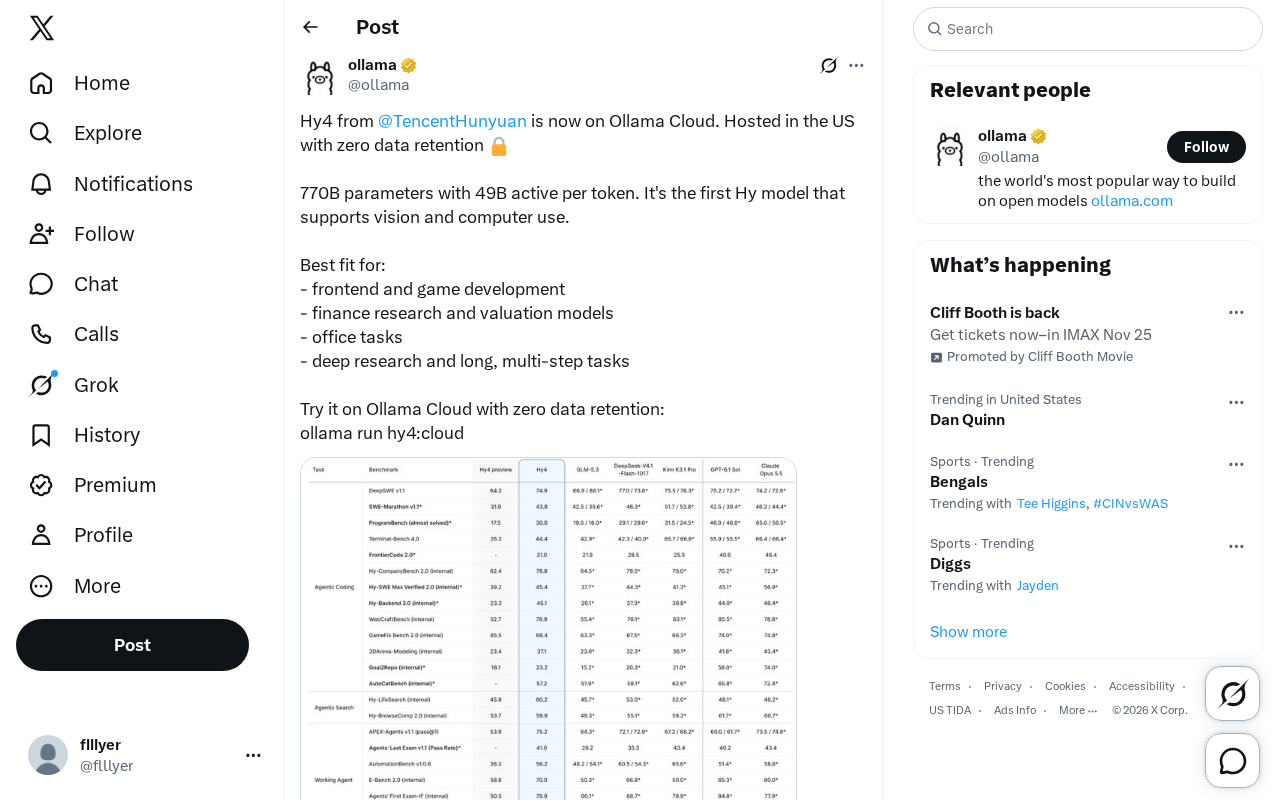
Tencent Hunyuan's Hy4 model is now available on Ollama Cloud, callable directly via the one-line command ollama run hy4:cloud. Hy4 has 770B total parameters with 49B activated per token, a typical MoE architecture that maintains large-scale knowledge capacity while controlling per-token computation. It is the first model in the Hy series to support visual understanding and computer use, positioned toward multimodal Agent scenarios. Ollama Cloud hosts the model in the US and offers zero data retention, addressing both deployment cost and data compliance concerns. The officially recommended scenarios—frontend and game development, financial research, office tasks, and deep research—share long task chains and the need for multimodal inputs or tool calls, consistent with Hy4's capability positioning.
Tencent Hunyuan's Hy4 model has officially launched on Ollama Cloud, according to a post from Ollama's official account. For developers accustomed to quickly calling large models locally or in the cloud, this means a very large model with visual understanding and computer use capabilities can now be invoked with a single command.
Model Specs: 770B Total Parameters, 49B Activated
According to Ollama's official tweet, Hy4 has 770B total parameters with 49B activated per token. This is characteristic of a typical MoE (Mixture of Experts) architecture: a massive total parameter count, but only a subset activated during inference, balancing capability and cost.
At 770B, it sits in the top tier of currently available open callable models. Compared to dense models, the MoE architecture lets it maintain large-scale knowledge capacity while keeping per-token computation closer to that of a mid-sized model. The tweet did not disclose specific inference costs or throughput figures, but Ollama Cloud's hosted model means users don't need to provision GPU clusters themselves.
MoE (Mixture of Experts) architecture works by splitting the feed-forward network into multiple parallel "expert" subnetworks and using a routing (gate) module to dynamically select and activate a small number of experts for each token. Thus "total parameters" is the sum of all expert parameters, while "activated parameters" is the number of parameters actually involved in computation for a single token. For Hy4, 770B total parameters means enormous knowledge capacity, while 49B activated parameters bring per-token computation close to that of a mid-sized dense model, striking a balance between inference cost and model capability. This design also brings the characteristic of high memory usage (all expert weights must be held) but relatively manageable compute consumption, and is currently a mainstream architectural choice for ultra-large-scale models.
First to Support Vision and Computer Use
The tweet explicitly states that Hy4 is the first model in the Hy series to support vision and computer use. The combination of these two capabilities is worth noting:
- Visual understanding: The model can process image inputs, suitable for scenarios like interface screenshot analysis and chart interpretation.
- Computer use: The model can understand and execute operation instructions related to computer interfaces, a foundational capability for building GUI Agents.
Previous versions of the Hy series did not have these two capabilities, so Hy4 is positioned more toward multimodal Agent scenarios rather than pure text conversation.
Computer use refers to a model's ability to understand graphical interface information such as screen captures and output operation instructions like clicks, typing, and scrolling to drive a computer to complete user-given tasks. It typically works in a "vision-language-action" loop: the model observes the current interface state, plans the next operation, executes it, and then adjusts based on the new screenshot. This transforms the model from a passive Q&A tool into a GUI Agent capable of autonomously operating software. Achieving this requires the model to have integrated capabilities in interface element recognition, spatial localization, and long-horizon task planning, placing high demands on multimodal understanding and instruction-following precision, and is currently an important competitive frontier in the Agent space.
Hosted in the US, Zero Data Retention
Ollama Cloud hosts Hy4 in the United States and offers a zero data retention commitment. For developers, this solves two practical problems: first, no need to deploy a 770B-class model yourself; second, data-sensitive teams can assess compliance risks based on the zero-retention terms.
Zero data retention generally means the service provider will not use request data for training or store it long-term. However, the tweet did not elaborate on specific terms, so teams with strong compliance needs should still consult Ollama Cloud's formal service agreement.
Zero Data Retention (ZDR) is a data governance commitment meaning the service provider does not persistently store user inputs and outputs after processing requests, nor use them for model training. For enterprise users, ZDR is a key clause in assessing compliance risk, especially in regulated industries like finance and healthcare. However, the specific boundaries of ZDR vary by vendor—for example, whether short-term logs are retained for abuse detection, how long metadata is kept, and whether third-party sub-processors are involved—all of which should be governed by the formal service agreement. Developers should carefully review the relevant terms before using cloud large models to process sensitive data, rather than relying solely on marketing language.
Four Official Recommended Scenarios
Ollama's tweet lists the suitable directions for Hy4:
- Frontend and game development: Combined with visual capabilities, the model can understand interface screenshots, assist in generating frontend code or game logic.
- Financial research and valuation models: Handling long documents, financial tables, and valuation calculation tasks.
- Office tasks: Document processing, information organization, and other daily office scenarios.
- Deep research and long-chain multi-step tasks: The model is described as suitable for long, multi-step tasks, which place high demands on context retention and planning capabilities.
What these scenarios share is long task chains, the need for multimodal inputs or tool calls, consistent with Hy4's positioning of supporting computer use.
How to Invoke
Ollama provides a one-line command for invocation:
ollama run hy4:cloud
The Ollama CLI connects to the cloud-hosted Hy4 without needing to download model weights locally. This lowers the barrier for developers who want to quickly validate model capabilities, though actual use still requires an Ollama Cloud account and appropriate permissions.
Ollama is an open-source tool for running and managing large models locally, providing a unified command-line interface to pull, run, and switch between different models. Its Cloud mode offloads inference workloads to Ollama-hosted cloud GPUs, while users still invoke models through the same CLI commands, with model identifiers typically suffixed with :cloud. This design lets developers avoid worrying about underlying hardware and deployment details, switching between small local models and ultra-large cloud models with a consistent development experience. Calling cloud models generally requires logging into an Ollama account with appropriate access permissions, and actual billing and quotas are subject to official documentation.
Observation: Cloud Hosting Becomes the Mainstream Distribution Method for Ultra-Large Models
For the vast majority of developers, locally deploying a 770B-class model is prohibitively expensive. Ollama Cloud taking on such models reflects a trend: ultra-large models are being distributed through cloud hosting plus CLI invocation, rather than requiring users to deploy themselves. Zero data retention is a direct response to enterprise users' concerns.
Whether Hy4 can deliver on its "long multi-step task" promise in Agent-type tasks still requires practical testing to verify. But at least from the specs, the combination of vision, computer use, and 770B parameters makes it a noteworthy option on Ollama Cloud.
Related articles
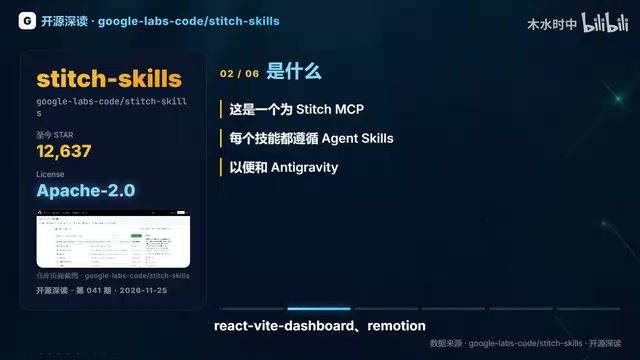
Google Stitch Skills: Connecting Coding Agents to the Design Workflow
Google Stitch Skills is an Agent Skills library following the open standard, adding a design-to-code workflow to the Stitch MCP Server. This article breaks down its three skill groups, SKILL.md directory structure, installation paths, and dependency pitfalls.

40.5-Inch Color E-Paper Art Frame: An Art Display You Charge Once a Year
The Ink Poster Tella 40.5-inch color e-paper art frame uses the E Ink Spectra 6 full-color solution: A1 format, no backlight, no noise, about one charge a year, 2,000+ licensed artworks built in, and automatic adaptation of phone photos.

Jingle Jam Memories: RT's Awkward First Encounter with Lewis
RT shares his awkward first Jingle Jam experience: unexpectedly pushed into the studio, meeting Lewis and Yogg's cast, and Toddy appearing in armor.