Tencent WorkBuddy Deep Dive: Pricing, Free Models, and a Practical Evaluation

Tencent WorkBuddy is a multi-model desktop AI office agent for non-technical users, with limited customization and privacy control.
Tencent's WorkBuddy is a desktop AI agent for office scenarios that calls multiple models like Hy3 and DeepSeek through TokenHub to handle document processing, email drafting, and more. This article covers its features, pricing and free quotas, target users, and overall assessment. WorkBuddy emphasizes execution over conversation and offers free Tokens to lower the trial barrier, with paid plans priced by model and Token consumption. Non-technical office workers benefit most, but users with mature AI workflows, high privacy needs, or very high usage frequency should choose carefully. Multi-model routing is the key highlight, though long-term costs should be compared against self-hosted alternatives.
Tencent recently launched WorkBuddy, a desktop AI agent designed for office scenarios that supports connecting to multiple models like Hy3 and DeepSeek through TokenHub. Is it a productivity powerhouse or just a concept product? This article analyzes it across four dimensions: features, pricing, free quotas, and practical boundaries.
1. What Is WorkBuddy: An AI Agent for Office Scenarios
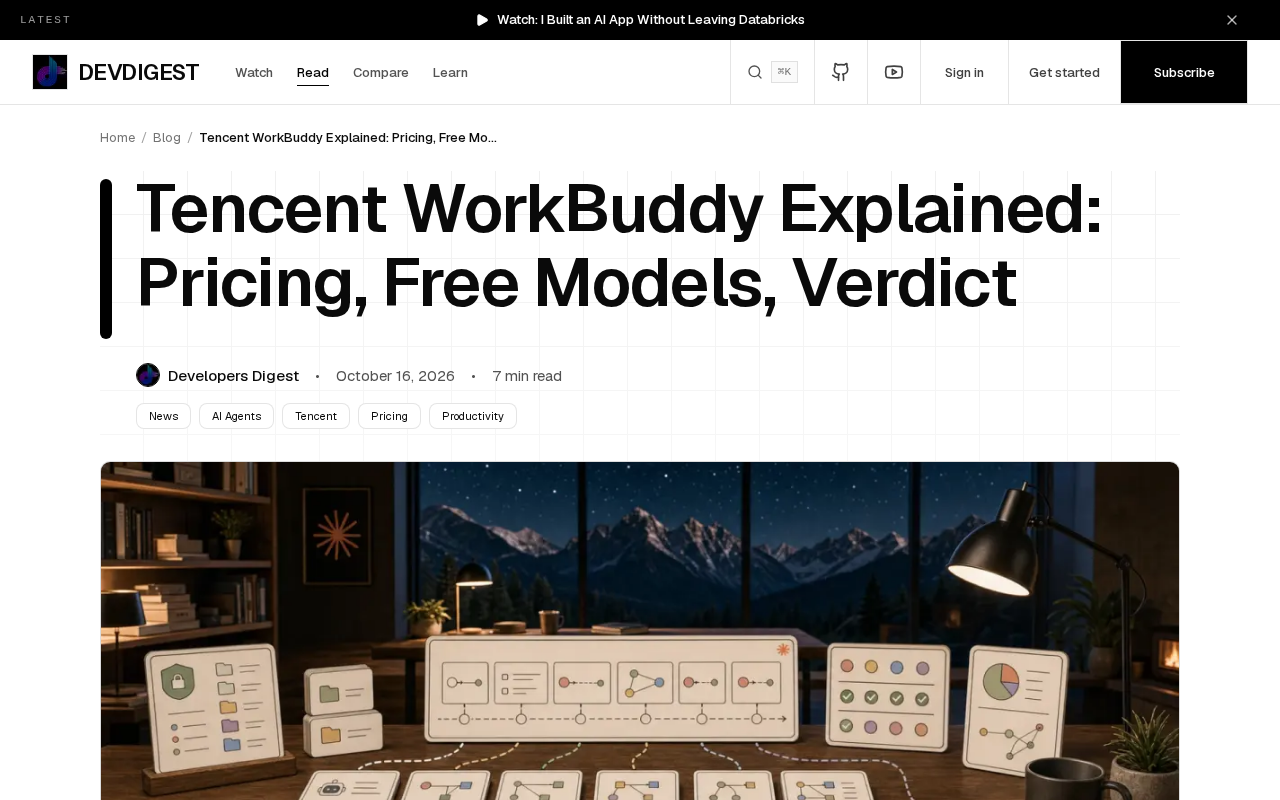
WorkBuddyAd is not a simple chat window—it's a desktop-level Agent that can execute specific tasks. Through the TokenHub model routing layer, it dynamically calls models like Hy3 and DeepSeekAd to handle document processing, data organization, email drafting, and other office operations.
The key difference from ordinary AI assistants is that WorkBuddy emphasizes "execution" over "conversation." After users issue commands, it can operate local files, extract information across applications, and return directly usable results. This design philosophy aligns with the current trend of AI Agents evolving from "answering questions" to "completing tasks."
Tencent's choice of a multi-model access strategy means users don't have to commit to a single model. As an intermediary layer, TokenHub can automatically match models based on task type—for example, routing reasoning-intensive tasks to DeepSeek, while lightweight text processing is handled by Hy3.
What Is an AI Agent
An AI Agent is an artificial intelligence system capable of autonomously perceiving its environment, making decisions, and executing actions to accomplish specific goals. Unlike traditional chat-based AI that can only "answer questions," Agents have task planning, tool invocation, and result delivery capabilities—they can break down complex instructions into multiple sub-steps, call external tools like file systems, browsers, and APIs, and adjust strategies based on feedback during execution. Current mainstream Agent architectures typically consist of three parts: a planning module (Plan), a memory module (Memory), and a tool use module (Tool Use). WorkBuddy is exactly this paradigm applied to office scenarios: after users give high-level instructions, it autonomously completes multi-step operations and returns usable final outputs, rather than merely providing reference text.
The Role of the TokenHub Model Routing Layer
Model Routing is an architectural design that dynamically selects the optimal model for invocation based on task characteristics in a multi-model environment. Its core logic is establishing a mapping between task types and model capabilities: by analyzing signals such as input instruction complexity, required reasoning depth, and response latency requirements, it automatically dispatches requests to the model with the best cost-performance ratio. For example, reasoning-intensive tasks are routed to strong reasoning models like DeepSeek, while lightweight text summarization is handled by lower-cost small models like Hy3. The routing layer also handles unified API interfaces, Token metering, and billing aggregation, so upper-layer applications don't need to worry about underlying model differences. This design both reduces the user's model selection burden and achieves a balance between cost and effectiveness.
2. Pricing and Free Quotas: Breaking Down Real Costs
Free Models and Token Giveaways
WorkBuddy offers free model options and provides a certain amount of free Tokens through TokenHub for new users to test core features. The free quota covers basic document processing and simple instruction execution, sufficient for an initial experience.
It's important to note that the rate of free Token consumption is directly related to task complexity. Simple text summarization consumes less, while multi-round reasoning or large file analysis significantly accelerates quota depletion.
Paid Plans
After exceeding the free quota, users need to pay per Token consumption or subscribe to a plan. Pricing is tied to the selected model—calling high-performance models like DeepSeek costs more than the lightweight Hy3 model. For high-frequency office users, subscription plans are typically more economical than pay-as-you-go.
Specific prices vary by region and promotional activities, so it's recommended to refer to the latest official announcements. Developers who already have self-hosted model services should compare WorkBuddy's invocation costs against the total overhead of their own solution.
Basic Concepts of Token Billing
A Token is the basic unit that large language models use to process and generate text. One Token roughly corresponds to 1-2 Chinese characters or 3-4 English characters. Each time a model processes a request, both the input content (Prompt) and output content (Completion) are billed by Token count, with output Tokens typically priced higher than input Tokens. This is why the same instruction can cost dozens of times more when processing a long document versus a simple Q&A. Understanding Token consumption patterns helps users estimate costs: longer inputs (such as attached large files), more reasoning steps (such as multi-round Agent calls), and richer outputs all lead to greater Token consumption. Subscription plans typically set an included Token quota ceiling, with overages billed separately or processed at reduced speed.
3. Who Should Use WorkBuddy, and Who Should Skip It
Recommended Use Cases
Non-technical office workers are the core beneficiary group. For administrative, marketing, and operations roles, WorkBuddy can significantly reduce repetitive work in daily document processing, meeting minutes organization, and batch email drafting.
Light developers can also use it as a rapid prototyping tool to validate whether Agent workflows meet business needs before deciding whether to invest in building their own.
Situations Where You Should Skip It
For development teams with mature AI workflows, WorkBuddy's closed nature may become a limitation. It doesn't offer underlying model fine-tuning capabilities, nor can it deeply customize Agent behavior logic.
Scenarios with extremely high data privacy requirements also warrant caution. Office files are processed through cloud models, and enterprises need to assess compliance risks.
Cost-sensitive users with extremely high invocation frequency may find that a self-hosted open-source model solution has lower long-term costs.
Cloud Processing and Data Compliance Risks
Most current commercial AI Agents, including WorkBuddy, use cloud inference architecture: user-input instructions and file contents need to be uploaded to remote servers, where cloud-deployed models complete the computation and return results. This means sensitive enterprise data such as contracts, financial reports, and customer information leaves the local environment. For organizations bound by the Personal Information Protection Law, Data Security Law, or industry regulations, such data transmission may constitute a compliance risk, requiring assessment of whether it meets requirements for cross-border data transfer and third-party processor notification and consent. Alternatives include deploying local open-source models or adopting commercial products that support private deployment, but such solutions typically require higher technical investment and hardware costs.
4. Overall Assessment: A Pragmatic Choice for Office AI
WorkBuddy's positioning is clear—lowering the barrier to using AI Agents, rather than pursuing technical limits. Multi-model access and TokenHub routing are practical designs, and the free quota reduces trial-and-error costs.
Its shortcomings are equally obvious: limited customization, reliance on cloud processing, and pricing that isn't friendly enough for heavy users. Whether it's worth using depends on whether your core need is "out-of-the-box" or "deeply controllable."
For most office scenarios, WorkBuddy provides a low-friction path to AI adoption. For developers seeking complete control, it's more of a reference template than a final solution.
As competition in Agent products intensifies, WorkBuddy's pricing strategy and model ecosystem will determine whether it can move from "usable" to "must-use."
One-line Summary
Tencent WorkBuddy is a multi-model desktop AI office agent suitable for non-technical users to quickly deploy AI tasks, but with limited customization and privacy control.
Paragraph Summary
Tencent's WorkBuddy is a desktop AI agent for office scenarios that uses the TokenHub model routing layer to call multiple models like Hy3 and DeepSeek for document processing, email drafting, and other tasks. This article analyzes it across four dimensions: feature positioning, pricing and free quotas, target users, and overall assessment. WorkBuddy emphasizes "execution" over "conversation," offers free Tokens to lower the trial barrier, and prices paid plans by model and Token consumption. The article concludes that non-technical office workers are the core beneficiary group, but users with mature AI workflows, high data privacy requirements, or extremely high invocation frequency should choose carefully. Multi-model routing is the core highlight, but long-term costs need to be compared with self-hosted solutions.
Related articles

Multi-task Model Accuracy Stuck at 0.40? Community Help and Diagnostic Approaches
A developer seeks help because their multi-task model's accuracy is only 0.40, suspecting model size or lack of pre-training. This article analyzes common bottlenecks in multi-task learning, including model capacity, pre-training, loss weights, and data balance, and provides systematic troubleshooting ideas and community suggestions.

Two RL Agents Team Up to 'Chopstick-Catch a Rocket': Mechazilla Captures Super Heavy Booster in Practice
A developer trains two PPO agents in JAX to control a Super Heavy booster and Mechazilla tower arms for cooperative capture, detailing staged training, rollout length, and learning rate tuning.
ConnectWise Breached by Chinese Hackers, Thousands of Enterprises Targeted by AI Agents
Microsoft discloses that ConnectWise was breached by a China-backed hacking group that used AI agents to rapidly infiltrate thousands of customer enterprises. This article analyzes the AI-driven trend in supply chain attacks, security risks of the MSP model, and defense strategies.