Terence Tao: AI Is Turning Beautiful Mathematics into Training Waste

Terence Tao warns that Silicon Valley's AI push on math problems is turning elegant mathematics into "toxic waste."
Terence Tao offers the "toxic waste" metaphor, criticizing Silicon Valley's use of AI to attack unsolved conjectures, producing verifiable but structurally inelegant solutions that reduce math to raw training material. The critique targets two issues: low-quality machine proofs flooding the literature and raising verification costs, and AI-assisted brute-force solutions diluting young mathematicians' motivation to pursue elegance.
Title
Terence Tao: AI Is Turning Beautiful Mathematics into Training Waste
Meta Description
Terence Tao criticizes Silicon Valley's use of AI to brute-force unsolved math problems, downgrading beautiful mathematics into raw training material and producing proofs devoid of structural elegance. This article unpacks the mathematical aesthetics and incentive conflicts behind his "toxic waste" metaphor.
Article Content
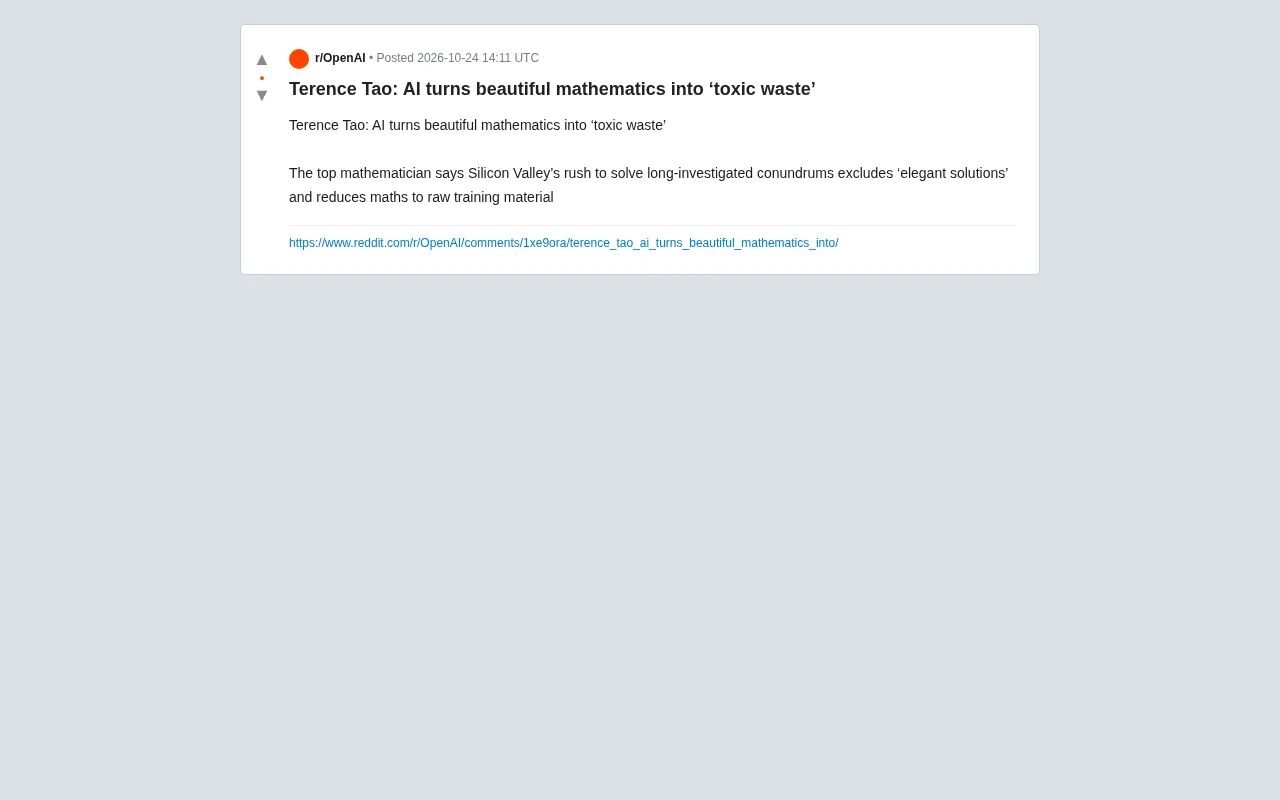
Terence Tao, one of the biggest names in mathematics, recently offered a jarring metaphor: Silicon Valley's use of AI to attack unsolved mathematical problems is turning beautiful mathematics into "toxic waste." The remark came from a widely discussed thread on Reddit, and it isn't about whether AI can solve problems—it's about how the way it solves them is reshaping the aesthetics and value order of mathematical research.
From "Elegant Proofs" to "Raw Training Material"
Tao's core criticism is this: Silicon Valley has a strong urge to crack long-standing mathematical conjectures, but what AI delivers are often verifiable solutions lacking structural beauty. These solutions downgrade mathematical objects into "raw training material" rather than intellectual works worth appreciating.
The mathematical community has an almost ruthless fixation on "elegance." Whether a proof is concise, whether it reveals deep connections, whether it can be generalized—these often matter more than whether it "holds." AI's brute-force search-style proofs can cross the finish line while bypassing all the paths that make mathematics fascinating. What Tao worries about is precisely the disappearance of these paths: when results can be mass-produced, the beauty of the process loses its room to survive.
"Mathematical elegance" is an evaluation standard widely used within the mathematical community—though never strictly defined—that typically refers to the conciseness of a proof, its ability to reveal deep structural connections, and its generalizability. Its opposite is the "brute-force proof" or "computational proof," which directly verifies a conclusion through exhaustive enumeration, large-scale computation, or machine search without offering a human-comprehensible line of reasoning. The computer-assisted proof of the Four Color Theorem and the formal proof of the Kepler Conjecture both sparked similar debates: the conclusion was accepted, but whether the process constitutes "mathematical understanding" remained in doubt. Tao's criticism continues this tradition, except that AI has increased the production speed of brute-force proofs by orders of magnitude, turning the tension between aesthetics and efficiency from an isolated case into a systemic problem.
The Sharpness of the "Toxic Waste" Metaphor
The phrase "toxic waste" spread quickly because it points to two layers of problems at once.
One layer is cognitive: a flood of low-quality, machine-generated proofs into the literature raises the cost for researchers to filter and verify, polluting the knowledge ecosystem. The other layer is about incentives: if the honor and resources for cracking hard problems flow to AI-assisted "brute-force solutions," young mathematicians' motivation to pursue elegant methods will be diluted.
This is not a denial of AI's mathematical capabilities. Tao himself has always been pragmatic; his concern is how the mathematical community redefines what counts as valuable work once AI intervenes. The opposite of waste isn't "uselessness"—it's "something that could have been elegant but was handled crudely."
The Clash Between Silicon Valley's Problem-Cracking Logic and the Rhythm of the Mathematical Community
Silicon Valley is accustomed to narrating through "cracking hard problems": pick a big problem, pour in compute, announce a breakthrough. This logic works in engineering but easily misfires in mathematics. Solving a mathematical conjecture often requires years of accumulation, and its value comes partly from the new tools and perspectives born during the process.
When AI skips these intermediate products and goes straight to the conclusion, what the mathematical community loses is not just a proof but an entire line of thought that might have led to other fields. Tao's warning targets this structural loss, not any particular AI problem-solving result.
The reason solving a mathematical conjecture matters lies not only in the conclusion itself but in the new tools, methods, and even subdisciplines born during the process. For example, the proof of Fermat's Last Theorem spurred numerous advances in algebraic number theory, and the resolution of the Poincaré Conjecture drove the fusion of Ricci flow and geometric analysis. This "process spillover effect" is one of the core mechanisms of mathematical knowledge growth. When AI outputs verifiable conclusions end-to-end, the intermediate products—those definitions, lemmas, and construction techniques that might be borrowed by other fields—are systematically skipped, and what the mathematical community loses is potential intellectual infrastructure, not merely a beautiful proof.
How Mathematicians Should Coexist with AI
Criticism is not rejection. The more constructive reading is this: the mathematical community needs to actively design how AI is used rather than passively accept the agenda set by Silicon Valley. For example, position AI in auxiliary roles such as conjecture exploration, counterexample search, and formal verification, while leaving aesthetic judgment and direction-setting to humans.
Tao's remarks are more like agenda-setting—putting the question of "what is worth doing" on the table before AI makes large-scale inroads into mathematics. The beauty of mathematics is not decoration; it is the underlying mechanism by which the discipline selects directions and holds the community together. Protecting this mechanism is more urgent than debating whether AI can solve the next big conjecture.
Formal verification refers to translating mathematical proofs into a computer-checkable formal language (such as Lean, Coq, Isabelle), with a proof assistant verifying each step of reasoning. Substantial progress has already been made in combining this process with AI: DeepMind's AlphaProof reached silver-medal level at the 2024 International Mathematical Olympiad, with its solutions formalized in Lean. The advantage of formal verification is that it provides a reliable guarantee of correctness, and the formalized library itself becomes a reusable public knowledge asset; the limitation is that formalization is costly, and a formalized proof is not necessarily more "elegant." Positioning AI in the auxiliary role of formal verification is precisely one concrete landing point of what Tao calls "leaving aesthetic judgment to humans."
One-line Summary
Terence Tao warns that Silicon Valley's use of AI to crack mathematical problems is turning elegant mathematics into "toxic waste."
Paragraph Summary
Terence Tao offers the "toxic waste" metaphor, criticizing Silicon Valley's problem-cracking logic of using AI to attack unsolved mathematical conjectures, producing verifiable solutions devoid of structural beauty and downgrading mathematical objects into raw training material. The article points out that this criticism targets two layers of problems: a flood of low-quality machine proofs into the literature raises verification costs and pollutes the knowledge ecosystem; and AI-assisted brute-force solutions dilute young mathematicians' motivation to pursue elegant methods. Silicon Valley's narrative of "pick a big problem, pour in compute, announce a breakthrough" structurally conflicts with mathematics' value system that emphasizes process accumulation and the birth of tools. The constructive direction is to let AI take on auxiliary roles such as conjecture exploration, counterexample search, and formal verification, while leaving aesthetic judgment and direction-setting to humans.
Related articles

T3 Code: The Open-Source AI Coding Assistant's Comeback Story
T3 Code is an open-source AI coding assistant that unifies subscriptions like Codex and Claude, with powerful remote control and parallel task management.

Never Elected, Yet Ruled New York for 30 Years: The Ultimate Case Study in the Mechanics of Power
Robert Caro's biographies reveal how unelected Robert Moses ruled New York for 30 years through legal drafting and public authorities, and how Lyndon Johnson built leverage as a "powerless" Senate Majority Leader. Unpacking the underlying logic of accumulating and sustaining power.

The CPython 3.10 Recursion Trap and Synthetic Recovery in TokenGuard, an LLM Circuit Breaker
TokenGuard's author recounts a recursion crash caused by OrderedDict.pop in CPython 3.10 and introduces v0.3.0's Loop Nudge synthetic recovery, inline DLP scanning, and other new LLM agent circuit-breaker capabilities.