Terence Tao Proposes 'Mathematics 2.0': When AI Makes Proofs Abundant

Tao warns AI is flooding math with proofs, demanding a shift from problem-solving races to human understanding.
Fields Medal laureate Terence Tao introduced the concept of 'Mathematics 2.0' at Caltech, arguing that AI is turning mathematical proofs from scarce to abundant and upending the traditional 'who solves it first' paradigm. He identified three reasons math is especially vulnerable to AI, warned of severe survivorship bias in AI publicity, and called for transparent reporting of failure rates and compute costs. Through his five-stage proof model and a cancer therapy thought experiment, he argued that human understanding remains irreplaceable and that blindly optimizing for problem-solving will damage mathematics' long-term health.
When the Era of 'Proof Scarcity' Comes to an End
Fields Medal laureate Terence Tao has made a judgment that could shake the mathematical world to its core: the Mathematics 1.0 era — built on the scarcity of proofs — is coming to an end, and Mathematics 2.0 has already arrived. Behind this conclusion lies the dramatic impact AI is having on the pace of mathematical research.
In the traditional Mathematics 1.0 era, proofs were always scarce. Tackling an open problem required deep domain expertise and enormous investments of time and effort. As a result, "who first solved what" naturally became the core metric for measuring mathematical contributions. But when AI can produce proofs in bulk within a short timeframe, the foundation of this evaluation system begins to crack.
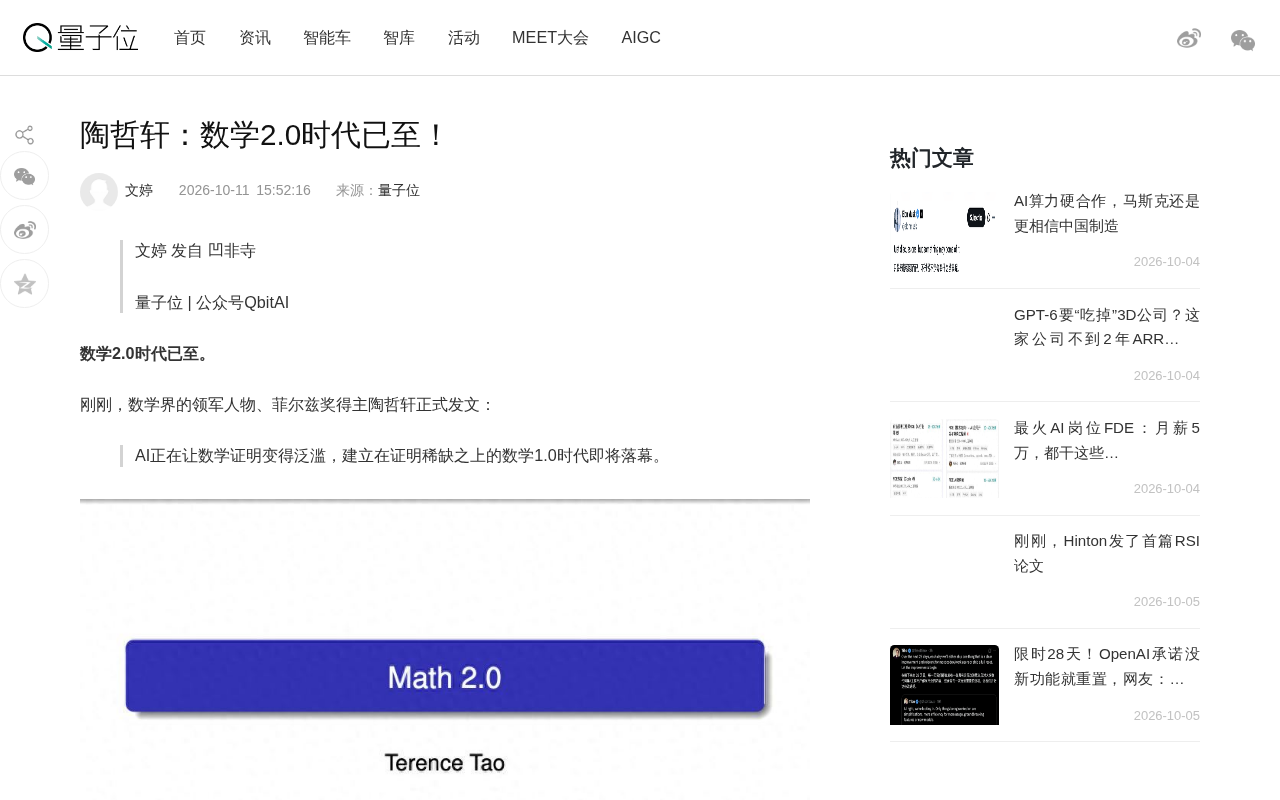
According to Qubit, Tao formally articulated this view in a recent lecture at Caltech. Interestingly, the talk was originally titled Machine-Assisted Proofs, but given the backdrop of AI's recent flurry of activity in mathematics, he was compelled to retitle it Mathematics 2.0 — a last-minute pivot that itself vividly illustrates the shock of AI-driven acceleration.
Why Mathematics Is So Susceptible to AI Breakthroughs
Tao identified three overlapping conditions that explain why mathematics has become a central battleground for rapidly advancing AI capabilities:
- Proofs can be objectively verified: there are clear standards for correctness that don't rely on subjective judgment;
- Mathematical objects and reasoning processes are highly digitalizable: naturally suited for machine processing;
- A large body of high-quality research literature already exists in digital form: providing ample training material for models.
These three factors, combined with the massive investments from frontier AI labs, have quickly made mathematics an ideal proving ground for models. Whether it's OpenAI releasing 722 mathematics papers overnight — sweeping across near-Riemann Hypothesis research, the Hodge Conjecture, the BSD Conjecture, and other landmark problems — or extending Wang Hong's freshly awarded Fields Medal result on the Kakeya set dimension conjecture from three to four dimensions, AI is rewriting the rhythm of mathematical research.
That said, Tao wasn't swept away by these success stories. He held up the classic "bullet hole diagram" to remind audiences of survivorship bias: the vast majority of frontier mathematical problems remain unsolved, AI's capabilities are uneven — impressive in some directions, still weak in others. What AI companies showcase are hand-picked success stories, while the countless failed attempts never get any public attention.
Transparent Evaluation: Failures and Compute Costs Should Be Reported
Counting only successes fails to answer the critical questions of success rates, resource consumption, and the degree of human involvement. With this in mind, Tao called for a more transparent and rigorous evaluation framework that includes failed results and AI compute costs in reporting.
This demand cuts directly to a core weakness in current AI mathematics publicity. When a lab claims to have "solved a hard problem," outsiders typically have no way of knowing how many attempts were made, how much compute was burned, or what role human researchers played. Without this information, so-called "breakthroughs" are difficult to scientifically evaluate or reproduce.
But Tao clearly believes that producing a correct proof and reporting failures and costs is far from sufficient. The deeper question is: can the growing flood of AI-generated proofs actually deliver more human understanding, better training, and more reliable real-world contributions?
Blindly Racing to "Solve Problems" Will Damage Mathematics' Long-Term Health
Tao used a vivid metaphor: open problems are like lighthouses — they guide people to explore the surrounding mathematical landscape, and reaching a lighthouseAd is not the same as completing the exploration.
In his view, the process of attempting to solve a problem — whether ending in success, failure, or partial progress — can generate insights more valuable than the final answer. If automated tools deliver answers too early, and the evaluation system only rewards "solved," the unexplored paths lose their incentive to be traversed. He emphasized: the Millennium Prize Problems are finite, but the pathways, understanding, connections, and new questions that grow from a single problem are nearly infinite.
For this reason, he warned that continuing to blindly optimize for the single metric of "problem-solving" will damage the long-term health of mathematics. This also explains why he was so unsparing in his criticism of AI companies at the SAIR lecture: "AI companies accelerate endlessly without any idea of what comes after — we must slow down."
In fact, this concern surfaced as early as his blog comments in early September: AI can be a tool serving mathematical research, but chasing short-term goals may come at the cost of the mathematical community's long-term sustainability.
The Millennium Prize Problems are seven unsolved mathematical problems established by the Clay Mathematics Institute in 2000, each carrying a $1 million prize. They include the Riemann Hypothesis, P vs NP, the Hodge Conjecture, and the BSD Conjecture (Birch and Swinnerton-Dyer Conjecture), among others. To date, only the Poincaré Conjecture has been solved — by Grigori Perelman, who declined the prize. These problems are called "lighthouses" not only because of their extreme difficulty, but because the theoretical tools and mathematical structures developed in pursuit of them are often far more valuable than the final answers themselves — for example, Wiles' proof of Fermat's Last Theorem gave rise to profound developments in the theory of modular forms and elliptic curves. Tao's concern is precisely this: if AI prioritizes "picking fruit" over "blazing trails," the knowledge ecosystems that grow as byproducts of exploration will wither for lack of motivation.
The "Cancer Therapy Experiment": Why Human Understanding Remains Irreplaceable
To explain why human understanding still matters, Tao proposed a striking thought experiment.
Suppose you ask a frontier AI to find a cancer therapy that can pass a Phase III clinical trial. After burning through compute, it produces a mixture of unknown chemical substances: the model predicts they will kill cancer cells, Lean formal verification passes, and the Phase III trial succeeds. But no one knows how it found this answer, and there's no way to determine whether the AI genuinely discovered a therapy or exploited loopholes in the trial process.
Before the needle goes into your vein, would you want — at minimum — one cancer specialist who understands its mechanism of action, one mathematician who can follow the underlying mathematical reasoning, and one scientist who can understand the model that found the therapy?
This experiment brings an abstract mathematical discussion into a concrete scenario: even when a model's conclusion passes verification, someone still needs to judge whether it is aligned with real-world goals. Models can generate answers, verify reasoning, and accelerate exploration — but they cannot serve as humanity's gatekeeper. This may be precisely the irreplaceable role of human scientists.
The Five Stages of Proof and "Proof Indigestion"
In his earlier essay Mathematics in the Age of AI, Tao broke down problem-solving into five stages:
- Generating a proof;
- Verifying correctness;
- Explaining it clearly;
- Having it understood and accepted by the community;
- Ultimately integrating it into the field's standard theory.
The final step is especially slow: researchers need to find more natural formulations and more elegant proofs, connect results with other knowledge, and bring them into textbooks as tools for the next generation of mathematicians. This is precisely the stage that AI struggles to accelerate.
If AI primarily speeds up the earlier stages, "proof indigestion" may follow. Tao therefore advocates reducing emphasis on "racing to generate proofs first" and increasing attention to explanation, peer review, and knowledge consolidation. He even argues that formal verification alone is far from sufficient — authors must also be able to clearly communicate their results, otherwise such contributions remain incomplete.
This stance reached a flashpoint in early October. On October 7th, OpenAI released 722 mathematics papers in a single drop, thoroughly infuriating the AI-skeptic faction led by Tao. He promptly co-founded the Association for Human Mathematics (AHM), releasing a joint statement criticizing the one-time publication of 700+ documents as "not scientific research at all, but a pure display of compute dominance," and urging mathematicians to cease collaboration with OpenAI and return to a scientific vision centered on human understanding.
Lean is an interactive theorem prover used to formalize mathematical proofs into computer-verifiable code. Proofs written in Lean can be checked step-by-step by a machine, ensuring every inference conforms to the axiom system and eliminating the oversights that can occur in manual review. In recent years, formal verification has been seen as critical infrastructure for AI-assisted mathematical research — AI generates candidate proofs, and Lean verifies them. However, Tao points out that formal verification only addresses "correctness," not "comprehensibility." A proof that passes Lean verification may be logically airtight yet yield no intuition or insight for any human reader. This is the core of his criticism that "formal verification alone is far from sufficient": a proof must be absorbable, reusable, and teachable by the mathematical community before it has truly fulfilled its purpose.
In the AI Era, Is a Math PhD Still Worth It?
This debate also cuts to the question young researchers care most about: if AI can rapidly generate papers, is grad school still worthwhile?
Tao's answer is clear-eyed: the value of a PhD is not in whether you can produce papers, but in whether you develop a systematic capacity to "absorb difficult material, synthesize knowledge, and ask good questions."
He draws an analogy with diet and exercise: just as people need to deliberately exercise once food and transport are abundant, people must also consciously maintain their cognitive abilities once answers are readily available — resisting the temptation to bypass thinking — and these are precisely the core capabilities a PhD is designed to cultivate. If your only goal is to produce outputs, the case for a PhD in the AI era is indeed weakening. But if you want to be trained to tackle hard problems, synthesize knowledge, and ask good questions, a PhD still holds its value.
On the other side, Tao is also actively exploring paths for human-AI collaboration. The SAIR Foundation, which he co-founded, has launched an "Open Mathematics Model Initiative." The first phase targets everyday research needs — such as understanding difficult arguments, checking citations, exploring examples, writing code, and formalizing proofs — with related models set to be released soon.
The SAIR (Science and AI Research) Foundation is a nonprofit co-founded by Tao to explore sustainable pathways for collaboration between AI and fundamental scientific research, standing in contrast to commercially driven AI labs like OpenAI. The "Open Mathematics Model Initiative" is positioned as a tool that assists daily research workflows, rather than a competition-style model designed to "solve Millennium Prize Problems" as a marketing hook. This choice of direction itself embodies Tao's philosophy: AI's greatest value lies not in racing to deliver answers, but in helping mathematicians more efficiently understand arguments, explore examples, and consolidate knowledge — that is, serving the later stages of the five-stage proof process that the current AI frenzy so conspicuously ignores.
The Bottleneck Is Not Compute — It's Imagination
At the end of his lecture, Tao identified the primary bottleneck to achieving Mathematics 2.0 as imagination.
The supply of proofs is undergoing a fundamental transformation, but how to leverage this change — advancing understanding, training, and exploration together — still requires a collective choice from the mathematical community. Once a problem is proven by AI, perhaps the mathematician's next question will be: what can we still learn from this answer? What can we do next?
From "who solves the problem first" to "what do we understand once it's solved" — this may be the most profound paradigm shift of the Mathematics 2.0 era. AI is changing not only how proofs are produced, but also forcing the entire field to redefine what truly constitutes a mathematician's competitive advantage.
Related articles

Gaussian Process Bandit Optimization: Exploration Strategies and Inference Regret Guarantees
Cumulative regret guarantees in Bayesian optimization fail to reflect final recommendation quality. This article examines a new study that provides inference regret guarantees for Gaussian process bandit optimization through exploration query strategies and fill distance analysis, validated on hyperparameter optimization and control tasks.

The Most Detailed Codex Guide on Bilibili: From Installation to Real-World Practice
The most detailed Codex guide on Bilibili: from app store installation to daily work mode configuration, with a real coffee shop project demonstrating file organization, data extraction, dashboard creation, and other practical tasks. Learn to use Plan Mode and desktop pets to leverage Codex efficiently.

Appearance Compensation in Volume Rendering: Why RGB Accuracy Cannot Guarantee Density Correctness
Volume rendering research reveals that volumetric data perfectly reproducing external RGB views may still contain density errors: appearance compensation can double central density and keep external rays unchanged even when L2 error exceeds 14.52%. Density recovery depends on appearance capacity, spatial resolution, and measurement design.