Terence Tao Shares Call for Mathematicians to Stop Collaborating with OpenAI

Terence Tao's repost of an anti-OpenAI statement highlights growing tensions over AI's role in mathematical discovery.
Fields Medal laureate Terence Tao recently shared a statement from the "Association for Human Mathematics" calling on mathematicians to stop collaborating with OpenAI, after the company continued using AI to tackle unsolved open problems despite recommendations to stop. The episode raises layered questions: who owns credit when AI solves a major conjecture, what verifiability standards AI-generated proofs must meet, and whether profit-driven AI companies should follow academic community norms. The controversy echoes historical debates over computer-assisted proofs like the Four Color Theorem, but the stakes are higher given AI's general reasoning potential.
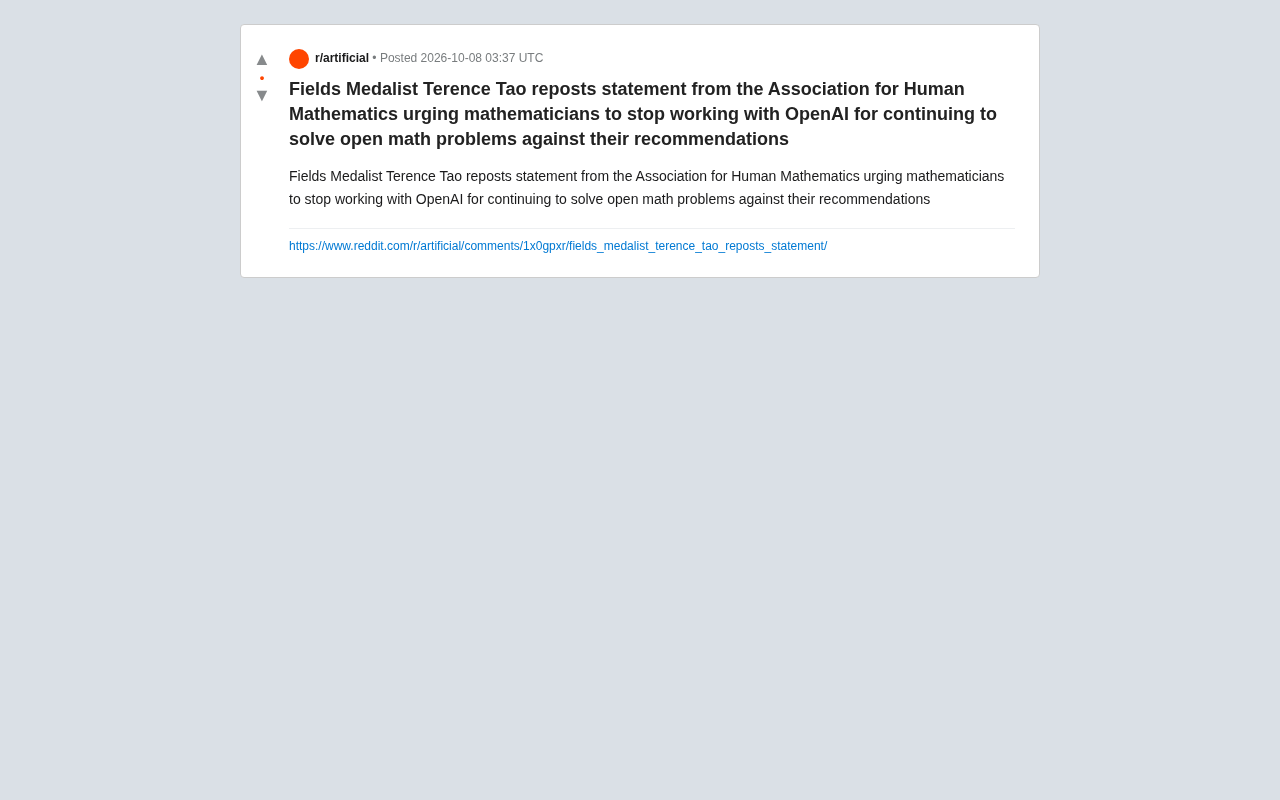
Fields Medal laureate and widely regarded one of the greatest living mathematicians, Terence Tao, recently shared a statement from the "Association for Human Mathematics" — sparking widespread discussion across both the mathematics community and the AI world. The statement calls on mathematicians to cease collaboration with OpenAI, citing the company's continued use of AI systems to tackle unsolved open mathematical problems despite explicit recommendations from the association to stop.
What makes this event noteworthy is not just Tao's enormous influence in mathematics, but the fundamental question it raises — one that is rapidly coming to a head: as AI begins to encroach on the most abstract and creatively intuitive domain of human endeavor, how should the academic community respond?
Note: This article is based on screenshots and discussions circulating on Reddit. The full text of the statement and official responses from all parties remain to be verified. Readers should treat specific details with caution.
The Core Controversy
Based on the information in circulation, the core demand of the "Association for Human Mathematics" is this: the mathematical community should take collective action to resist OpenAI's continued efforts to solve open mathematical problems. The underlying concerns operate on multiple levels.
First is the question of attribution and ownership. Open mathematical problems — conjectures that have challenged human mathematicians for decades or even centuries — have long been regarded as a benchmark of human intellectual achievement. If these problems are solved first by an AI system, the symbolic value of mathematics as a distinctly human intellectual pursuit may be diluted.
Second is concern about methodology and verifiability. Can proofs generated by AI be fully understood and verified by humans? If a resolution to a major conjecture is produced in a way that humans cannot readily follow, what it actually means for the advancement of mathematical knowledge remains an open question.
Why Tao's Position Matters
Terence Tao's stance has long been seen as a bellwether. Unlike many scholars who take a conservative view of AI, he has actually been an active proponent of AI-assisted mathematical research — publicly discussing at length how large language models and formal proof tools like Lean can be integrated into mathematical workflows.
That is precisely what makes his decision to share this statement so intriguing. Sharing a post does not necessarily imply full endorsement — in the context of social media, it often signals "I think this is worth discussing" rather than "I agree with every word." But given Tao's stature, any gesture of skepticism toward AI's role in mathematics will inevitably be amplified.
This also reminds us that the conversation around AI and mathematics is moving from the technical plane to one of values and professional ethics. Even the most technology-embracing scholars are now grappling with where the line should be drawn.
Lean is an interactive theorem prover developed by Microsoft Research. It allows mathematicians to write proofs in a rigorous formal language, which a computer then automatically checks for logical correctness. In recent years, Tao has publicly led efforts to formalize his own research results in Lean — including the proof of the Polynomial Freiman-Ruzsa conjecture — in collaboration with dozens of mathematicians worldwide. This practice shows that formalization tools are already accepted by leading mathematicians. The debate is not about "machines participating in verification" — it is about "whether machines can lead discovery." The emerging direction of combining LLMs with Lean means AI can now not only assist in verification, but also attempt to autonomously generate proof steps. This is the technical backdrop to the current controversy.
The Deeper Tension: Tool or Competitor?
At its core, this controversy is a dispute over AI's role in scientific research. One camp holds that AI is a powerful tool — helping mathematicians explore a broader space of conjectures and automating tedious verification work — essentially a continuation of the tradition of computer-assisted proof, as with the Four Color Theorem.
The other camp worries that when AI transitions from "assistive tool" to "independent problem solver" and begins systematically tackling problems humans have yet to crack, it is no longer a tool but a competitor — or even a replacement. The very name "Association for Human Mathematics" carries an unmistakable ideological statement.
It is worth noting that this kind of anxiety is not new to the history of science. From calculators to computer-assisted proofs, every major leap in tooling has prompted debates about what counts as "real mathematics." The difference this time is that AI is encroaching on creative discovery itself — not merely computation or verification.
The Four Color Theorem is a landmark in the history of computer-assisted proof. In 1976, mathematicians Kenneth Appel and Wolfgang Haken used a computer to exhaustively verify approximately 1,900 cases, completing the first proof of the theorem. This was itself deeply controversial at the time: some mathematicians argued that a proof no human could check step by step was epistemologically incomplete and should not be considered a "real proof." Yet decades later, the result is universally accepted and regarded as the beginning of computer-assisted mathematics. The current debate around AI closely parallels the Four Color Theorem episode — but the scale and speed are far greater. AI is not a specialized program targeting a single theorem; it is a system with general reasoning potential, making the question of boundaries far more urgent and complex.
Implications for the AI–Research Relationship
Setting aside the specifics of this particular event, the trend it reflects is clear: generative AI's capabilities are approaching the upper reaches of human professional intellect, and the academic community has yet to establish mature norms for dealing with this.
Several unresolved questions deserve continued attention: How should research results involving AI be credited and attributed? What standard of verifiability must AI-generated proofs meet before the community accepts them? Should profit-driven AI companies follow some form of community consensus when tackling academic problems with strong public-good dimensions?
None of these questions have standard answers, but Tao's decision to share this statement at least signals that even the most forward-looking explorers believe these issues have reached a point where they must be taken seriously.
There is currently no internationally accepted standard for crediting AI contributions in research. Existing academic norms — such as policies at Nature, Science, and other top journals — generally prohibit listing AI as an author while requiring authors to disclose how AI was used. But when AI has substantively generated the core proof ideas or derivation steps, whether a mere "acknowledgment" is sufficient remains hotly debated. Mathematics is particularly unique in this regard: the core contribution of a mathematics paper lies almost entirely in the proof itself. If the proof is primarily produced by AI, the substantive meaning of a human author's name becomes questionable. This issue does not merely concern the allocation of academic credit — it directly affects research evaluation systems, career advancement, and the foundational logic of research funding.
Conclusion
This episode functions more like a mirror, reflecting the identity anxiety and ethical confusion that AI's rapid development is bringing to traditional academic fields. Regardless of whether the Association for Human Mathematics' call ultimately gains traction, the questions it raises will accompany the integration of AI and science for a long time to come.
For readers who follow the AI frontier, rather than fixating on the outcome of any particular boycott, it is more productive to treat this as a signal: the boundary dispute between AI and human intellectual activity has only just begun.
Related articles

Amphibious Transforming Drone: Beyond 100x Power Savings, What Are the Real Needs?
Is the amphibious transforming drone just a gimmick? Starting from the 100x power difference of the M4 Morphobot, explore real application scenarios and thesis topic ideas, analyzing boundary conditions where pure drones and pure ground robots both fail.

Warhound Raises $200 Million: Genetically Engineered "War Dogs" Paired with Anduril Gear
Warhound raises $200M, backed by Ben Lamm and Palmer Luckey, to genetically engineer dogs for military and law enforcement use and equip them with Anduril gear. This article analyzes its technology direction, funding logic, and ethical controversy.

Claude API Comes to Google Cloud: IAM Integration and SDK Access Guide
Anthropic hosts the full Claude API on Google Cloud with IAM-controlled permissions and unified billing. This guide covers the Vertex AI and Anthropic-hosted entry points, IAM role configuration, and SDK access.