Terry Pratchett's 'Horizontal Wealth': Spend Money on What You Love
Pratchett's 'horizontal wealth' lets income match existing interests rather than define identity.
The article draws on Terry Pratchett's distinction in *A Slip of the Keyboard* between 'vertical wealth' (yachts, luxury cars) and 'horizontal wealth'—investing more in what you loved before getting rich. Using his study expansion and purchases for 'undirected research' as examples, it argues spending should keep curiosity running, not boost efficiency. Quoted by Simon Willison on Hacker News, the view resonated in the tech community as an alternative to post-raise consumption.
What Is 'Horizontal Wealth'?
In A Slip of the Keyboard, Terry Pratchett introduces a pair of thought-provoking concepts: vertical wealth and horizontal wealth. Vertical wealth means spending money on 'the things rich people are supposed to have'—yachts, luxury cars, private jets. Horizontal wealth is the opposite: continuing to spend money on the things you loved before you got rich, just spending more of it.
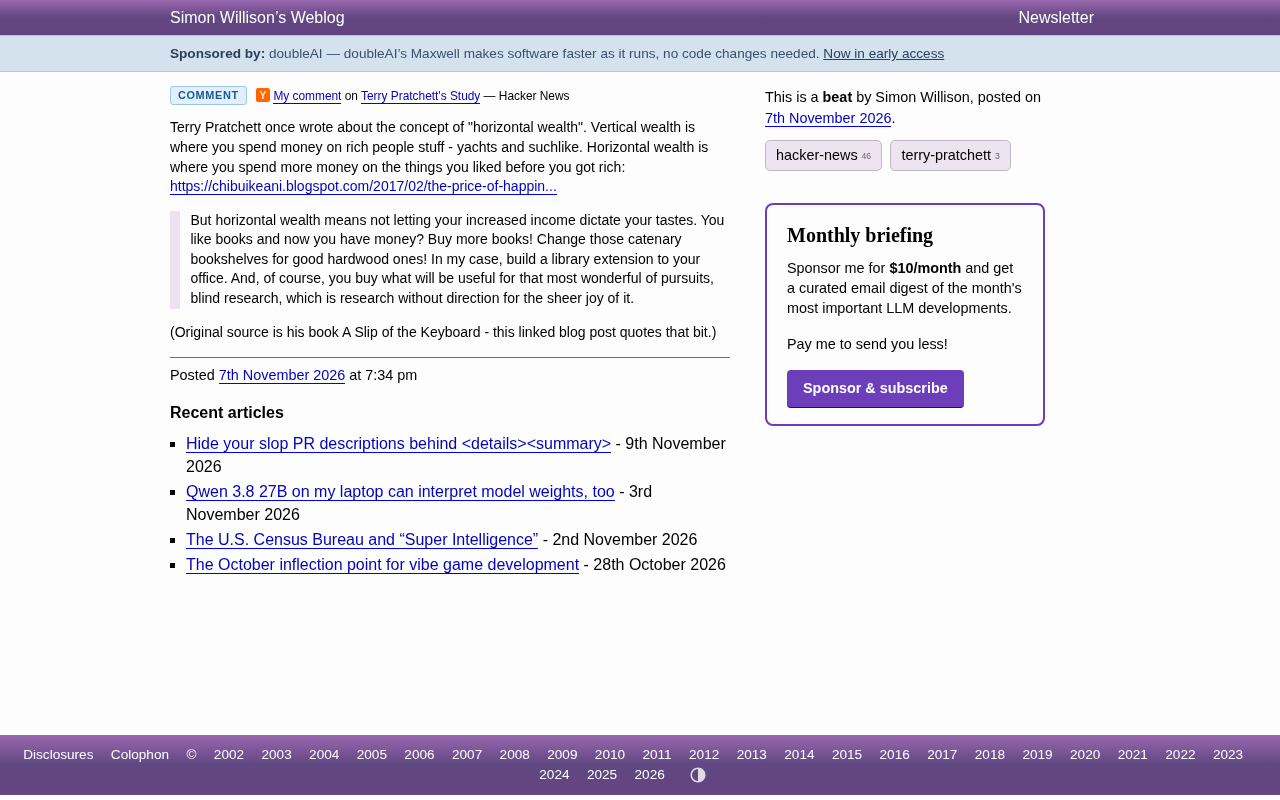
This idea was recently revived on Hacker News, where Simon Willison quoted the original passage in a comment and linked to a blog excerpt. Pratchett's point is direct: when your income rises, don't let your income dictate your tastes. You love books, and now you have money? Buy more books. Swap the chain-and-chandelier bookshelf for good wood; in his own case, add a library extension to his office.
This view of wealth isn't anti-consumption—it's anti letting consumption define your identity.
Terry Pratchett (1948–2015) was one of Britain's bestselling fantasy authors, known for the Discworld series, which has sold over 85 million copies worldwide. A Slip of the Keyboard is a posthumously published 2014 nonfiction collection of his essays and speeches on writing, reading, death, and his creative career. The 'vertical/horizontal wealth' passage comes from one of these essays, on writing income and lifestyle. Pratchett himself practiced this philosophy: after finding fame, he didn't shift to yacht-style consumption but kept expanding his study and book collection, and long funded reading promotion and Alzheimer's research. Understanding this context helps clarify that he wasn't offering financial advice but a life philosophy about 'the autonomy of one's interests.'
Spending Money on 'Undirected Research'
The most striking part of Pratchett's passage isn't the bookshelf but the use he explicitly names—'undirected research,' or research with no direction, purely for the joy of it.
He calls this kind of research 'one of the finest pursuits,' and is willing to buy useful things for it: reference books, materials, space, tools. Here 'useful' isn't about output but about keeping curiosity running. For the many people doing knowledge work today, this is an easily forgotten spending logic—spending money not for efficiency but to allow yourself to dig into things aimlessly.
In the context of the HN discussion, this view was contrasted with popular narratives like 'productivity tools' and 'second brain': the latter instrumentalize knowledge consumption, while Pratchett emphasizes the joy of research itself.
Pratchett's 'undirected research' shares something with 'basic research' in the academic sense, but is more personal. Basic research usually refers to exploration aimed not at direct application but at understanding principles, whose value often emerges only in the long term; Pratchett scales it down to the individual level—buying books and materials and making space, not to complete a project but to let curiosity run uninterrupted. This distinction matters because most modern knowledge tools are designed on the premise of being 'searchable, reusable, and productive,' whereas undirected research precisely requires allowing inefficiency, allowing detours, and allowing you to read something you can't use for now. The role of horizontal wealth here is to provide the material conditions for this 'unproductive' activity.
Why This View Resonates in the Tech Community
The Hacker News discussion around Terry Pratchett's study may look like just a photo of a desk and a bookshelf, but it actually touched a nerve in the tech crowd's reassessment of 'wealth, consumption, and interests.'
Tech workers often face an invisible income-growth curve: as salaries rise, spending quickly gravitates toward 'vertical wealth'—bigger houses, better cars, more expensive gear. But Pratchett's 'horizontal wealth' offers an alternative path: channel the incremental income back into what you already loved, giving familiar passions more resources.
The benefit of this path is that it doesn't require you to change your interests to match your income—it lets your income match the interests you already have. For people who pour large amounts of spare time into open source, reading, and tinkering with hardware, this is an almost naturally coherent spending philosophy.
Hacker News is a tech and startup community run by Y Combinator, known for dense technical discussion and sustained attention to topics like 'productivity,' 'side hustles,' and 'instrumentalizing the self.' Simon Willison is a co-creator of the Django framework and a long-active tech blogger; his HN comment quoting Pratchett's original text helped recirculate the passage among developers. This context is key: HN's mainstream narrative heavily emphasizes efficiency, output, and measurable value, and Pratchett's view stands in sharp contrast—it shifts the justification for consumption from 'does this boost output' to 'does this serve existing interests,' creating a contrarian appeal for tech workers long stuck in an optimization mindset.
From Study to Code: How Horizontal Wealth Takes Shape
Pratchett used a study as his example, but horizontal wealth takes forms beyond physical space.
For developers, it can be continuously investing time and equipment in an open-source project that makes no money; buying a whole set of tech books you've long wanted, even if you won't use them soon; or building a lab-style home workspace simply because you want to 'research blindly' in it.
The key is that the criterion changes: no longer asking 'will this boost output' but 'does this serve what I already love.' This isn't anti-productivity—it puts productivity back where it belongs: serving people's interests rather than replacing them.
The Boundary Between Vertical and Horizontal
Pratchett didn't deny the legitimacy of vertical wealth; his distinction is closer to a reminder: when income grows, the direction of your tastes is yours to decide, not defaulted by your income level.
This reminder is especially meaningful today. Consumerism excels at packaging 'upgrades' as 'necessities,' while the logic of horizontal wealth is simple—if you love books, just buy more books. Simple, but it takes a bit of self-awareness: between income and desire, keep the power to choose.
One-line Summary
Pratchett's 'horizontal wealth' argues for letting income match existing interests rather than define identity.
Paragraph Summary
Drawing on Terry Pratchett's distinction between 'vertical wealth' and 'horizontal wealth' in A Slip of the Keyboard, the article discusses how to spend as income grows. Vertical wealth means yachts, luxury cars, and other 'things rich people should have'; horizontal wealth means continuing to invest in what you loved before getting rich, just more of it. Using his own study expansion and purchases of reference books and space for 'undirected research' as examples, Pratchett stresses that spending is about keeping curiosity running, not boosting efficiency. The article notes that this view, quoted by Simon Willison on Hacker News, resonated in the tech community because it offers an alternative to consumption after a salary increase: let income match existing interests rather than let taste be led by income.
Related articles

Seven Years of Evolution: How Far Has the Foldable Come From the First Generation?
From the first foldable to today's latest models, what has seven years changed? Shallower creases, higher brightness, thinner bodies, and smoother software migration—has the foldable crossed the chasm from enthusiasts to ordinary users? This article discusses the question based on a video comparison.

When Did Humans Start Eating Salt? A 10,000-Year History of Salt
When did humans start eating salt? From salt use at the dawn of agriculture 11,000 years ago to ancient seawater evaporation and rock salt mining, and on to the salt trade, salt taxes, and Gandhi's Salt March, this article traces salt's key role in human civilization.
Microsoft Paza Research: How African Language Speech Recognition Breaks Through Architecture and Data Bottlenecks
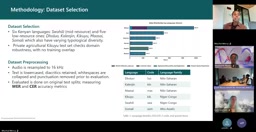
Microsoft's Paza research evaluates 53 speech models across 39 African languages, revealing architecture choice matters more than pre-training coverage, 200-300 hours is the practical data threshold, and language typology deeply influences recognition performance.