Tesana AI Hands-On: Loop Mode Lets AI Agents Build Games on Their Own

Tesana AI's Loop Mode autonomously builds games in Godot — great at mechanics, but level design is still a human job.
This article documents a deep hands-on test of Tesana AI — an agent orchestrator integrating Claude, GPT, and Kimi K3 with unified image, 3D, animation, and VFX APIs, built on Godot. Its Loop Mode autonomously creates, reviews, and fixes bugs within a token budget, often running overnight. After building five diverse games, the verdict is clear: AI handles mechanic-driven games like pinball and auto-chess remarkably well, but level design, numerical balance, and quadruped animation rigging remain hard limits. Most future games may be built with AI tools, but those with genuine creative vision and polished levels will still stand apart.
Pack today's best AI models into an agent orchestrator, set it to work around the Godot engine in a continuous loop — writing code, generating art assets, reviewing and fixing bugs — until the game is done. That's the premise one Bilibili creator used to put Tesana AI to the test. This article breaks down the full experience, examining the tool's real capabilities and just how far AI-driven game development has come.
What Tesana Actually Is: An Agent Orchestrator Built Around Godot
Tesana isn't just another closed-box AI generator — a point the creator emphasizes repeatedly. At its core, it's an agent orchestrator that integrates multiple models including Claude, GPT, and Kimi K3, and like Claude Code, it has multi-layer skill scheduling that can dispatch multiple sub-agents to work in parallel.
What truly sets it apart from a DIY local setup is how it consolidates all the APIs needed for game development in one place, with seamless integration: image generation, 3D asset generation, 2D/3D animation libraries, VFX libraries, and more. In one project the creator showcased, a huge volume of art assets was generated — all transparently, with the agent knowing which capability to call at each step.
The animation library layer at the top is especially significant. It's not just a pile of assets — it's a described library, meaning the agent knows how to combine animations intelligently. The result is a noticeably more polished final product, and the VFX effects are genuinely impressive.
The whole stack is built on the Godot engine, which means the output isn't platform-locked: you can export to an app or pull the source code into a local environment and keep developing. The creator put it bluntly: "If this feature didn't exist, I couldn't have made this video at all — I hate black boxes."
Godot is an open-source, cross-platform game engine released under the MIT license, meaning anyone can use it for free — even commercially — without paying royalties. Unlike Unity or Unreal Engine, Godot's source code is fully public and can be freely audited or modified by the community. It uses its own GDScript scripting language (with Python-like syntax) and also supports C# and C++. Godot's scene system is organized around a node tree, which makes it well-suited for modular, AI-generated code. Beyond avoiding vendor lock-in, Tesana's choice of Godot also reflects the engine's lightweight architecture: compared to commercial engines that require complex editor interactions, Godot's project file structure is clean and easy for AI agents to generate and modify programmatically.
The Core Feature: Loop Mode
The star of this hands-on test is the newly introduced Loop Mode. The concept is straightforward: give the agent a token budget, and it begins autonomously looping — creating content, self-reviewing, fixing bugs, checking again — until the budget runs out or the task is complete.
This approach mirrors the gauntlet loop skill in Claude Code, and Tesana has brought that same pattern to game development. The creator's real-world numbers are worth noting: one game consumed 30,000 tokens in its first loop alone, and subsequent projects were typically budgeted at 50,000 to 60,000 tokens, often running overnight — roughly four to five hours — before producing results.
He also pointed out one product detail worth improving: the interface currently doesn't show how long a task actually took, which is information developers genuinely care about. Additionally, during the loop, the system actively suggests "what you could do next" — a feature that's both useful and addictive. When a suggestion makes sense, you just click and keep going.
The gauntlet loop in Claude Code is an autonomous iteration mode designed by Anthropic for its coding agent: given a goal, the agent continuously cycles through "generate code → run tests → analyze errors → fix → retest" until all validation conditions pass or the preset resource limit is hit. The core idea is to automate the debugging cycle that traditionally requires repeated human confirmation, letting the model self-correct without intervention. The trade-off is enormous compute consumption — every loop iteration requires a full model inference pass. Tesana brings a similar mechanism to game development, replacing "pass the tests" with "no code errors, game runs" — which explains why a single game project can consume tens of thousands of tokens and run for hours.
Five Games Tested: AI Excels at Mechanics, Struggles with Level Design
The creator built several stylistically diverse games in sequence, and together they sketch a clear picture of where AI's capabilities begin and end.
Black Hole Swallower: Solid Mechanics, Minor Tuning Needed
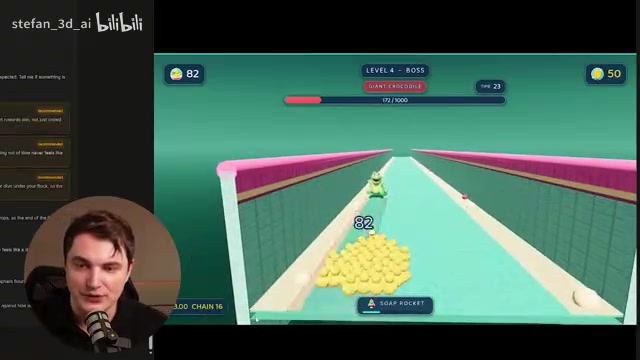
The first game was inspired by an Instagram ad — a hole in the ground that swallows objects and grows larger over time. Loop Mode produced a playable version on the first run, with about seven additional prompts mainly used to polish the UI. The creator praised the asset consistency in particular: in a snowy level, cows looked like tiny figurines on a tabletop, creating a diorama effect enhanced by depth-of-field blur, with camera work that complemented the gameplay. He called it one of the best visual results he'd gotten from AI. Difficulty balance occasionally went off the rails, though — jumping straight from "too easy" to "can't find any targets."
Duck Survival and 3D Pinball: Strong Mechanics Win, Weak Levels Lose
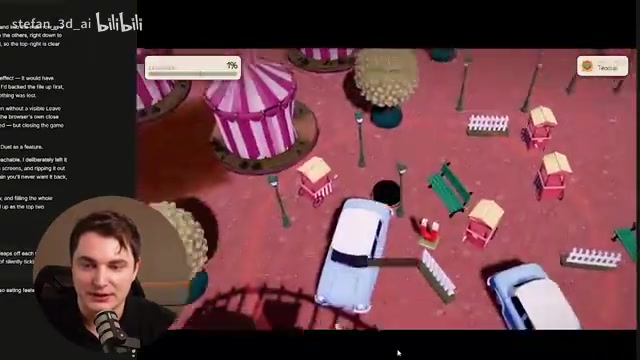
The second game was a "multiplayer survival" clone reskinned with ducks, running overnight with about six or seven prompts. It revealed an important pattern: AI can build game mechanics quite completely, but it struggles to design interesting levels on its own — and level design often accounts for more than half the fun. The creator's conclusion was clear: if the fun comes primarily from the mechanics themselves, AI can produce something enjoyable; but if the experience is about progressing through levels, outsourcing that to AI doesn't work. He suggested Tesana add a level editor or a way for users to describe how they want levels organized.
By contrast, the 3D pinball Roguelike Lucky Muck is a strong example of "AI mastering mechanics." Place triggers, drop balls, chase combo chains — AI understood and implemented this system well. After debugging (including a flipped VFX bug fixed via screenshot feedback), the final version added "connect matching types to generate bigger bonuses" as a mechanic. The creator's verdict: "surprisingly fun."
Auto-Chess Sim and Open-World Tower Defense: The Surprises of Procedural Generation
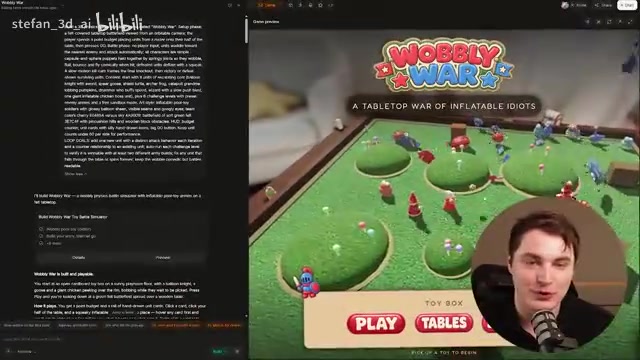
The auto-chess-style simulation demonstrated the power of procedural generation — 3D units built from primitive geometry ran extremely smoothly, far more fluid than the laggy duck game. More interesting was the dry humor in the unit descriptions ("a spear goose that refuses to apologize," "a bastard who closes both eyes and gives it everything"), which the creator suspected came from the agent itself. Almost all post-launch feedback focused on the main menu; the gameplay was quite polished from the first version, with the only clear issue being unbalanced numbers.
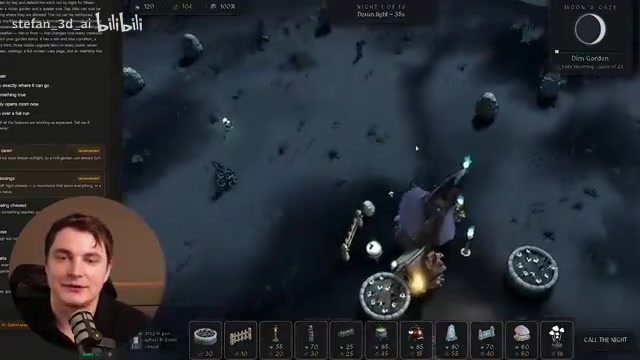
The project that consumed the most tokens was the open-world tower defense, iterated over more than ten prompts. It showcased some standout product design: a seamless animated loading transition, an in-game "fix it" button that routes errors directly back as bug reports, and buildings with viewable durability that can be repaired. The creator used Grok Imagine 2 to generate style reference images, and after iterating on the art and gameplay, ended up with something he felt was "even better than the original concept."
Hard Limits: Animation Rigging and Level Design
The testing exposed two hard constraints that anyone looking to use AI for game development should keep in mind.
First: animation rigging. Humanoid characters can be handled, but quadrupeds (like the deer in the tower defense game) can't get skeletal animation — even with a quadruped animation library available, auto-rigging for those body types isn't technically mature yet. The creator mentioned the "skin tokens" paper, but felt results were still unsatisfactory. This isn't a limitation specific to Tesana — it's an industry-wide gap right now.
Second: level and scene design. This was a shared weakness across nearly every game tested: mechanics run fine, but what actually requires a creator's investment is level layout, difficulty curves, and numerical balance. The creator offered a pointed observation: if 90% of future games end up being made with AI tools, the ones where "the idea came from AI" won't succeed — because AI can't create genuinely exploratory levels. The indie games that stand out will be those with strong creative vision, carefully designed levels, and rigorously tested balance.
Animation rigging refers to the process of creating a skeleton system for a 3D model and binding the mesh to that skeleton so the surface deforms as the bones move. For humanoid characters, the regularity of posture patterns means the academic and industry communities have accumulated enough training data that auto-rigging tools like Mixamo perform reasonably well. Quadrupeds are far harder — their limb topology varies widely and their motion patterns (running gaits, jumping, etc.) are complex, making automation a persistent challenge. The "skin tokens" paper the creator mentioned refers to recent research using Transformer architectures to automate the mapping of mesh vertices to skeletal weights, framing skinning weight prediction as a sequence generation problem similar to language models. However, generalization on complex topology remains limited, and the approach isn't yet production-ready. This constraint means non-humanoid creature animation will continue to require human intervention for the foreseeable future.
Signals Worth Watching
Several meaningful signals emerge from this extended hands-on session, relevant to both developers and creators. The combination of multi-model orchestration + unified asset pipeline + autonomous loop iteration has genuinely lowered the bar for going from "one sentence" to "playable prototype" to a new low. The Godot foundation with source code export ensures the output isn't platform-locked — a significant plus for serious creators.
But the stronger AI gets, the more a creator's attention is drawn to what it can't do well: levels, balance, distinctive creative ideas, and feel. As the creator admitted, he's been sitting on game ideas for ten years, and just getting those ideas onto paper and generating suitable reference images meant "the ideation phase alone was already exhausting." The tools handle execution — but creativity and polish remain firmly human territory.
Related articles

Amphibious Transforming Drone: Beyond 100x Power Savings, What Are the Real Needs?
Is the amphibious transforming drone just a gimmick? Starting from the 100x power difference of the M4 Morphobot, explore real application scenarios and thesis topic ideas, analyzing boundary conditions where pure drones and pure ground robots both fail.

Warhound Raises $200 Million: Genetically Engineered "War Dogs" Paired with Anduril Gear
Warhound raises $200M, backed by Ben Lamm and Palmer Luckey, to genetically engineer dogs for military and law enforcement use and equip them with Anduril gear. This article analyzes its technology direction, funding logic, and ethical controversy.

Claude API Comes to Google Cloud: IAM Integration and SDK Access Guide
Anthropic hosts the full Claude API on Google Cloud with IAM-controlled permissions and unified billing. This guide covers the Vertex AI and Anthropic-hosted entry points, IAM role configuration, and SDK access.